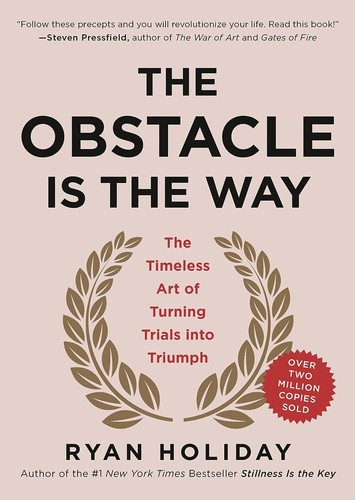
Holiday translates ancient Stoic philosophy — Marcus Aurelius's idea that 'the impediment to action advances action; what stands in the way becomes the way' — into modern business and personal examples, arguing that obstacles, reframed correctly, become the actual source of opportunity and growth.
The line the whole book hangs on
Marcus Aurelius, writing privately to himself while running an empire and fighting a war, put down a sentence that Holiday builds an entire book from: the impediment to action advances action; what stands in the way becomes the way. It's a claim, not a consolation. Aurelius isn't saying difficulties are secretly fine, or that everything happens for a reason. He's saying that the thing blocking you is itself workable material — that your response to the obstacle is an action available to you right now, and often the only one that is.
Holiday's contribution is packaging rather than philosophy, and he's fairly upfront about that. Stoicism has a long-standing image problem: it gets read as passive resignation, grim endurance, the emotional flatness of the word "stoic" in ordinary English. His counter-argument, made through roughly a hundred short historical vignettes rather than through argument, is that it's the opposite — a discipline aimed squarely at acting well, and a strikingly practical one, developed by people who were mostly running things rather than sitting in seminar rooms. The book is organised into the three disciplines he takes from that tradition: perception, action, will.
It's worth knowing what kind of book this is before you start. It became the first of a loose trilogy — followed by Ego Is the Enemy and Stillness Is the Key — and it's built from very short chapters, two or three pages each, most of them a historical anecdote with the lesson drawn out at the end. There is little sustained argument and no real exegesis of the original texts; if you want Marcus Aurelius, Epictetus or Seneca themselves, this is a doorway rather than a substitute. What it does well is make a two-thousand-year-old body of practical philosophy feel immediately usable, which is no small thing given how many people bounce off the primary sources.
Perception: seeing what is actually there
The first discipline is about the layer of interpretation we wrap around events before we've even noticed we're doing it. Holiday's recurring move, taken from Epictetus, is to separate the event from the judgement about the event: "the client left" is a fact, "this is a disaster and I'm finished" is an opinion, and almost all the felt weight of an obstacle lives in the second one. The Stoic practice isn't to suppress the feeling, it's to notice which part is which and to work with the part that's actually true.
Sitting behind this is the dichotomy of control — the division of everything into what is up to you and what isn't. Externals, including other people's decisions, the market, your health, and the past, are not up to you. Your judgements, your responses and your next action are. It's an old idea and its usefulness is entirely in the application: enormous amounts of energy get spent on the outer circle by people who then have none left for the inner one.
Holiday's favourite illustration is John D. Rockefeller, who lived through repeated nineteenth-century financial panics and, by Holiday's account, cultivated a deliberate coldness of appraisal while everyone around him panicked and sold — treating the crisis as a set of facts to be assessed rather than an emotional event to be reacted to. Whether or not you find the framing of Rockefeller entirely comfortable, the habit being illustrated is genuinely transferable: get the situation onto paper in plain, unadjectival language before you decide anything.
Holiday is good, too, on the specific damage done by panic and by the story we tell ourselves about being uniquely unlucky. A large part of the discipline, in his framing, is simply not making it worse: resisting the reflex to react immediately, to fire off the email, to make the irreversible decision while the adrenaline is still up. Steadiness is treated here as a trainable skill rather than a temperament you either have or don't — practised deliberately on small annoyances so that it's actually available when something large arrives.
Action: the boring, relentless kind
The second discipline is where Holiday is most useful to anyone actually running something, because his version of action is deliberately unglamorous. It isn't the bold pivot, the dramatic announcement or the grand gesture. It's persistence, iteration, doing the job in front of you properly, and being willing to go around a problem rather than through it when going through it is just ego.
Several strands stand out. There's the case for process over outcome — focusing entirely on the next immediate step rather than the size of the whole task, an approach borrowed from sport and applied to anything that looks overwhelming when viewed in full. There's the flank attack: the argument that the direct route is often the one everyone else is queuing for, and that the indirect approach is not a compromise but frequently the better play. There's the insistence that what is right is what works, an anti-perfectionist streak aimed at people who'd rather be theoretically correct than practically effective. And there's the repeated point that action must be sustained, not heroic — that the failure mode isn't usually a lack of effort but a lack of effort continued past the point where it stopped feeling productive.
The examples do the persuading. Demosthenes, born with a speech impediment, becoming Athens' greatest orator by treating the impediment as the training regime. Amelia Earhart accepting a demeaning offer to cross the Atlantic as a passenger, because that was the door that was open. Ulysses S. Grant grinding around Vicksburg after direct assaults failed. The pattern is consistent: the obstacle isn't a detour from the achievement, it's frequently the raw material the achievement is made of.
There's also a strong anti-overwhelm thread running through the section. Holiday's repeated instruction is to shrink the frame until the next step is small enough to actually take, on the grounds that the size of the whole thing is almost never what you have to deal with today — and that people freeze not because the task is impossible but because they insist on looking at all of it at once.
Will: for the part that can't be fixed
The third section is the one readers tend to skim on the way in and return to later. Holiday is clear that not every obstacle yields to clearer perception or harder work. Some things simply cannot be solved — an illness, a death, a market that has gone and isn't coming back, a decision made by someone else that you have to live inside. Will is the discipline for that category, and its subject is endurance rather than resolution.
The Stoic tools here are old and strange-sounding but sturdier than they look. Premeditatio malorum: rehearsing in advance what could go wrong, not to catastrophise but to remove the shock and the sense of personal injustice when something does. The inner citadel: the idea that resilience is built deliberately before it's needed, not summoned in the moment. Amor fati: not merely accepting what has happened but choosing to work with it, on the grounds that the alternative — arguing with a fact — costs energy and changes nothing. And memento mori, the deliberate awareness of mortality, which Holiday deploys as a scale-check rather than as morbidity: most of what feels enormous is not.
It's the least tactical part of the book and, for anyone who's been through a genuinely unfixable bad patch in a business or a life, usually the part that lands hardest. Holiday also does something quietly sensible by putting it last: the book doesn't end on triumph. It ends on the acknowledgement that some obstacles don't move, and that how you carry those is still a choice you get to make.
Key lessons
- Perception, discipline and will, applied deliberately to an obstacle, can turn it from a setback into an opportunity.
- You control your response to events, even when you don't control the events themselves — a core Stoic principle applied practically.
- Difficulty and adversity, viewed correctly, are frequently what actually create the conditions for real growth.
- Objective, unemotional perception of a problem — separating the facts from your feelings about them — is the first step to acting on it well.
The obstacle in front of you isn't separate from the path forward — reframed correctly, it often *is* the path, and the way through it is what actually builds capability.
What this means for a UK small business
The perception discipline is worth applying literally the next time a bad email arrives. Two columns: what actually happened, in flat language with no adjectives, and separately what you're telling yourself it means. A customer has disputed an invoice. Versus: they hate us, word will spread, this is the beginning of the end. The gap between the columns is usually where the entire sleepless night was living.
The action chapter is the corrective for a very recognisable owner instinct — responding to a setback with a dramatic gesture. Lost a big client, so it's time for a rebrand. Bad quarter, so let's announce a new service line. Holiday's examples consistently reward the unshowy alternative: the owner who quietly fixes the supply problem, calls the ten customers who matter, and gets the pricing right beats the one who launches something to distract from the hole.
And the dichotomy of control has an obvious UK application in a decade of things landing on small businesses from outside — rate changes, Budget announcements, National Insurance thresholds, energy costs, a supplier going under. None of it is up to you. Your pricing, your service standard, your cash buffer and who you hire all are. The book's practical value is mostly in getting attention back onto that second list.
What’s aged well
Grounded in genuinely ancient philosophy, the core ideas are inherently durable and remain widely applied in business writing.
What feels outdated
Nothing significant; Stoic philosophy predates trend cycles entirely.
Where it falls short
Holiday is a populariser rather than a philosopher, and the vignettes are shaped to fit the thesis — real lives are messier than the neat three-act arcs imposed on Rockefeller, Edison or Grant, and there's a clear survivorship bias in choosing only people whose obstacles did turn into the way. The plenty of people who applied exactly the same disciplines and still failed don't get a chapter. It's also long on reframing and short on technique: strong on how to think about a problem, thin on how to solve one. And the compressed vignette format means many examples get a page and a half, which is enough to inspire and not enough to actually learn from.
The Business Stuff verdict
An accessible, well-written entry point into practical Stoicism for business owners, genuinely useful during hard periods.
Three things to actually do after reading it
- Take your current biggest business obstacle and write down, objectively, the facts versus your feelings about it.
- Identify one way a past setback actually became the source of a later opportunity.
- Practise separating what you control (your response) from what you don't (the event itself) on today's biggest frustration.
If you liked this, read next
Five similar books
- Ego Is the Enemy (Ryan Holiday)
- The Daily Stoic (Ryan Holiday & Stephen Hanselman)
- Man's Search for Meaning (Viktor Frankl)
- Grit (Angela Duckworth)
- Four Thousand Weeks (Oliver Burkeman)
Common questions
How do you actually apply this to a real problem?
Take a concrete case: your largest customer gives notice, and they were 22% of revenue. Perception means writing the facts flat — one customer has given three months' notice, 22% of revenue ends in April, nothing else changed today — kept separate from the story, which is usually some version of we are finished and it is my fault. Action means the unglamorous list: call the next ten accounts this week, work out which fixed costs are genuinely fixed, quote the two jobs already sitting in the inbox. Will covers the part you cannot fix — they are not coming back — where the job is to stop relitigating it.
Should I read this or go straight to Marcus Aurelius?
Do both, and in that order if you have bounced off philosophy before. Meditations is short, cheap and startlingly direct — Gregory Hays's translation is the one most people find readable — but it is a private notebook with no structure, and plenty of readers put it down without extracting much. Holiday's book is the on-ramp: it organises the ideas, supplies modern examples, and tells you what to do with them. What it will not give you is the original voice, which is the thing people end up rereading for years. Treat The Obstacle Is the Way as the map and Meditations as the territory.
Isn't this just telling yourself that problems are secretly good?
No, and the distinction matters. Toxic positivity says the bad thing is not really bad, which requires ignoring evidence and collapses under pressure. Holiday's claim is narrower: the bad thing is genuinely bad, your response to it is still an action available to you, and that response is frequently where any useful outcome comes from. The entire Will section exists precisely because some obstacles never become opportunities and simply have to be carried. A book claiming that everything happens for a reason would not need a third of its length devoted to enduring what cannot be fixed.
Do I need the other books in the trilogy?
They are standalone and stopping after one is perfectly reasonable. Ego Is the Enemy is the sharper of the three and arguably the more useful for anyone running something — it is about the ways self-regard sabotages people at the start, during success, and after failure. Stillness Is the Key is the softest and most repetitive. If you read one more, make it Ego. The Daily Stoic is a different format altogether, a page a day across a year, which suits people who want a daily habit rather than an argument and works badly as a straight read-through.