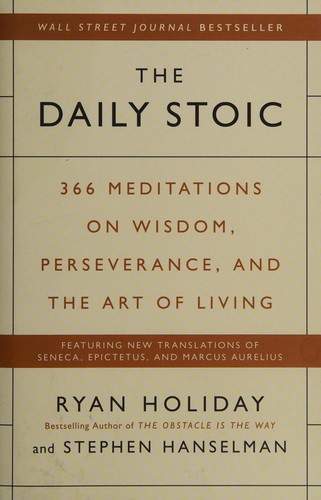
A year-long collection of daily Stoic meditations, each with a short passage from Marcus Aurelius, Seneca or Epictetus alongside brief modern commentary, designed to build a sustained reflective practice rather than be consumed in one sitting.
A book built to defeat the way you read books
Almost everything else on the Business Stuff shelf has one argument you can absorb in an afternoon and forget by Friday. The Daily Stoic is deliberately engineered to make that impossible. It is 366 entries — one for every day of the year, leap day included — and each one is a single page: a short passage from Marcus Aurelius, Seneca or Epictetus, freshly translated from the Greek and Latin by Stephen Hanselman, followed by a page of plain-English commentary from Ryan Holiday applying it to something recognisably modern.
The format is the argument. The Stoics never treated philosophy as a body of knowledge you understand once and file away. They treated it as training — closer to physiotherapy than to a lecture course. Marcus Aurelius wasn't writing Meditations for publication; he was writing the same handful of reminders to himself, over and over, at night, while running the Roman empire, because he kept needing them again the next morning. If that is what the source material actually is, then packaging it as a single continuous argument would misrepresent it. Holiday and Hanselman package it as a drill instead.
Which means the book punishes the obvious way to read it. Plenty of people buy it and read the whole thing in a weekend, and when they do it collapses: the ideas repeat, the commentary starts to feel thin, and you close it with the vague sense you've read the same page fifty times. You have. That isn't the book failing — it's the design working exactly as intended against a reader using it wrong. Read one page a day and the repetition becomes the mechanism. Read 366 pages in two days and the repetition is just repetition.
The three disciplines, spread across twelve months
Underneath the daily entries is a real structure, borrowed from the way Epictetus organised Stoic practice and carried through the calendar. The first four months work on the discipline of perception, the middle four on the discipline of action, and the last four on the discipline of will. Each month inside those blocks has its own theme — clarity, passions and emotions, awareness, unbiased thought; then right action, problem solving, duty, pragmatism; then fortitude and resilience, virtue and kindness, acceptance, and finally, in December, mortality.
The discipline of perception is the claim that you do not control events, you control the label you put on them. Epictetus's line is that people are disturbed not by things but by their opinions about things. A client paying 40 days late is a fact. 'This client is taking the mickey and my business is falling apart' is an interpretation you added on top of the fact — and the interpretation is where nearly all the suffering lives. Four months of entries chip away at the gap between what happened and what you decided it meant.
The discipline of action is what you do once you're seeing straight: do the work in front of you properly, act for something beyond yourself, and treat obstacles as the route rather than the blockage. This is the section that produced Holiday's earlier book — Marcus's observation that what stands in the way becomes the way — and in the daily format it lands less as a slogan and more as a repeated instruction to get on with it.
The discipline of will is the part most readers skim and most readers need. It covers what you do about the things you cannot touch at all: illness, other people, luck, ageing, death. This is where amor fati sits — not enduring your fate but actively wanting it — and memento mori, the deliberate daily remembering that you will die, which the book saves for December on the reasonable grounds that most people need eleven months of warm-up first.
The dichotomy of control, hit three hundred times
If you strip the book back to one idea, it is Epictetus's opening move in the Enchiridion: some things are within our power and some are not. Our judgements, our intentions, our own effort and response are ours. Our body, our reputation, our position, other people's choices, the weather, the market — none of those are. Nearly every daily entry in the year is, in some costume or other, that same split applied to one specific situation: a competitor's win, an unfair review, a plan that fell apart, a diagnosis, an economy.
Worth doing once, properly, with real figures, because the split is much less obvious under pressure than on the page. Take an illustrative week for a café owner: a £4,200 VAT bill due on the 7th, two staff off sick, a one-star Google review, a rent review letter proposing £1,800 a month instead of £1,500, and a coffee supplier putting prices up 6%. Sort them. Not yours: the illness, the fact that the review was written, the landlord's opening ask, the wholesale price of coffee. Yours: whether VAT money gets set aside monthly rather than found in a panic, how you reply to the review, whether you negotiate the rent or start looking, and whether that 6% goes on the menu price or comes out of margin. Four of the five had an action hiding underneath them, and the fifth needed a rota plan rather than resentment. That is the entire method — sort first, then act only on your own column.
Holiday knows he is repeating himself and does it anyway, which is the honest choice. Reading 'focus only on what you control' once changes nothing — everybody already agrees with it and almost nobody applies it under pressure. Being handed it in a new costume three hundred times across a year is a different intervention entirely, and it is the only mechanism the book has. Alongside it the year cycles through the other practical Stoic tools: the premeditation of adversity, where you deliberately rehearse what could go wrong so it can't ambush you; the view from above, zooming out until today's crisis is the right size; and Seneca's habit of interrogating his own day each evening — what did I do badly, what did I do well, what will I do differently.
Why two-thousand-year-old material keeps landing
The three main sources are not academics, and that is the whole reason the book works. Marcus Aurelius was the most powerful man in the known world, writing private notes to himself about not losing his temper with irritating colleagues. Seneca was extraordinarily rich, wrote about the vanity of wealth while continuing to accumulate it, advised a genuinely dangerous emperor, and was eventually ordered by that same pupil to kill himself. Epictetus was born into slavery, was lame, and taught in exile. None of the three is theorising from a comfortable chair. All three are coping in real time with pressure, power, unfairness and constraint, which is why material this old keeps landing on a Tuesday problem in a modern business.
The cast is wider than the famous three, too. Zeno, who founded the school after losing everything in a shipwreck; Cleanthes, who worked nights as a water-carrier to fund his studies; Chrysippus; Musonius Rufus; Cato, who died rather than accept Caesar's clemency; and Agrippinus, who declined to attend a dinner because being ordered to attend was itself the problem. The book uses them to make a point Holiday returns to constantly: Stoicism was practised by people with jobs, obligations and enemies, not by a monastic order.
Holiday's commentary is simultaneously the weakest and the most necessary part of the book. It is plain, occasionally glib, and sometimes reaches for a modern example that hasn't aged well. But it does the translation job that stops the ancient text sitting inert on the page — the move from 'a Roman emperor wrote something wise' to 'here is what that means when your best supplier lets you down on Thursday.' Read only the passages and you have an anthology. Read the commentary too and you have a practice.
One thread runs underneath the whole year and is easy to miss: this is a book about journaling. Meditations exists because Marcus wrote to himself every night. Seneca's letters are, functionally, a man thinking on paper. The Daily Stoic keeps nudging the reader toward the same habit — read the entry, then write something down about your own day — and the entries that ask a direct question are doing exactly that. Readers who only read tend to give up around week five. Readers who write something, even two lines, tend to keep going, because the writing is what converts a nice thought into a noticed pattern in your own behaviour.
The realistic outcome is worth being honest about. Almost nobody completes 366 consecutive days. Most people do six weeks, drift, come back in March, drift again. That is still a better result than most books produce, because even a partial year leaves you with a reflex you didn't have before: when something goes wrong, some part of your brain now asks whether this is yours to control before it starts catastrophising. That reflex is the entire return on investment.
Key lessons
- Regular, brief reflection compounds over a year into a genuinely different default mindset, more than a single intense reading session would.
- Stoic philosophy consistently emphasises focusing only on what's within your control.
- Difficulty and setbacks are framed throughout as material for growth, not just events to endure.
- A daily practice, however short, builds a habit of reflection that pure one-off reading doesn't.
A brief, genuinely daily reflective practice — not a single intense read — is what actually embeds a philosophy into how you handle real situations.
What this means for a UK small business
This isn't a book to read for new information so much as a practice to run alongside actually operating a business. Five minutes each morning, before the phone comes out, applying the day's entry to whatever is genuinely happening: the client who has gone quiet, the VAT bill landing in a bad month, the member of staff you know you need to have a conversation with. The dichotomy of control is the single most reusable filter in it, and it is brutally practical for an owner. Is today's biggest frustration something you can act on, or only something you can choose how to respond to? Late payment, for instance, splits neatly — chasing, credit control terms and who you take on as a client are yours; whether that customer's own bank balance clears this week is not.
It pairs well with a Monday routine. Read the week's first entry, pick one real situation from the week ahead, and decide which column it goes in. Owners running trades or hospitality — where the day is genuinely reactive — tend to get more from this than from the productivity books, because it doesn't ask you to control your calendar. It only asks you to control your reaction to a calendar you were never going to control anyway.
What’s aged well
Drawing on genuinely ancient source material, the content is inherently durable.
What feels outdated
Nothing significant; designed as an evergreen daily reference.
Where it falls short
Read in one go it is repetitive and slow, and the entries blur — the book only makes sense as a daily reference, not as a single argument, so anyone who reads it the normal way will conclude it is thin. It also assumes a level of daily discipline that is easy to abandon once the novelty wears off, which is the fate of most daily-practice books.
The commentary is uneven: Holiday is a populariser rather than a classicist, some modern examples are shallow, and there is a persistent whiff of Stoicism-as-productivity-hack — the philosophy repackaged for ambitious professionals, with the awkward bits about civic duty and indifference to wealth quietly softened. Purists should read Meditations and Epictetus directly instead.
The Business Stuff verdict
Best treated as an ongoing practice rather than a book to finish — a good complement to The Obstacle Is the Way and Ego Is the Enemy.
Three things to actually do after reading it
- Read one daily entry each morning for a month and note whether it changes how you approach that day.
- Pick one recurring frustration and apply the 'focus only on what you control' lens to it directly.
- Keep a short daily log of one Stoic principle applied to a real situation that day.
If you liked this, read next
Five similar books
- The Obstacle Is the Way (Ryan Holiday)
- Ego Is the Enemy (Ryan Holiday)
- Man's Search for Meaning (Viktor Frankl)
- Meditations (Marcus Aurelius)
- The Happiness Advantage (Shawn Achor)
Common questions
Do I have to read it one page a day, in order?
You don't have to, but the book stops working if you don't. The entries are dated and deliberately repetitive, so reading it straight through in a weekend produces the feeling that you have read the same page fifty times — because you effectively have. The repetition is the mechanism: the point is to meet the same handful of Stoic ideas in a new costume three hundred times across a year until they become a reflex rather than a nice thought. If you start in June, start in June. Nothing about the January entries requires January, and abandoning it in March then picking it up again is a normal, perfectly useful way to use it.
Is it worth buying if I've already read The Obstacle Is the Way?
Yes, but understand that you are buying a format rather than new ideas. The Obstacle Is the Way and Ego Is the Enemy are arguments; The Daily Stoic is a practice built on much the same source material, and if you loved the arguments you will recognise a great deal here. What you get that the earlier books don't give you is the daily contact and Hanselman's fresh translations of the primary sources, which are the genuinely valuable part. If you found Holiday's earlier books thin, this will not change your mind — the commentary is the same voice, just cut into 366 pieces.
Do I need to have read Marcus Aurelius or Epictetus first?
No, and for many readers this is the better entry point. Each entry gives you the passage and then explains it, so no prior reading is assumed and the primary sources arrive in small, translated, contextualised doses rather than as a wall of ancient text. The reverse order works well too: use the year to find which of the three you actually respond to, then go and read that one properly. Most people discover they are either a Marcus reader (private, self-correcting, duty-focused) or a Seneca reader (worldly, literary, very good on time and money), and the anthology format is a cheap way to find out.
Is reading the page enough, or do I need to journal?
Reading alone is where most people give up around week five. The book is quietly a journaling book — Meditations exists only because Marcus wrote to himself every night, and Seneca's letters are a man thinking on paper — and several entries ask you a direct question that expects an answer. Two written lines a day is enough: what happened, and which column it belonged in. The writing is what converts a pleasant idea into a noticed pattern in your own behaviour, because you can look back over a month and see that the same situation upset you four times. Reading it back is where the change actually comes from.