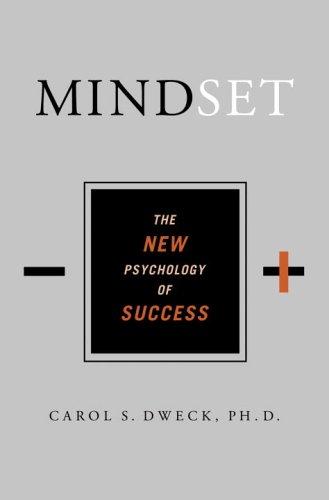
Psychologist Dweck's foundational research distinguishes a 'fixed mindset' (believing ability is largely innate and fixed) from a 'growth mindset' (believing ability develops through effort and learning), showing how this single belief shapes how people respond to challenge, failure and feedback — with major implications for leadership, hiring and how a business treats mistakes.
One belief, two completely different responses to difficulty
Dweck's work starts from an observation made watching children tackle puzzles that were deliberately too hard for them. Some fell apart, declared themselves no good at puzzles, and asked to stop. Others rubbed their hands together and said something like 'I love a challenge'. The interesting part wasn't the difference in ability — it was that the second group didn't appear to think they were failing at all. They thought they were learning. Decades of research followed from trying to explain that split.
The explanation she landed on is a single, usually unexamined belief about where ability comes from. In a fixed mindset, intelligence and talent are things you have in a fixed quantity; every task is therefore a test that either confirms or exposes you. In a growth mindset, ability is something that develops through effort, strategy and instruction; a task is therefore information. Same event, two entirely different meanings. The belief itself is rarely stated out loud, which is exactly why it does so much damage — it's operating underneath the decisions rather than in them.
The consequences fan out predictably. If ability is fixed, then effort is incriminating: needing to work hard proves you're not naturally good, so the smart play is to look effortless and avoid anything that might expose the ceiling. Challenges become risks. Criticism becomes a verdict on your worth rather than a comment on the work. Other people's success becomes threatening, because in a world of fixed talent someone else's win implies something about you. If ability is developed, every one of those flips: effort is the mechanism, criticism is free data, and someone else doing well is mostly a source of method.
How praise quietly installs one or the other
The most cited work in the book is a set of studies on praise, and it's the most directly actionable thing Dweck ever produced. Children completed a set of easy problems and were then praised in one of two ways: some were told they must be clever, others were told they must have worked hard. The wording difference was a single sentence. Offered a choice of what to attempt next, the children praised for cleverness disproportionately chose easier problems — protecting the label — while the effort-praised group disproportionately chose harder ones. Given a genuinely difficult set afterwards, the cleverness group enjoyed it less, performed worse on a subsequent easy set, and were markedly more likely to misreport their scores.
The mechanism generalises straight into management. Telling someone they're a natural at client work is warm, well-meant, and quietly hands them a reputation to defend. From that point on, every stretch task carries a risk of disproving the compliment, so the rational move is to stay in the zone where the label holds. Praising the specific thing they did — the way they handled a difficult call, the decision to check the numbers again — carries no such liability, because it points at a repeatable behaviour rather than a fixed identity.
Dweck's related classroom idea is the word 'not yet'. A student who has failed has a verdict; a student who hasn't got there yet is on a curve. It sounds like a semantic trick and largely is, but the framing genuinely changes what the next conversation is about — remedy rather than judgement.
What a fixed-mindset leader looks like
The business chapters are where the book earns its place on a management shelf. Dweck's argument is that fixed-mindset leaders need to be, and be seen as, the smartest person in the building, and everything else bends around that need. They surround themselves with people who confirm it. They interpret bad news as disloyalty. They take credit personally and distribute blame widely. She contrasts these with leaders who continually ask what they're missing, promote people who challenge them, and treat their own reversals as material.
She's especially sharp on what she calls the talent mindset at organisational level — the belief, popularised in the late nineties, that companies win by hiring and worshipping innate stars. Her charge is that a culture built on venerating natural genius produces people who must never be seen to be wrong, which means problems get concealed rather than fixed, and that this is a far better predictor of an eventual blow-up than any shortfall in raw ability. The sporting parallels she draws make the same point in a more visible arena: the player whose game is built on being naturally gifted collapses when the natural gift stops being enough, while the one who was cut, went away and drilled has somewhere to go.
The organisational version is not a poster in reception. It's what actually happens in the room after something goes wrong — whether the meeting is about what to change, or about whose fault it was.
The relationships chapter is the one readers least expect and most often quote back. A fixed mindset applied to a partnership produces the belief that if something is right it shouldn't require work, so the first serious friction is read as evidence of a mistake rather than as the normal cost of two people sharing a life. The same logic runs straight into business partnerships and long client relationships: the first real disagreement either becomes proof the thing was wrong all along, or it becomes the conversation that makes it workable. Which of those it is has almost nothing to do with the disagreement itself.
False growth mindset, and where the evidence stands
The book has a sequel problem, and to her credit Dweck is the one who named it. As the idea spread it flattened into 'praise effort and everything improves', which she has publicly called a false growth mindset. Effort alone isn't the point; effort with a new strategy, and asking for help when the current approach isn't working, is. Praising hard work on an approach that is plainly failing is a consolation prize, and children and employees both spot it immediately. She's also clear that nobody is purely one or the other — everyone has domains and triggers where the fixed voice takes over, and the useful work is noticing your own rather than awarding yourself the label.
The practical instruction she gives for changing your own is a four-step sequence, and it's the most concrete thing in the book. Learn to hear the fixed-mindset voice — the one that says don't risk it, you'll look stupid, this proves you were never any good at this. Recognise that you have a choice about how to interpret what it's reacting to. Answer it deliberately in the other register: not yet, and here's what I'd try differently. Then take the action that follows from that second reading rather than the first. It is essentially cognitive behavioural therapy applied to competence, and its virtue is that it treats the fixed voice as a permanent resident to be argued with rather than a flaw to be eliminated.
On the evidence, honesty is required. Since around 2018, large meta-analyses and several big school-based trials, including UK ones, have found the effects of mindset interventions on academic achievement much smaller than the popular version of the idea implies, and in some cases indistinguishable from nothing. That's a real dent in the claim that a short intervention can move outcomes at scale. It's a smaller dent in the underlying distinction, which remains a genuinely useful lens for how you give feedback and how you read your own bad quarter. Read it for the lens, not as proof that a training day will change your team.
Key lessons
- A fixed mindset treats ability as innate and avoids challenges that risk exposing failure; a growth mindset treats ability as developable through effort.
- How praise is given matters — praising effort and process builds resilience, while praising innate talent quietly builds fragility.
- Setbacks are interpreted completely differently depending on mindset — as proof of limitation, or as information to learn from.
- Organisations, not just individuals, can have a collective mindset that shapes how openly mistakes get discussed and addressed.
Whether you treat ability as fixed or developable shapes how boldly you take on challenges and how you respond to failure — and it's a belief that can be deliberately shifted, in yourself and your team.
What this means for a UK small business
The praise finding is the cheapest useful change available to an owner-manager, because it costs nothing and takes effect the same day. Swap 'you're a natural with customers' for 'the way you handled that complaint was exactly right — you let her finish before you offered anything'. The first builds someone who protects a reputation and hides mistakes; the second builds someone who repeats a behaviour and tells you early when something has gone wrong. In a business of six people with no HR function, whether staff report problems at week one or week six is not a soft issue.
It reframes how an owner reads their own rough patch too. A lost contract or a VAT bill that lands harder than expected is either evidence about what to change in pricing, cash-flow timing or client mix, or it's confirmation that you were never really cut out for this. Both readings are available from the same facts, and which one you reach for determines whether the business adjusts or quietly winds down.
Worked example, with illustrative figures. A fitter on a £2,800 installation notices in the first hour that the measurements are wrong. In a shop where being good at your job means never getting it wrong, he says nothing and hopes it works out: the error surfaces at handover, the remedial visit costs two days of labour at roughly £320 a day plus £450 of materials, and the customer's review costs more again. In a shop where the boss's response to early bad news has always been 'good catch, what do you need', he rings at 9:20am, the correction costs an hour and a delivery, and the job still lands on margin. Same fitter, same mistake, roughly £1,090 of difference — decided entirely by what he expects to happen when he makes the call.
One caution worth carrying: don't run this as a staff away-day. The evidence for mindset as a programme is weak. The value is in a hundred small feedback moments, and in what you say in the meeting after something goes wrong.
What’s aged well
The growth mindset concept has become deeply embedded in education, parenting and business thinking, and remains widely cited, though some individual studies have faced replication scrutiny common across psychology.
What feels outdated
The core concept holds up; some of the more sweeping popular applications since publication have oversimplified the original, more nuanced research.
Where it falls short
The popular growth-mindset movement the book launched has been diluted into a corporate cliché that Dweck herself has spent years disowning, and a reader who arrives via that version will find the original both more nuanced and less magical. More seriously, the replication record has not been kind: large trials and meta-analyses since 2018 have found much smaller effects than the book's enthusiasm suggests. The writing also leans hard on stark hero-and-villain portraits of real executives and athletes, assigning mindsets from the outside based on public behaviour, which is a lot of interpretive weight for anecdote to carry.
The Business Stuff verdict
A genuinely foundational read — the core distinction is simple to state but has deep, lasting implications for how you lead and hire.
Three things to actually do after reading it
- Notice one place you're avoiding a challenge purely to protect a fixed sense of your own competence.
- Praise effort and process in your next piece of feedback to a team member, not just innate talent or outcome.
- Reframe your most recent setback as information to act on, rather than proof of a fixed limitation.
If you liked this, read next
Five similar books
- Grit (Angela Duckworth)
- The Happiness Advantage (Shawn Achor)
- Atomic Habits (James Clear)
- The Obstacle Is the Way (Ryan Holiday)
- Drive (Daniel Pink)
Common questions
What is the actual difference between a fixed and a growth mindset?
It is one belief about where ability comes from. In a fixed mindset, intelligence and talent are quantities you either have or do not, so every task is a test that confirms or exposes you. In a growth mindset, ability develops through effort, strategy and instruction, so a task is information. The same setback therefore means two completely different things: a verdict, or a data point. The downstream effects are what matter — if effort proves you are not naturally good, the rational move is to look effortless and avoid anything that might reveal your ceiling, which is precisely the behaviour that stops people improving.
Has the growth mindset research held up?
Unevenly, and the honest answer matters. The praise studies at the core of the book remain influential, but since around 2018 large meta-analyses and several big school-based trials, including in the UK, have found the effect of mindset interventions on academic achievement far smaller than the popular version promised, and sometimes indistinguishable from zero. So the claim that a short workshop shifts outcomes at scale is weak. The underlying distinction is in better shape: as a lens for how you give feedback and how you interpret your own bad quarter it is still genuinely useful. Read it for the lens, not as evidence for a training programme.
How should I change the way I give praise at work?
Point at what the person did, not at what they are. 'You're a natural with difficult customers' is warm and hands them a reputation to protect, so every stretch task afterwards carries the risk of disproving it. 'The way you handled that complaint was right — you let her finish before offering anything' points at a repeatable behaviour with no identity attached. The practical test is whether your praise describes an action they could choose to repeat tomorrow. Dweck is also clear that praising effort on an approach that is obviously failing is worse than useless; the point is effort plus a change of strategy.
Is this a book for parents or for managers?
It was written for a general audience and covers parenting, teaching, sport, relationships and business, which is either good value or a lot of scope depending on your patience. For a business reader the chapters on leadership and on organisational culture are the ones that earn their place, particularly her argument that a culture built on venerating natural talent produces people who must never be seen to be wrong — so problems get concealed rather than fixed. The parenting material is not padding, and the praise research sits inside it, but you can read selectively without losing the thread.