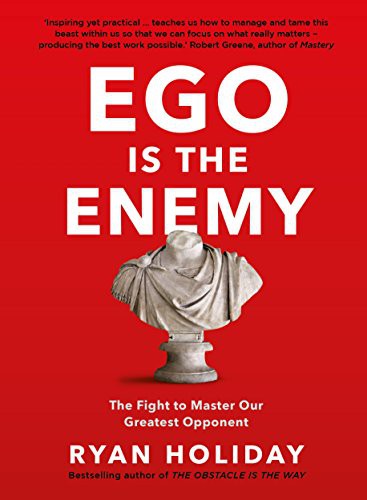
A companion to The Obstacle Is the Way, this book argues that ego — not obstacles — is often the real enemy of sustained success, distorting judgement at every stage: aspiring, succeeding, and failing. Holiday draws on historical figures who were undone by unchecked ego at each of these stages.
Three stages, three different egos
Holiday's structural move is to split the book into Aspire, Success and Failure, on the argument that ego doesn't have one form but three, and that most writing on the subject only ever addresses the middle one. While you're aspiring, ego talks — it announces, positions and performs expertise it hasn't earned. Once you've succeeded, ego mistakes an outcome for proof of permanent genius, stops listening, and starts defending. And in failure, ego refuses to look at what happened honestly, rewriting the story to protect itself until no learning is possible.
The definition he's working with is worth being precise about, because it's narrower than the everyday use of the word. Ego here isn't confidence or ambition — it's an unhealthy need to be seen as better than you are, which corrupts your read of reality in whichever direction protects the image. That's why he can argue that ego is as dangerous to the unknown twenty-five-year-old as to the celebrity chief executive. The twenty-five-year-old's version just looks like having strong opinions about an industry they haven't worked in yet.
Structurally the book is short chapters, historical examples and Stoic sources — Marcus Aurelius, Seneca and Epictetus run underneath the whole thing, alongside Holiday's own account of an early career in which the success arrived before the judgement did. He is explicit that he wrote it for himself first, which does a lot to keep it from being sanctimonious.
One consequence of the three-stage structure is that the book is genuinely re-readable at different points in a working life, and the sections land completely differently depending on where you are. Read it at the start and the Aspire material is the whole book; read it after a good year and Success is uncomfortable in a way it wasn't before; read it after something has fallen over and Failure is the only part you can hear. Holiday says as much himself, and it's a fair description of how the book actually gets used.
Aspire: talk, the canvas, and doing the work
The best diagnostic in the book is the ratio of talking about a plan to doing the work behind it. Holiday's claim, drawing on psychological research into announced intentions, is that going public with a goal delivers a genuine hit of social credit — people nod, congratulate, express interest — and that the mind partly banks this as progress, reducing the drive to do the actual thing. The plan announced is a plan already half-rewarded. He isn't arguing for secrecy as a virtue. He's arguing that you should notice when explaining the strategy has started substituting for executing it, which for most people is a real and recurring pattern rather than an occasional lapse.
The second idea in this section is the Canvas Strategy, taken from the Roman anteambulo — the person who walked ahead of an important figure clearing the path. Holiday's version: early on, deliberately do the unglamorous, uncredited work that makes other people look good. Find opportunities for the people around you. Send the introduction, do the research nobody wants, produce the thing your boss needed and didn't ask for. The payoff isn't karma, it's access and craft — you learn how the work actually gets done, from a position where nobody is threatened by you, and you build a network of people who owe you nothing but like you anyway.
The counterexample he keeps returning to is the ambitious operator who demands the credit and command before acquiring the judgement to use either, contrasted with those who did the unglamorous work first and let results rather than self-presentation build the reputation. His related rule is to always stay a student: find people who know more, put yourself in rooms where you're the least accomplished person present, and treat that discomfort as the price of the education.
Success: the moment you stop learning
The success section is the one most relevant to anyone already running something, and its central claim is counterintuitive: the moment you are least likely to seek honest feedback is immediately after a genuine win, which is exactly when you most need it. Success narrows your information. People stop telling you things. Your own story about why it worked hardens into doctrine, and the parts that were luck, timing or someone else's work get quietly absorbed into your account of your own ability.
Holiday's practical instruction here is to maintain your own scorecard — a private standard of what good work looks like, independent of external results, so that a good quarter doesn't automatically read as validation of everything you did that quarter, and a bad one doesn't read as a verdict on all of it. The coaching example he leans on is the idea of a standard of performance: define exactly how the job is done properly at every level, hold that, and let the score take care of itself. It's the difference between managing to outcomes you don't control and managing to behaviours you do.
He's also good on entitlement and control, which he treats as ego's operational symptoms once money arrives — the belief that you're owed the next thing, the inability to delegate because nobody else will do it properly, the expansion into areas you have no business in because success in one domain feels like general competence. The cautionary tales are people whose early brilliance was real and whose later collapse came entirely from the conviction that it was transferable and permanent.
Running alongside is a chapter on restraint that deserves more attention than it gets. Holiday's argument is that the impulse to answer every slight, correct every misrepresentation and win every minor exchange is ego presenting itself as principle, and that it is almost always a bad trade: you spend real time and reputation on an audience of nobody, and you hand the other party a share of your attention they hadn't earned. The related idea is to get out of your own head — the story you narrate about yourself while the work is happening is the enemy of noticing what's actually in front of you, and the more compelling that story is, the less accurate your read of the situation tends to be.
Failure: alive time and dead time
The strongest single idea in the final section is borrowed from Robert Greene: at any moment you're in either alive time or dead time. Dead time is waiting — for the market to turn, for the case to settle, for someone to give you permission, for the phase to end — passive, resentful and gone forever. Alive time is the same period spent learning something, building something or getting better at the craft. The circumstances are identical; the only variable is what you do inside them. It reframes a bad year from a sentence you're serving into a period with an output.
Alongside it sits the argument that the effort has to be sufficient in itself. If your sense of whether the work was worth doing depends entirely on how it was received, you've handed the verdict to people who saw a fraction of it, and you'll shape the next piece of work around anticipated applause. Holiday's position, straight from Stoicism, is that you control the effort and the standard, not the reception, and that attaching your identity to the reception is what makes failure unsurvivable rather than merely painful.
The last move is the honest one: ego is not something you defeat once. It comes back at every stage, in a form suited to that stage, and the work is recurring maintenance rather than a cure. That's a less satisfying ending than most books in this genre offer, and it's more accurate.
Key lessons
- Unchecked ego distorts judgement at every career stage — aspiring, succeeding and failing — in different but equally damaging ways.
- Staying a student, genuinely open to feedback, even after real success, protects against the complacency that often follows achievement.
- Talk less about what you're going to do, and more actually doing it — ego often substitutes talk for real work.
- Failure handled with humility becomes useful data; failure handled with ego becomes denial and repeated mistakes.
Ego, more than external obstacles, is what most often derails otherwise capable people — staying genuinely humble and teachable, especially after success, is a deliberate discipline worth maintaining.
What this means for a UK small business
The talk-versus-work ratio is worth checking literally, on your own social feeds. An owner who posts constantly about the big plan, the exciting news coming soon and the direction of the industry, but rarely posts finished work, has usually swapped one for the other without noticing. The correction is dull: talk about it after it's shipped, not while you're still deciding whether to start.
The stay-a-student lesson bites hardest right after a good year or a big client win, which is precisely when a UK owner is least inclined to hear that anything needs improving, and when the accountant, the one honest employee and the customer who nearly left all have something useful to say that nobody is volunteering. Going looking for it deliberately, in that specific month, is the whole practice.
And alive time versus dead time is a genuinely useful frame for the flat periods every small business has — the quiet January, the sector downturn, the six months waiting on a planning decision or a big contract. Those months are going to pass either way. Whether they produce a rebuilt pricing model, a proper set of systems and a new skill, or just anxiety and a lot of checking the bank balance, is the only part that's actually up for negotiation.
What’s aged well
The historical case studies and Stoic grounding remain durable and widely referenced.
What feels outdated
Nothing significant; the core argument doesn't depend on any particular era.
Where it falls short
As a companion to The Obstacle Is the Way it recycles a fair amount of the same Stoic framing and some of the same historical figures, so back-to-back reading gets repetitive. The bigger weakness is method: the argument runs almost entirely on selected historical anecdotes, with ego assigned retrospectively to people who failed and humility to people who succeeded, which is close to unfalsifiable. It can also tip into counterproductive modesty — some ambition genuinely has to be voiced to attract customers, staff or funding, and the book is weak on distinguishing necessary self-promotion from the ego it warns against.
The Business Stuff verdict
A useful, humbling companion to The Obstacle Is the Way — particularly worth reading right after a genuine win, not just after a setback.
Three things to actually do after reading it
- After your next win, deliberately seek out critical feedback rather than only accepting praise.
- Notice one instance of talking about a plan instead of actually doing the work behind it, and reverse the ratio.
- Review a recent failure for genuine lessons rather than defensive explanations.
If you liked this, read next
Five similar books
- The Obstacle Is the Way (Ryan Holiday)
- The Daily Stoic (Ryan Holiday & Stephen Hanselman)
- Principles (Ray Dalio)
- Extreme Ownership (Jocko Willink & Leif Babin)
- Mindset (Carol Dweck)
Common questions
Do I need to read The Obstacle Is the Way first?
No — they stand alone and cover different ground, though they share a Stoic frame and some of the same historical figures. The Obstacle Is the Way is about adversity and how to use it; this one is about the internal need to be seen as better than you are, and how that distorts judgement at every stage of a career. If you read them back to back you will notice repetition in the sources and the storytelling style. Most readers get more from spacing them out, and if you only read one, pick by which problem you currently have.
What is the Canvas Strategy?
It is Holiday's name for a deliberate early-career posture, borrowed from the Roman anteambulo — the person who walked ahead clearing a path for someone more important. In practice it means doing unglamorous, uncredited work that makes other people look good: sending the introduction, doing the research nobody wants, producing the thing your boss needed and had not asked for. The payoff is not karma. It is access and craft — you learn how the work actually gets done from a position where nobody feels threatened by you, and you accumulate people who like you without owing you anything.
Does a business owner not need some ego to sell?
This is the fairest criticism of the book, and Holiday handles it poorly. His definition of ego is narrow — an unhealthy need to be seen as better than you are — and by that definition confidence and ambition are not ego at all. But the book is weak on where the line sits in practice, and an owner does have to make claims about their own competence to win customers, attract staff and raise money. The usable version of his argument is the talk-to-work ratio: notice when describing the plan has started substituting for executing it, which is a real and recurring pattern rather than an occasional lapse.
What is alive time versus dead time?
It is the strongest single idea in the book, borrowed from Robert Greene. At any moment you are in one of two states. Dead time is waiting — for the market to turn, for the case to settle, for someone to give you permission — passive, resentful and gone forever. Alive time is the same stretch spent learning something or building something. The circumstances are identical; the only variable is what you do inside them. For a business it reframes the flat periods every firm has: the quiet January and the sector downturn are going to pass either way, and what they produce is the only part actually up for negotiation.