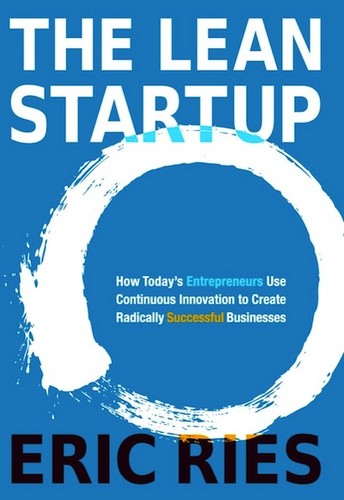
Ries takes the disciplines of lean manufacturing and applies them to the much messier problem of building something nobody's asked for yet. The central argument: treat a new business as a series of testable hypotheses rather than a fixed plan, get a Minimum Viable Product in front of real customers as fast as possible, and let actual behaviour — not opinions, including your own — decide what happens next.
The startup as an experiment
Ries' core loop is a direct rebuke to the business plan. Instead of spending six months building what the plan says the market wants, you build the smallest thing that tests your riskiest assumption, measure what real customers actually do with it, and learn whether to persevere or change course. Speed around the loop — not perfection of any single lap — is the competitive advantage, because the total distance you can travel before the money runs out is a function of how many times you get round it. Most founders instinctively run the loop backwards: build for a year, launch, and only then discover which assumptions were wrong, at the point where there is no runway left to act on the discovery.
Underneath sits Ries' definition of a startup, which is deliberately broad and does a lot of work: a human institution designed to create something new under conditions of extreme uncertainty. Nothing in that mentions technology, venture capital or a garage, and he means it — the same conditions apply to a new service line inside an established firm as to two people with a laptop. What the definition rules out is the assumption that you know what you're building. If you do know, you don't have a startup, you have an execution problem, and lean's machinery is the wrong tool.
His name for the failure mode is achieving failure: successfully executing a plan that leads nowhere. Hitting every milestone, shipping on schedule, launching to acclaim from your friends, and discovering that the plan was built on a guess. The discipline the book proposes exists to catch that guess early, and the reason the argument stings is that achieving failure looks exactly like competence right up until the end.
The method he borrows to avoid it is Toyota's genchi genbutsu — go and see for yourself. Ries' point is that no amount of analysis inside the building substitutes for watching an actual customer use the actual thing, and that founders who rely on summaries, surveys and secondhand reports systematically learn the wrong lessons, because what people say they want and what they do diverge in ways no questionnaire catches. It is the least technological idea in the book and probably the highest-return one.
What an MVP actually is
MVP is the most abused term the book produced, so it is worth stating plainly what Ries meant: not a shoddy version of your product, but the smallest experiment that generates validated learning about a specific assumption. The version of a feature that skips the polish is not an MVP if it doesn't test anything.
The examples do the explaining better than the definition. Dropbox's early test was a video demonstrating software that didn't fully exist yet, aimed at finding out whether anyone wanted it before building the hard synchronisation engineering. A concierge MVP does manually, for a handful of customers, what the software will eventually automate — the founders personally doing the work, learning what the process actually requires, before writing a line of code to industrialise it. A Wizard of Oz MVP presents an automated front end with humans doing the work invisibly behind it. All three answer the same question: does anyone want this, and what do they actually do when they get it?
Ries is honest about what it costs. Releasing something unfinished feels awful, especially for a founder with strong taste; the fear of damaging the brand is real. His answer is that the alternative — perfecting something nobody wants, in private, for a year — is far more damaging, and that the number of people who see an early MVP is small enough that the reputational risk is largely imagined. That answer is right more often than not, but it is not universally right, and the book somewhat glosses over the cases where it isn't.
Innovation accounting
Ries' sharpest contribution is on measurement, and it starts with the distinction between vanity metrics and actionable ones. Total registered users, cumulative downloads, page views — numbers that only go up, that make everyone feel good and that cannot tell you whether anything you did last month worked. Actionable metrics are per-cohort: does the group that signed up in June behave better than the group from May? If you changed the onboarding and the June cohort converts better, you learned something. If the total went up because you spent more on ads, you learned nothing at all.
Innovation accounting is his framework for proving progress when revenue is still zero, and it runs in three steps: establish a baseline with a crude MVP so you know where you actually stand, tune the engine by running experiments that move the per-customer numbers towards where the business model requires them to be, then decide — pivot or persevere. The virtue of the framework is that it makes stagnation visible. If the numbers won't move despite honest effort, that is data, and the alternative to admitting it is a year of activity dressed up as progress.
He pairs this with the three engines of growth, which determine which numbers matter at all. The sticky engine runs on retention, where growth depends on the acquisition rate exceeding the churn rate. The viral engine runs on customers bringing in other customers as a side effect of normal use, where the coefficient is the number to watch. The paid engine runs on spending a fraction of the revenue from each customer to acquire the next one, where lifetime value against acquisition cost is the whole game. Ries' point is that a business running one engine while tracking another's metrics is flying blind, and that trying to run all three at once is a reliable way to run none of them well.
Pivots, small batches and the enterprise half
A pivot is a change of strategy with one foot planted in what you have already learned — not a fresh start, and not persistence in disguise. Ries catalogues them: zoom-in, where a single feature becomes the whole product; zoom-out, where the product becomes a feature of something larger; changes of customer segment, of customer need, of channel, of the engine of growth. His honest observation is that founders almost always pivot too late, because admitting the plan was wrong feels like personal failure, and because a company limping along with modest numbers can sustain hope indefinitely. His fix is procedural: a scheduled pivot-or-persevere meeting that forces the question on a date set in advance, before the money and the morale run out.
The book's second half is the part most readers skip, and it is where lean gets applied to how you work rather than what you build. Small batches, illustrated with the envelope-stuffing example, argue that doing work in small increments end-to-end beats large batches even when it feels slower, because it surfaces problems immediately rather than at the end. The five whys takes a defect and asks why five times, on the observation that technical failures almost always bottom out in human and process causes, and pairs it with proportional investment — fix at a scale matched to the size of the symptom, so you neither ignore small problems nor over-engineer for them. And the chapters on internal startups make the case that established organisations can do this too, provided the new venture gets a genuine sandbox: a small, ringfenced team with its own metrics, protected from being judged by the standards of the mature business it sits inside.
Key lessons
- Build-Measure-Learn: get something real in front of customers before you've perfected it, then use what actually happens to decide the next move.
- A Minimum Viable Product is the smallest thing you can build to start the learning loop, not a cheap version of the full product.
- 'Validated learning' beats vanity metrics — track numbers that would genuinely change a decision, not ones that just go up and to the right.
- Be willing to 'pivot' — change a fundamental element of the strategy while keeping what you've already validated.
- Innovation accounting applies the same rigour to uncertain, early-stage bets that traditional accounting applies to established operations.
The fastest way to fail is to spend a long time building something in isolation before finding out whether anyone actually wants it.
What this means for a UK small business
Strip off the Silicon Valley wrapper and this is a book about not betting money you don't have on guesses you haven't tested. Thinking of a second location, a new service line, or an online shop alongside the physical one? The lean question is: what is the cheapest real-world test that produces actual customer behaviour rather than opinions? A weekend market stall before you sign the lease. A pre-order page before the stock order. Ten paying pilot clients before the rebrand. Opinions are free and worthless; a deposit is data.
It pairs unusually well with UK cash-flow reality. Validated learning is cheap and HMRC doesn't care about your vision — the VAT and the PAYE fall due on the same date regardless of how promising the new idea felt. Every pound not spent industrialising an untested idea is a pound of runway, and for a business without investors, runway is the only thing standing between a bad guess and a fatal one.
The cohort discipline transfers directly, too. "We had a good month" is a vanity metric. Whether the clients you signed in June are still with you in December, and whether they're worth more than the ones from March, is the number that would actually change a decision — and most small firms have that data sitting unexamined in their accounting software.
Cost the test before you cost the idea. Say the plan is a second location at £2,200 a month plus a £15,000 fit-out. The lean version asks what £300 and a fortnight would tell you: a stall at the market that town holds every Saturday, a pre-order page with a real deposit button, or a pop-up in someone else's premises for a weekend. If forty people pay a £10 deposit, you have evidence. If four do, you have saved £15,000 and learned it in a fortnight rather than a year.
What’s aged well
The build-measure-learn discipline and the emphasis on real customer behaviour over opinion are as relevant now as they were in 2011.
What feels outdated
Some of the specific tooling and web-startup examples feel dated, and 'MVP' has been so widely misused since publication (as an excuse for shipping something half-finished) that it's worth re-reading the original definition carefully.
Where it falls short
The book is repetitive, the case studies have dated badly — IMVU, its central example, was never a household name and is now a curiosity — and the methodology fits software far better than businesses with physical constraints. You can't MVP a fish and chip shop's fryer, and iterating your way towards an acceptable restaurant in public costs you the customers who came once.
It also underweights the businesses where quality on day one is the entire brand, and the term MVP has since become such a convenient excuse for shipping something half-finished that Ries' actual definition has been almost buried. Read it for the discipline of testing assumptions cheaply, not as a literal operating manual.
The Business Stuff verdict
Essential for anyone building something genuinely new, even outside tech — the underlying logic transfers to physical products and services just as well.
Three things to actually do after reading it
- Write down the single riskiest assumption behind your current idea, and design the cheapest possible test for it.
- Pick one vanity metric you currently track and replace it with a number that would actually change a decision.
- Set a date to review whether to persevere or pivot on your current approach — don't let it drift indefinitely.
If you liked this, read next
Five similar books
- The Mom Test (Rob Fitzpatrick)
- Running Lean (Ash Maurya)
- Zero to One (Peter Thiel)
- The Four Steps to the Epiphany (Steve Blank)
- Sprint (Jake Knapp)
Common questions
What is a minimum viable product, actually?
It is the smallest experiment that produces validated learning about a specific assumption — not a cheap or unfinished version of your product. That distinction matters, because the term has been so widely abused that most people now use MVP to mean "version one, but rushed". Ries' own examples make it clearer: a video demonstrating software that did not exist yet, a service delivered manually by the founders before any code was written, an automated-looking front end with humans working invisibly behind it. If it does not test an assumption you could be wrong about, it is not an MVP however small it is. Ask what you would learn, and what you would do differently depending on the answer.
Does the lean startup method work for non-tech businesses?
The discipline transfers; the tooling does not. The core question — what is the cheapest real-world test that produces actual customer behaviour rather than opinions — applies to a café, a trade or an agency as much as to software. A weekend market stall before signing a lease, a pre-order page before committing to stock, ten paying pilot clients before a rebrand. What does not transfer is rapid iteration in public. You cannot ship a half-finished restaurant and improve it weekly, because the customers who came once will not come back, and in a business where quality on day one is the brand, the lean instinct actively works against you.
What's the difference between a pivot and just giving up?
A pivot keeps one foot planted in what you have already validated and changes the rest. You learned that a particular customer segment has a real, expensive problem, but your product does not solve it — so you change the product and keep the segment. Or one feature is the only thing anyone uses, so that feature becomes the whole business. Giving up discards the learning along with the plan. Ries' harder point is that founders almost always pivot too late, because admitting the plan was wrong feels like failure, and a company with modest numbers can sustain hope for years. His fix is procedural: put a pivot-or-persevere date in the diary in advance.
Is the book still worth reading given how dated the examples are?
Yes, but read it for the framework and expect the case studies to creak. IMVU, the running example, was never a household name and means little now, and the specific web tooling described has long since moved on. What has held up is the underlying discipline: build-measure-learn, the vanity-versus-actionable metrics distinction, cohort analysis, and innovation accounting as a way of proving progress before there is revenue to point at. Those ideas are now so embedded in how new products get built that reading the original mainly serves to show you how much of the received wisdom has been diluted along the way, MVP most of all.