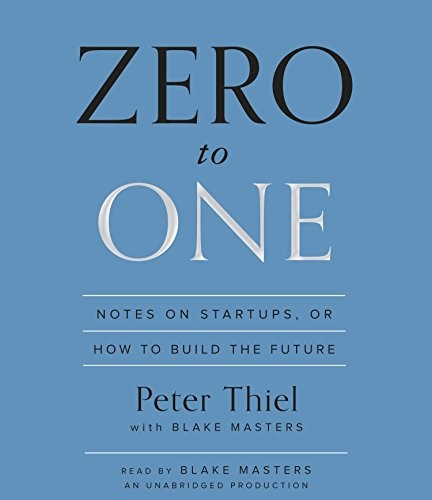
Adapted from Thiel's Stanford lectures, the book argues that real progress comes from going from zero to one — creating something genuinely new — rather than from one to n, copying what already works. It's built around a series of contrarian questions, most famously: what important truth do very few people agree with you on? The best businesses, Thiel argues, aim for a kind of monopoly built on being genuinely better, not on being the tenth company to compete in an already-crowded market.
Competition is for losers
The book began as notes from a Stanford course Thiel taught in 2012, written up by one of his students, and it never loses the shape of a lecture series: short, provocative, essayistic, far more interested in overturning an assumption than in walking you through a process.
The central provocation is that capitalism and competition are opposites rather than synonyms. Under perfect competition — the textbook ideal — margins are arbitraged down to nothing, every firm sells an undifferentiated product at cost, and nobody earns enough to fund anything beyond survival. The businesses actually worth building, Thiel argues, are the ones that escape competition: not through illegal conduct, but by being so genuinely and durably better at one specific thing that comparison stops being the right frame.
He pairs this with a sharp observation about how firms lie. Monopolists disguise themselves by defining their market as broadly as possible — a search advertising business with an overwhelming share describing itself as a technology company competing with everyone. Companies in brutal competition do exactly the reverse, defining their market so narrowly that they appear to dominate it: the only British-Nepalese fusion restaurant on this particular street. If you catch yourself describing your business as the only X doing Y for Z in the north-west, Thiel's diagnosis is that you may have described a market too small to be worth dominating rather than a moat.
He is blunt too about the psychological cost. His argument, drawn partly from his own passage through elite academic and legal tracks, is that competition is seductive because it supplies an unambiguous scoreboard, and that people pour their lives into contests whose prize they never stopped to examine.
Four moats, and starting absurdly small
Thiel gives four characteristics of a durable monopoly, and the list is the most practically useful page in the book. Proprietary technology, where you need to be roughly ten times better at something than the nearest alternative, because incremental improvement is invisible to customers and trivially matched. Network effects, where the product becomes more valuable as more people use it — powerful, but creating a chicken-and-egg problem that forces such businesses to start in very small markets. Economies of scale, where fixed costs spread over volume, which favours software and punishes service businesses in which every new customer needs another pair of hands. And branding, which is real, though Thiel is pointed that brand without substance is the classic failure mode: a company that starts with the brand rather than the product has started at the wrong end.
The strategic advice that follows is the part small businesses routinely ignore: start absurdly small and monopolise a tiny market first. PayPal did not launch at 'payments'; it took the few thousand eBay power sellers who had an acute, specific problem. Facebook took one campus. Amazon took books. Thiel's rule of thumb is that the ideal first market is a small group of people served by few or no competitors, chosen precisely because you can dominate it — and then expanded outwards into adjacent markets from that base.
He is contrarian about first-mover advantage too, which he considers overrated to the point of being a trap. The first mover frequently just pays to educate a market that somebody else then takes off them. What matters is being the last mover: the one making the final significant improvement in a category, and enjoying the years of profit that follow it.
Underneath the moats sits a checklist Thiel says every business must answer, and it is worth writing out because it doubles as a diligence tool for any new venture. Can you create breakthrough technology rather than incremental improvement? Is now the right time to start this particular business? Are you starting with a big share of a small market? Do you have the right people? Do you have a way to deliver your product, not just make it? Will your position still be defensible in ten and twenty years' time? And have you identified a unique opportunity that others don't see? His claim is that a business failing several of these will struggle regardless of execution — and that most founders can only answer three or four honestly.
Secrets, and definite optimism
The chapter on secrets is the book's philosophical core. Thiel's question is: what valuable company is nobody building? A great business, he argues, rests on a secret — something true and important that few people yet know or believe — and he thinks the modern world has talked itself out of believing secrets exist at all. He blames four things: incrementalism, which rewards doing the assigned work and getting the grade; risk aversion; complacency; and what he calls flatness, the assumption that in a globalised world any solvable problem would already have been solved by someone cleverer somewhere else. If you believe everything worth finding has been found, you will not look.
Alongside it runs the framework readers remember longest: a two-by-two of attitudes to the future. Definite optimism believes the future will be better and holds a specific plan to build it. Indefinite optimism believes things will improve but has no idea how, so it optimises, diversifies and keeps its options open. Definite pessimism plans for a worse future. Indefinite pessimism expects decline and does nothing about it.
Thiel's argument is that the developed world drifted out of definite optimism — the mid-century habit of building things — and into indefinite optimism, and that the drift shows in what its most talented people choose to do: finance, law and consultancy, the careers that preserve optionality rather than committing to a specific plan. His personal-scale version of the point is that a bad plan is better than no plan, which is a genuinely useful corrective for anyone who has quietly confused keeping their options open with having a strategy.
Distribution, and the power law
The chapter every technical founder needs is the one on sales, and Thiel is unsparing: if you have invented something new but have not invented an effective way to sell it, you have a bad business regardless of how good the product is. Engineers resist this because good distribution looks like manipulation and good products are supposed to speak for themselves. They don't.
His most practical contribution is a map of distribution by deal size. Complex sales: seven-figure contracts closed by the founder in person over months. Personal sales: a proper salesforce, mid-sized deals, a repeatable process. Marketing and advertising: for low-priced products with no viral mechanic. Viral marketing: where the core use of the product invites other people in. And sitting awkwardly between personal sales and marketing is what he calls the dead zone — products priced at roughly a thousand to ten thousand pounds, too expensive to sell on advertising alone and too cheap to justify a salesperson's time. Businesses stuck there fail quietly, usually without ever diagnosing why.
The last big idea is the power law. Venture returns are not normally distributed: the single best investment in a fund tends to return more than every other holding combined. Thiel's point extends well beyond venture capital, because the same skew governs which of your customers, products, hires and channels actually matter. Most of what you do will be roughly worthless and a very small number of things will be everything, so the useful discipline is working out what the one thing is rather than spreading effort across a portfolio of hedges. His caution to individuals is the sharpest version: you cannot diversify your own life the way a fund diversifies its holdings, so choosing what to be good at matters more than keeping every door open.
Key lessons
- Competition destroys value; the goal is to build something so differentiated that competition becomes irrelevant, at least for a while.
- Ask yourself what important truth very few people agree with you on — your answer is close to your actual competitive advantage.
- A great business should be defensible on at least one axis: proprietary technology, network effects, economies of scale, or brand.
- Sales and distribution matter as much as the product itself, even though most technical founders would rather ignore that fact.
- Definite optimism — having a specific plan for a better future and working towards it — beats vague, indefinite optimism about things generally getting better.
Being the tenth similar business in a crowded market is a much harder path than most founders admit to themselves; genuine differentiation is worth the extra difficulty of finding it.
What this means for a UK small business
Most UK small businesses are, by Thiel's own definition, deliberately 1-to-n: another café, another accountancy practice, another electrician. That is a perfectly sound way to make a living and the book has no real interest in it. But the questions still bite. What does this business do that the nine competitors within ten miles genuinely don't — and does the pricing reflect it? A firm that cannot answer in one sentence is competing on price by default, whether it chose to or not.
'Start absurdly small' is the most transferable idea here, and it is the opposite of what most UK owners do. An accountancy practice serving 'SMEs across the North West' is competing with two thousand firms. One that serves only dental practices — and knows their NHS contracts, associate agreements and equipment finance better than anyone — has built a genuine moat at parish-council scale. The niche feels frighteningly small right up to the moment it becomes the reason people call you.
The distribution chapter deserves a careful read from anyone selling a £2,000-£8,000 service, because that is precisely Thiel's dead zone. It explains why so many UK consultancies at that price point can neither advertise their way to volume nor afford to employ a salesperson.
What’s aged well
The core argument about competition versus genuine differentiation applies well beyond Silicon Valley, to any small business choosing a market position.
What feels outdated
Some examples lean heavily on a specific late-2000s/early-2010s tech-startup worldview, and the monopoly framing sits more comfortably in venture-backed tech than in most traditional small businesses.
Where it falls short
It is a set of provocations rather than an operating manual, and it says as much — but readers hoping for a method will finish it inspired and none the wiser about Monday morning. The venture-scale framing needs constant translation for a business funded by a bank loan and sweat equity, and the survivorship problem is real: the case studies are the handful that worked, reasoned backwards from the outcome.
Two things have aged in particular. The monopoly rhetoric reads very differently after a decade of antitrust action against exactly the firms Thiel held up as models. And the cleantech chapter, used as the book's cautionary tale of a whole sector failing his seven questions, has been overtaken by the collapse in solar and battery costs that turned the sector into one of the largest in the world — his critique of a specific venture bubble was fair, his implied verdict on the technology was not.
The Business Stuff verdict
Worth reading for the thinking tools even if you never build a venture-scale company — the differentiation questions apply at any size.
Three things to actually do after reading it
- Write down one belief about your market that most competitors would disagree with — test whether it's actually true.
- List the specific, defensible reason a customer would choose you over the next five alternatives, in one sentence.
- Identify which of the four defensibility axes (technology, network effects, scale, brand) your business actually has, honestly.
If you liked this, read next
Five similar books
- The Innovator's Dilemma (Clayton Christensen)
- Blue Ocean Strategy (Kim & Mauborgne)
- The Lean Startup (Eric Ries)
- Crossing the Chasm (Geoffrey Moore)
- Loonshots (Safi Bahcall)
Common questions
Is Zero to One worth reading if I'm not building a startup?
Yes, for the questions rather than the plan. The book is written for people trying to build something venture-scale and makes no pretence otherwise, so an electrician or a cafe owner will get nothing from the examples. The thinking tools transfer anyway. What can this business do that nobody within ten miles genuinely can? Is the market you are dominating small enough to actually dominate? What do you believe about your industry that your competitors do not? Which of your customers, products and channels is carrying everything, and which are you keeping out of habit? Those questions are as sharp at £300,000 of turnover as at £300 million, and most owners have never sat down and answered them.
Does the monopoly argument still hold up?
As a description of where profits come from, yes; as advice, it has aged awkwardly. Thiel's economic point is hard to argue with - undifferentiated firms compete their margins away and firms with something genuinely defensible do not - and that logic works at any scale. What has changed is the context. He held up the large US technology platforms as models of the good monopoly in 2014, and the decade since has brought sustained antitrust action against several of them on both sides of the Atlantic, which makes the celebratory framing read very differently now. Thiel is also a polarising public figure, and some readers will not separate that from the book. The four moats survive either way.
What are Thiel's seven questions, and are they usable in a small business?
They are a diligence checklist, and about half of them work unchanged at small scale. In short: can you make a real breakthrough rather than an incremental improvement; is now the right moment for this specific business; are you starting with a big share of a small market; do you have the right people; can you deliver the thing as well as build it; will your position still hold in ten years; and have you spotted something others have missed. Three of those - the small market, the right people, and delivery - are directly usable by any UK firm. The breakthrough-technology question mostly is not, and pretending otherwise is how owners talk themselves into believing an ordinary service business is something rarer.
How long does it take to read?
Three to four hours - it is around 200 pages, the chapters are short, and it reads like the lecture series it was adapted from. That brevity is deliberate and it is part of why the book gets recommended so often: there is very little padding and almost no case-study filler. The trade-off is that it is a book of provocations rather than instructions, so the reading is quick and the thinking afterwards is not. The most useful way to read it is with a pen. The seven questions and the four moats are worth writing out and applying honestly to your own business, and that will take considerably longer than the book itself.