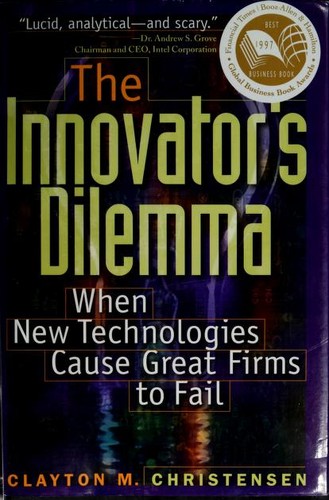
Christensen's foundational work on disruptive innovation explains a genuinely counterintuitive pattern: well-run, well-managed companies that listen carefully to their best customers can still lose their market to a cheaper, initially worse competitor — because that competitor started by serving customers the incumbent had no interest in, then improved until it was good enough for the mainstream market too. The 'dilemma' is that the very management practices that make a company excellent also make it vulnerable to this pattern.
The paradox: good management is what kills you
Christensen's book exists to explain a genuinely puzzling pattern. The companies destroyed by new entrants were not, on inspection, badly run. Many were exemplary — attentive to their best customers, disciplined about margins, rigorous in killing projects that failed to clear a return threshold, well regarded by analysts right up until the point they weren't. The failure wasn't complacency or stupidity. It was the faithful application of everything a manager is correctly taught to do.
That's the dilemma in the title, and it's what makes the book uncomfortable rather than merely interesting. If incumbents lost because they were lazy, the fix would be obvious. Christensen's finding is that they lost because they were competent, and that the same practices producing this year's excellent results were systematically blinding them to the thing that would end them. He built the case on the disk-drive industry, chosen deliberately as the fruit fly of business history: generations turned over so quickly that decades of competitive dynamics could be tracked in a single dataset. Every time the dominant drive format shrank, the leading firms in the old format almost entirely failed to lead the new one — not once, but repeatedly, with the regularity of a physical law.
Sustaining versus disruptive, and the trajectory underneath
The central distinction is between two kinds of innovation that behave completely differently. Sustaining innovations improve a product along the dimensions existing customers already value — faster, more capacity, more reliable. Incumbents win these almost every time, including the technically radical ones, because they have the resources, the customer relationships and every incentive to pursue them. Disruptive innovations are worse on the established metrics but better on a different set: usually cheaper, simpler, smaller or more convenient. They can't be sold to the mainstream market at first, so they take root somewhere the incumbent isn't looking — a low-end segment, or a new use that didn't previously exist.
The mechanism that turns this from a curiosity into a threat is a trajectory argument, and it's the part people miss. Technology tends to improve faster than customer requirements rise. So a disruptive product that starts out plainly inadequate is improving along a steeper slope than the market's demands, and at some point it becomes good enough for the mainstream — at which point its other advantages, price and simplicity, decide the outcome. The incumbent, meanwhile, has spent years adding performance its customers stopped valuing, because it was competing on the only dimension it knew.
This is why the basis of competition shifts over a market's life: first functionality, then reliability, then convenience, then price. Once most customers have more performance than they can use, being better stops being worth paying for, and the game moves to a dimension the incumbent has never optimised for. His other case studies — hydraulic excavators, which began as tiny machines fit only for residential trenching before eating the cable-shovel industry, and steel minimills, which entered at the bottom with rebar nobody serious wanted and worked steadily up-market — show the same shape in industries with nothing technologically in common.
Value networks and why the money can't flow to the right bet
The sharpest analysis in the book isn't about technology at all — it's about internal capital allocation, and it's the part most worth an owner's attention. Christensen argues that every company is embedded in a value network: a web of customers, suppliers, channels and cost structures that determines what it can even perceive as an opportunity. Inside that network, a disruptive proposal arrives looking like a small market, thin margins, unproven demand and unhappy existing customers, and it must compete for engineering time and capital against sustaining projects that offer large markets, good margins and customers actively asking for them.
It loses that competition every time, and it loses it fairly, using entirely sound financial logic. This is the key move: no villain is required. The managers are not short-sighted, the analysis is not wrong, and the process is working exactly as designed. Christensen's related and slightly heretical point, drawing on resource-dependence thinking, is that the people effectively directing a company's investment are its biggest customers and investors, not its executives — a chief executive who insists on funding something their best customers don't want and their shareholders can't see a return on tends not to remain chief executive.
Two other constraints compound it. Small markets cannot solve the growth problem of a large company: a promising new segment that would transform a start-up is a rounding error against a big firm's growth target, so it never justifies senior attention. And markets that don't yet exist cannot be analysed — the standard tools, market sizing and customer research, require customers to ask, and by definition there aren't any. Applied to a genuinely new market, good research reliably produces the wrong answer with high confidence.
What Christensen actually tells you to do
The prescriptions follow directly from the diagnosis, and they amount to routing around your own organisation rather than trying to persuade it. First, place responsibility for the disruptive opportunity in an organisation whose size matches the market — small enough that a modest win is a real win, with its own cost structure and its own definition of an attractive margin. Trying to make the parent company care about a segment its entire incentive structure exists to ignore is a losing argument, and Christensen's point is that you should stop having it.
Second, plan to learn rather than plan to execute. Because the market is unknown, the first strategy will be wrong, so the goal of the first round of spending is information, and the budget should be sized to survive being wrong two or three times rather than to win on the first attempt. Third, use the parent's resources — capital, manufacturing, relationships — but not its processes and values, since those are calibrated to a different business.
Fourth, and most counterintuitively: the disruptive technology itself is usually not the hard part. It's typically simpler and more mature than what the incumbent already builds. The hard part is finding a market that values what it's actually good at, rather than trying to force it to satisfy the existing customers who will always find it inferior.
Underneath the prescriptions is a claim about where an organisation's capabilities actually live, and it explains why buying the disruptor rarely fixes anything. In a young company, what it can do is mostly a function of the people in it. As it matures, capability migrates into processes — the established way things get done — and then into values, meaning the criteria by which everyone at every level decides what is worth doing. Resources are transferable; processes are sticky; values are close to immovable, because they're what made the company successful. That's why an acquisition gets absorbed and neutralised, and why the honest answer to 'can we do this inside the existing business' is usually no.
It's also worth noting how ordinary the entry point tends to look. When Honda arrived in the American motorcycle market it wasn't attacking the big machines at all — it was selling small, cheap bikes to people the incumbents didn't consider customers, through channels the incumbents didn't use. Every element of that was easy to dismiss right up to the point it wasn't. The pattern to watch for isn't a threatening new competitor. It's a competitor you find slightly embarrassing.
The book's final chapter applies the framework as a thought experiment to electric vehicles, and it's worth reading now both for the demonstration of method and as a live illustration of how confidently a good framework can point at the right industry and still miss the shape the disruption eventually took.
Key lessons
- Disruptive innovations typically start by serving customers the market leader doesn't care about — the low end, or a market that doesn't exist yet.
- Listening closely to your best, most demanding customers can actively blind you to a threat emerging from a different, less profitable segment.
- Sustaining innovations improve existing products for existing customers; disruptive innovations create new markets with a different, often lower, value proposition.
- Resource allocation processes inside successful companies naturally starve genuinely disruptive projects, because they look unattractive next to the core business on normal metrics.
- The right response to a disruptive threat is often a separate, deliberately independent unit, not an attempt to force the parent organisation to change.
Being genuinely good at serving your current best customers is not protection against a competitor who starts by serving the customers you've written off.
What this means for a UK small business
Every established local business has a version of this story waiting. The accountancy practice servicing complex clients at good fees, dismissing subscription bookkeeping software as not proper accounting. The independent garage ignoring fast-fit chains because its regulars want a mechanic who knows their name. The high-street retailer who treated online marketplaces as a toy for a few years too long. None of those entrants looked like a threat on day one; each looked like a worse, cheaper option no serious customer would choose, which is exactly what a disruption looks like at the start.
The value-network point is the one that stings for an owner. If your best clients are your most profitable and most demanding, they will steer you steadily up-market, and every individual decision to serve them better will be correct. The cumulative effect is abandoning the bottom of your market to whoever is willing to take it, and that is who eventually comes for the top.
Worked example, with illustrative figures. A small practice charges £1,400 a year for a limited company's accounts and returns, at a 50% gross margin — £700 of contribution per client. A subscription bookkeeping product aimed at the bottom of the same market sells at £45 a month, so £540 a year, at an 80% margin, giving £432. Put the two side by side at a partners' meeting and the cheaper line loses on every measure that gets discussed: lower fee, lower contribution, and a client base that asks more questions per pound. The decision to leave it alone is correct on those numbers. What the numbers don't show is that the £432 client needs no annual chasing, scales without adding staff, and gets a little more capable every year — so the practice has rationally declined the only line of business that still works when the £1,400 compliance fee comes under pressure.
The practical discipline is to look downmarket deliberately, once or twice a year: who is serving the customers you've decided aren't worth the hassle, how are they doing it, and what happens if they get good enough to come for the ones you do want? If the honest answer is that it could genuinely work, that deserves a small, separately run experiment with its own numbers — not a dismissal in a five-minute conversation.
What’s aged well
The disruption framework has held up remarkably well and is still the standard lens through which new market entrants are analysed today.
What feels outdated
The framework has occasionally been stretched to explain things it doesn't quite fit (Christensen himself pushed back on some later loose uses of 'disruption'), which is worth bearing in mind when applying it.
Where it falls short
The disk-drive industry anchoring the research is one most readers have never thought about and which barely exists in its 1990s form, so real translation work is needed to feel the argument rather than just concede it. More seriously, the evidence has been challenged: a 2015 review in MIT Sloan Management Review examined the cases Christensen himself cited and found only a minority fitted his own theory in full. Christensen also publicly regretted how loosely 'disruption' got applied to any successful newcomer. Read it as one real, specific pattern, not a universal law — plenty of cheap entrants stay cheap forever.
The Business Stuff verdict
Genuinely important for understanding competitive threats from below — dense, but worth the effort for any established business.
Three things to actually do after reading it
- List the customer segment your business currently has least interest in serving — and ask honestly whether a competitor could build there unnoticed.
- Check whether your product roadmap is entirely driven by your best, most demanding customers, and whether that's created a blind spot.
- If you're testing a genuinely different, lower-margin offer, consider running it as a separate small team rather than folding it into the core business.
If you liked this, read next
Five similar books
- Zero to One (Peter Thiel)
- Crossing the Chasm (Geoffrey Moore)
- The Innovator's Solution (Christensen & Raynor)
- Blue Ocean Strategy (Kim & Mauborgne)
- Loonshots (Safi Bahcall)
Common questions
What is disruptive innovation, precisely?
It is narrower than the everyday use of the word, which now means roughly any successful newcomer. Christensen's definition is specific: an innovation that is worse on the metrics existing customers care about, but better on a different set — usually cheaper, simpler, smaller or more convenient — so it cannot be sold to the mainstream at first and instead takes root at the bottom of the market or in a use that did not previously exist. The threat comes from the trajectory. Technology tends to improve faster than customer requirements rise, so the inadequate product eventually becomes good enough, and then its price advantage decides the outcome.
Does this apply to a small business or only to corporations?
The mechanism is the same at any size, and arguably clearer in a small firm because you can see it happening. The trap is that your best clients are usually your most profitable and most demanding, so they steer you steadily up-market, and every individual decision to serve them better is correct. The cumulative effect is handing the bottom of your market to whoever will take it — and that is who eventually comes for the top. Any established local business has a version of this waiting: the practice dismissing subscription software, the garage ignoring the fast-fit chain, the shop that treated online marketplaces as a toy.
Has the theory held up?
The pattern is real; the universality claimed for it is not. A 2015 review in MIT Sloan Management Review examined the cases Christensen himself cited and found only a minority fitted his own theory in full, and Christensen publicly regretted how loosely the word disruption was applied by consultants and journalists to any new entrant that did well. Plenty of cheap competitors simply stay cheap forever and never climb. Read it as a description of one specific, genuine and recurring pattern that is worth being able to recognise, rather than as a law that explains every competitive outcome you will encounter.
What do I actually do about it?
Christensen's advice is to route around your own organisation rather than argue with it, because a disruptive opportunity loses the internal competition for money and attention every time, fairly, on sound financial logic. Put it in a separate unit small enough that a modest win counts as a win, with its own cost base and its own idea of an acceptable margin. Plan to learn rather than to execute, and size the budget to survive being wrong two or three times. Use the parent's resources but not its processes or its definition of an attractive customer, because those are calibrated to a different business entirely.