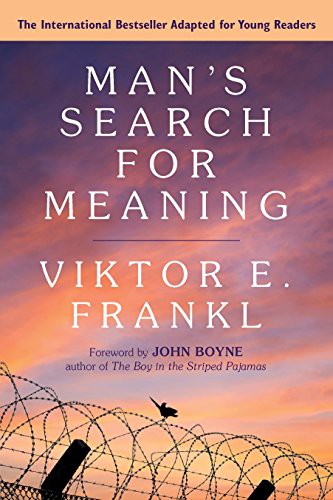
Psychiatrist Frankl's account of surviving Nazi concentration camps, and the logotherapy approach he developed from that experience, argues that meaning — not pleasure or power — is the primary human drive, and that even in the most extreme suffering, people retain the freedom to choose their attitude toward it.
Two books in one
The first half is Frankl's own account of surviving Auschwitz and other camps as a prisoner-psychiatrist, observing with clinical precision how people responded to conditions designed to strip away every shred of dignity and control. The second half turns that observation into logotherapy, the school of psychotherapy he built around a single conviction: the primary human drive isn't pleasure, as Freud argued, or power, as Adler argued, but meaning — and life remains meaningful, even findable-meaningful, under any circumstance, including the very worst humanity has produced.
The last of the human freedoms
The book's most quoted line carries the weight of the whole argument: 'everything can be taken from a man but one thing: the last of the human freedoms — to choose one's attitude in any given set of circumstances.' Frankl watched prisoners in identical conditions respond in radically different ways, and concluded that the difference wasn't external at all — it was an internal freedom that survived even when literally everything else, including the prospect of surviving the week, was removed. That's not a motivational slogan in his telling; it's an observation made under the most extreme possible test of whether it's true.
The tragic triad and tragic optimism
Frankl names three unavoidable features of human existence — pain, guilt, and death — and argues the task isn't to eliminate them (impossible) but to find or create meaning in relation to them, which he calls tragic optimism: remaining hopeful and purposeful despite, not by denying, genuine tragedy. This is a harder-edged optimism than most positive-thinking literature offers, because it doesn't promise things will get better, only that meaning remains available regardless of whether they do.
Three roads to meaning
Logotherapy identifies three routes by which meaning gets found: through work or deeds (creating or accomplishing something), through love (a relationship or connection with another person), and through the attitude taken toward unavoidable suffering when it can't be changed or avoided. The third is the book's most radical claim — that suffering itself, faced rather than merely endured, can be a source of meaning rather than only a thing to survive.
Key lessons
- Meaning, more than pleasure or power, is the primary human motivator, even — especially — under genuine adversity.
- Even when everything else is taken away, the freedom to choose your attitude toward circumstances remains.
- Suffering, when it can't be avoided, can still be given meaning through how it's faced.
- A clear sense of purpose is one of the most powerful predictors of resilience under extreme pressure.
Even in circumstances offering no other freedom at all, the freedom to choose your own attitude and find meaning remains — a perspective that reframes almost any ordinary business hardship.
What this means for a UK small business
This isn't a business book and shouldn't be forced into being one, but the scale-check it offers is genuinely useful for an owner catastrophising over a lost contract or a bad quarter: measured against what this book describes, almost every ordinary business setback is recoverable, survivable and, in Frankl's terms, still full of available meaning if you choose to look for it.
The 'meaning through work' route is worth sitting with directly: what does this business actually mean to you beyond the invoice total — the trade learned, the team built, the customers actually helped — because that's the layer that keeps an owner going through the flat, grinding months that have nothing to do with profit.
What’s aged well
A profound, historically significant text whose relevance hasn't diminished with time.
What feels outdated
Nothing significant; if anything its lessons feel more, not less, urgent with time.
Where it falls short
It offers no practical business framework whatsoever and shouldn't be read expecting one; its value is entirely perspective, not tactics. The comparison it invites — measuring ordinary hardship against genocide — can also feel like an uncomfortable category error if pushed too literally, and Frankl's own theory has faced the same scrutiny most mid-century psychology has for lacking rigorous empirical grounding by modern standards.
The Business Stuff verdict
Not a business book, but essential reading regardless — genuinely changes perspective on what 'hard' actually means.
Three things to actually do after reading it
- Write down what gives your current work genuine meaning, beyond the money it generates.
- Reframe your current biggest business stress against the scale of what this book describes, honestly.
- Identify one choice of attitude, not circumstance, you have genuine control over this week.
If you liked this, read next
Five similar books
- The Obstacle Is the Way (Ryan Holiday)
- Four Thousand Weeks (Oliver Burkeman)
- The Daily Stoic (Ryan Holiday & Stephen Hanselman)
- Grit (Angela Duckworth)
- The Happiness Advantage (Shawn Achor)