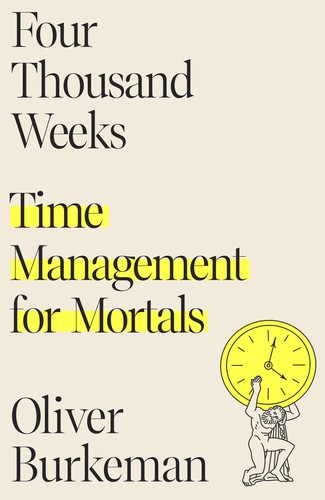
Taking its title from the roughly four thousand weeks in an average human life, Burkeman argues that most productivity advice is a doomed attempt to escape the fundamental limitation of finite time, and that real peace comes from accepting those limits and making deliberate, honest trade-offs rather than chasing an impossible 'get everything done' ideal.
Four thousand weeks, and the efficiency trap
Burkeman opens with a number chosen to be rude: live to eighty and you get roughly four thousand weeks. Not four thousand weeks of spare capacity — four thousand weeks total, inclusive of sleep, illness, commuting and the years you spent on a business that didn't work. The book's argument follows from taking that seriously rather than flinching from it. Almost every productivity book of the last hundred years, he says, is a sophisticated way of flinching: a promise that with the right system you can eventually get on top of things and reach a state where nothing important is being dropped.
That state does not exist, and the reason is structural rather than personal. Burkeman calls it the efficiency trap. Get faster at email and you do not end up with an empty afternoon; you end up known as someone who replies fast, which generates more email. Get faster at quoting and you win more jobs, which is more work. The supply of things that could plausibly demand your attention is effectively infinite, so any increase in your throughput is absorbed almost immediately by an increase in demand. Efficiency doesn't create space. It raises the waterline.
He extends the same logic to convenience. Every technology that removes friction from a task also removes the natural pause that used to come with it, and quietly raises the standard of what a competent person is expected to handle. The result is the peculiar modern feeling of being busier than any previous generation while doing objectively less physical work, and of having more time-saving devices than ever while feeling more short of time. Burkeman's diagnosis is that we've mistaken a condition for a problem. Finitude isn't a bug in your week to be engineered out. It is the week.
There's a good historical detour underneath this. For most of human history people worked to the task rather than the clock — you milked the cows when they needed milking, and the day ended when the work did. Abstract, measurable clock time is largely an industrial invention, arriving with factories that needed to coordinate hundreds of people and pay them by the hour. The side effect was that time became a resource you could be seen to waste, and that you could fall behind on. Burkeman's point is that the anxious feeling of not using your hours well enough is not a timeless part of being human; it's a few centuries old, and it came bundled with a system designed to extract output rather than to make anyone content.
Why we hide from our own limits
The most original stretch of the book is the reframe of procrastination. The standard account says we put off important work because we're lazy, badly organised, or insufficiently motivated. Burkeman's account is that we put off important work precisely because it matters: starting means finding out that your ability is finite, that the result will be worse than the version in your head, and that choosing this project means the other three are dead. As long as it's unstarted it remains perfect and everything remains possible. Procrastination on the big thing is a way of avoiding the confrontation with limits, not a failure of willpower.
Distraction gets the same treatment. We tend to talk about being distracted from what we want to do, as if attention were being stolen. Burkeman argues the pull is often in the other direction — distraction is a relief we go looking for, because staying with a hard piece of work means staying with discomfort. That's why the phone comes out at exactly the moment the writing gets difficult, and why an owner will happily reorganise a supplier folder for an hour rather than start the pricing conversation they've been avoiding for a month.
The same fear shows up in commitment. He's good on the modern instinct to keep options open — the belief that settling on one path, one place, one partner, one business model is a kind of failure. His counter is that a decision only has weight because it closes doors. Keeping every option live doesn't preserve freedom, it just spreads a thin layer of attention over everything and lets none of it accumulate into anything. The word he rehabilitates is 'settling', on the grounds that every choice worth making is one.
Choosing your neglect on purpose
For a book that argues against systems, there are three usable rules, and they're the part most readers actually apply. The first is pay yourself first: if something genuinely matters, take the time for it off the top, before the day's demands, rather than hoping for a residue at the end. There is never a residue. The second is limit work in progress — hold a hard cap of about three active projects, and take nothing new on until one is finished. Not a priority list, a physical limit, because an unbounded list of started things is where good intentions go to rot.
The third is the sharpest: resist the pull of middling priorities. The dangerous items aren't the things you don't care about, which are easy to decline. They're the moderately attractive ones — the reasonable-sounding networking event, the small side product, the client who is fine but not good — because each is individually defensible and collectively they eat the whole calendar. The discipline is to be actively ruthless about things you genuinely quite like.
Underneath all three sits the central move. You are already neglecting almost everything, every day, whether you've admitted it or not. The only question available is whether you're neglecting the right things deliberately or the wrong things by drift. That's a very different exercise from a to-do list, and a much more uncomfortable one, because it requires saying out loud what will not get done this year.
Hurry sickness, rest, and cosmic insignificance
The later chapters turn to what the recovered time is actually for, and Burkeman is scathing about instrumental rest — hobbies pursued to become good at them, holidays taken to return more productive, meditation done to improve focus at work. If everything is a means to something later, nothing is ever the thing itself, because later keeps moving. He makes a serious case for doing something you will never be good at, purely because you're doing it: the point of a bad amateur choir is that it is not building towards anything.
He also makes the underrated point that leisure is a network good. Rest is far more restorative when it's synchronised with other people, and the modern shift towards everyone holding a different schedule has quietly degraded the quality of everyone's time off, even where the hours are the same. An owner working Sundays isn't just losing a day; they're losing the day everyone else has free.
The book closes on what he calls cosmic insignificance therapy — deliberately holding your own concerns against the scale of geological time and finding it a relief rather than a wound. Most of what feels existential in a business, the unanswered email, the one-star review, the competitor's new website, shrinks fast when held at its actual size. This isn't an argument for not caring. It's an argument against caring about everything at the same intensity, which is the fastest route to caring about nothing well.
He ends with a short set of questions rather than a method, and they're better than most books' entire frameworks. Where in your life are you pursuing comfort when what the situation actually calls for is discomfort? Are you holding yourself to standards of productivity or performance that nobody could meet? In what respects are you still refusing to accept that you are who you are rather than who you think you ought to be by now? Where are you withholding effort until you feel more confident, when confidence only ever arrives after the effort? And how would you spend today differently if you stopped needing your projects to turn out well? None of those has a right answer, which is the point — they're designed to be sat with rather than solved, and for a lot of readers the last one does more work than the preceding two hundred pages.
Key lessons
- You will never get everything done — accepting genuine finitude changes decision-making more than any productivity hack.
- Trying to optimise your way out of having limited time is a trap; the limits are the actual condition of being human.
- Choosing what to neglect deliberately is more honest, and more freeing, than pretending you can avoid neglecting anything.
- Presence in the current, limited moment is more valuable than constant optimisation for some hypothetical future payoff.
You will never finish your to-do list, and that's not a personal failure to fix with a better system — it's the actual condition of having finite time, worth making peace with rather than fighting.
What this means for a UK small business
Owners get hit by the efficiency trap harder than employees, because a business genuinely does expand to fill any capacity you free up. Automate the quoting, hire the admin, buy the software — the outcome is usually more volume rather than an afternoon back, unless you decide in advance what the freed time is for and defend it. The book is the antidote to the belief that the next system or the next hire will finally create breathing room. It won't on its own, because nothing about your calendar is self-limiting.
The practical UK version of choosing your neglect is an honest, written list: which services, which customers, which bits of admin this business is simply not going to get to this quarter. Not aspirationally deprioritised — genuinely not happening. Most owners already know what's on that list; what they haven't done is say it out loud to a business partner, an accountant or a spouse, which is the bit that actually changes what Friday evening feels like.
The three rules translate cleanly to a small firm. Pay yourself first means the strategy hour, the VAT prep or the sales calls go in before the day gets eaten. Limiting work in progress means no new service line until the last one is finished and selling. And resisting middling priorities is hardest of all in a small business, because the moderately good client who pays late and rings on Sundays is exactly what nobody can quite justify turning down.
Worked example, with illustrative figures. Say you automate quoting and save 4 hours a week. Over 46 working weeks that is 184 hours — more than four full working weeks recovered. In practice almost none of it shows up as time off, because the freed capacity is immediately spent quoting more jobs, and the year ends at the same 55-hour week with more revenue and no more room. Burkeman's correction is to decide what the 184 hours are for before you free them up: 2 hours a week on the strategy work that never happens (92 hours) and 2 hours a week genuinely not working (92 hours), booked in the diary as commitments rather than left as a gap the business will fill for you. Same saving, deliberately allocated instead of quietly absorbed.
What’s aged well
Recent and philosophically grounded rather than trend-dependent, likely to remain relevant for a long time.
What feels outdated
Nothing significant given its recent publication.
Where it falls short
This is philosophy rather than a manual, and beyond the three rules there's no framework, checklist or method — which is either the entire point or a genuine frustration depending on why you picked it up. Burkeman also writes from a comfortable professional vantage point where choosing to neglect things is a real option. For an owner one bad month from a personal guarantee being called in, some of the equanimity reads as easier to write than to practise, and the book never really engages with the reader whose overwhelm is caused by not having enough money rather than too many choices.
The Business Stuff verdict
A genuinely different, more honest take than most productivity books — a useful corrective for anyone burnt out on optimisation.
Three things to actually do after reading it
- Consciously choose one thing to deliberately neglect this month rather than pretending you can do everything.
- Notice one moment where you're optimising the present purely for a hypothetical future payoff, and reconsider.
- Accept, in writing, three things your business genuinely won't get to this quarter, rather than letting them linger unfinished.
If you liked this, read next
Five similar books
- Essentialism (Greg McKeown)
- The Happiness Advantage (Shawn Achor)
- Man's Search for Meaning (Viktor Frankl)
- Flow (Mihaly Csikszentmihalyi)
- The Obstacle Is the Way (Ryan Holiday)
Common questions
Is this actually a productivity book?
Not in the usual sense, and buying it expecting one is the main way readers end up disappointed. Burkeman spends most of the book arguing against the premise every other productivity title is built on — that with the right system you can eventually get on top of everything. His position is that the backlog is infinite by nature, so getting faster only attracts more work, and the useful skill is deciding what you will deliberately not do. There are three concrete rules in it, covered below, but the bulk is philosophy about living with limits rather than technique for beating them.
What are the three practical rules?
First, pay yourself first: take time for what genuinely matters off the top of the day, before the demands arrive, because there is never anything left at the end. Second, limit work in progress — hold a hard cap of about three active projects and start nothing new until one is finished, so that half-done things stop accumulating. Third, resist middling priorities: the things that eat a calendar are not the ones you dislike, which are easy to refuse, but the moderately appealing ones that are each individually defensible. Together they are less a system than a set of restrictions on how much you let yourself begin.
Should I read this or a conventional time-management book?
It depends on what is actually wrong. If your problem is that work is genuinely disorganised — nothing is captured, deadlines get missed, you rediscover jobs by accident — a conventional system is what you need, and Burkeman will not supply one. If your problem is that you already run a decent system, still feel permanently behind, and have started to suspect the next app will not fix it, this is the better book, because it addresses the belief underneath rather than the mechanics. Plenty of people benefit from reading one of each, in that order.
Does it help if I am genuinely overloaded rather than just disorganised?
Partly, and it is fair to be sceptical here. The reframe is useful: if you bill 1,200 chargeable hours a year and the work in front of you would take 1,800, no system closes that gap, and pretending otherwise just means the shortfall lands as guilt instead of a decision. Naming it turns an impossible workload into a pricing, hiring or client-mix problem, which is at least solvable. What the book does not do is help if the overload is financial rather than a surplus of options — Burkeman writes from a comfortable position, and never really engages with the reader who cannot afford to neglect anything.