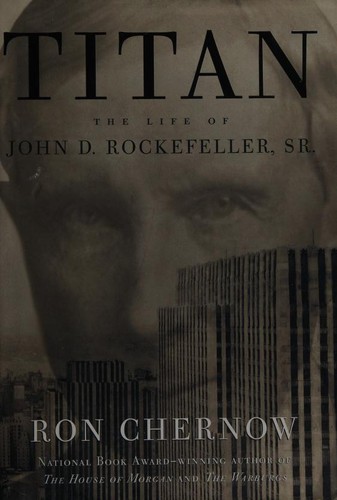
Chernow's exhaustive biography of Rockefeller traces the creation of Standard Oil and, with it, the modern industrial monopoly, alongside Rockefeller's deeply devout personal life and eventual transformation into one of history's most significant philanthropists — a genuinely complex, contradictory figure rather than a simple caricature.
The bookkeeper who never stopped being one
Chernow's Rockefeller doesn't arrive as a tycoon; he arrives as a sixteen-year-old assistant bookkeeper in Cleveland who was so pleased to have found work that he celebrated the anniversary of the day he got the job for the rest of his life. The famous Ledger A — the little account book in which he recorded every penny received and given away, from his first wages onward — is the key Chernow uses for the whole character. This was a young man who tithed to his Baptist church before he had anything worth tithing, who negotiated for himself with the same flat patience he later used on railroads, and who genuinely believed that money was a responsibility rather than a pleasure.
The counterweight is his father, William, a travelling con man and bigamist who sold quack remedies and kept a second family under a false name. Chernow's reading is not crude psychoanalysis, but he lets the contrast do its work: the son's obsessive rectitude, secrecy and horror of disorder look a great deal like a life built in deliberate opposition to a chaotic and dishonest one. It also explains a habit that shaped everything Standard Oil did — Rockefeller's instinct to say nothing publicly, ever, which served him beautifully in business and catastrophically in the court of public opinion.
Choosing the choke point
The strategic decision that made everything else possible gets less attention than the ruthlessness, and it's the most transferable thing in the book. The Pennsylvania oil rush of the 1860s was a lottery: thousands of drillers sinking wells, striking or ruining themselves, flooding the market and then watching the price collapse. Rockefeller looked at that chaos and declined to play. He went into refining instead — the narrow, unglamorous middle of the chain that every barrel had to pass through on its way to a customer — and later into the transport that fed it.
The logic is worth sitting with. Drilling had the romance, the upside and all of the risk; refining had margin, repeat volume and, crucially, leverage over everyone else in the industry. Because refiners were the railroads' customers, a refiner large enough to guarantee steady daily traffic could negotiate terms no individual driller ever could — which is exactly what Standard did. Chernow's implicit lesson is that the most profitable position in an industry is rarely the most exciting one, and that identifying which link in a chain has the leverage is a decision available long before you have any power to exercise it. Rockefeller made that call in his twenties, with almost no money, and spent the next forty years collecting on it.
Efficiency as the actual weapon
The most persistent myth this book dismantles is that Standard Oil won by cheating alone. Chernow's case is that the cheating came second: first came a genuine, sustained, almost pathological obsession with cost that competitors simply did not match. Standard built its own barrels rather than buying them, then bought the timber tracts to make the staves; hired chemists to find uses for the by-products other refiners poured into the river; owned its own wagons, warehouses and eventually pipelines. The best-known scene in the book has Rockefeller watching a machine solder the caps on kerosene tins and asking why it uses forty drops of solder. Thirty-eight leaked. Thirty-nine didn't — and the saving, one drop per tin across millions of tins, was real money.
This is where the book's moral complexity lives. The efficiency was genuine and its benefits were genuine: kerosene got dramatically cheaper, and lighting that had been a luxury reached ordinary households. But the cost advantage that efficiency created was then used as a weapon. Standard extracted secret rebates from the railroads — and, more damagingly, drawbacks, under which the railroads paid Standard a cut of what they charged its competitors — and used the resulting margin to price rivals into ruin and then buy them cheaply. Rockefeller's own defence, which Chernow reports without endorsing, was that the oil industry of the 1870s was a chaotic mess of overbuilt refineries destroying each other, and that consolidation was rescue rather than predation. It was both.
Consolidation, secrecy, and the making of a villain
The mechanics of how the monopoly was actually built are the most instructive pages for anyone interested in how business power works. The South Improvement Company scheme of 1872 — a railroad-and-refiner cartel that collapsed under public fury before it properly operated — was followed within weeks by what became known as the Cleveland Massacre, in which Standard absorbed the great majority of its home city's refining capacity in a matter of months. The offer to each rival was the same, and Chernow shows how effective it was: show me your books, take Standard stock or cash, and understand that if you refuse you will be competing against a company that can sell below your cost for as long as it takes. Those who took stock became rich. Those who took cash mostly regretted it.
The trust structure that followed — a legal invention designed to hold operating companies across states that forbade one company owning another — is what gave the era its name, and gave American law the word it still uses for competition policy. And because Rockefeller refused on principle to explain himself publicly, the story was told by other people: most consequentially by Ida Tarbell, whose serialised history of Standard Oil, published from 1902, was written by the daughter of an oil man ruined in exactly these years. Chernow is even-handed about her — the reporting was formidable, the motive was personal — and clear about the outcome. A man who thought silence was dignity handed the writing of his reputation to his enemies.
Dissolution, and the second life
The long arc of the book is that dominance changes its own risk profile. Standard's scale generated a level of public suspicion, journalistic attention and eventually legal action that no merely successful company attracts, and in 1911 the Supreme Court ordered it broken into 34 separate companies — the ancestors of, among others, ExxonMobil and Chevron. Chernow's twist, and it's a good one, is that the breakup made Rockefeller richer than ever: he held shares in every successor, and the parts turned out to be worth considerably more than the whole.
The second half of Rockefeller's very long life — he died in 1937, aged 97 — gets serious treatment that most short accounts skip entirely, and it's arguably the more interesting story. Guided by the Baptist minister Frederick T. Gates, he applied the same systematic rigour to giving money away that he had applied to making it, and in doing so more or less invented modern institutional philanthropy: not alms, but funded research aimed at root causes, run by professionals and measured. The Rockefeller Institute for Medical Research, the General Education Board, the campaign against hookworm in the American South, the endowment of the University of Chicago and eventually the Rockefeller Foundation all came from that machinery. Chernow declines to score the ledger for us. He simply shows both halves at full length and lets the reader sit with the fact that they were the same man, working the same way.
Key lessons
- Standard Oil's dominance came from ruthless operational efficiency and aggressive consolidation of a fragmented industry, not just favourable circumstance.
- Rockefeller's personal frugality and discipline persisted even at the height of enormous wealth, echoing a pattern seen across several founders on this list.
- Monopoly power, once achieved, invited a level of public and legal scrutiny that eventually forced Standard Oil's breakup — dominance carries its own long-term risk.
- Rockefeller's later philanthropic scale and rigour became as consequential and deliberately systematic as his business empire had been.
Extreme business dominance and extreme personal discipline often travel together — and dominance achieved through aggressive consolidation eventually invites scrutiny and consequence proportional to its scale.
What this means for a UK small business
Almost none of the monopoly-building in this book is legally available to a UK business, and most of it wouldn't be desirable if it were — the Competition and Markets Authority exists in large part because of exactly this history, and price-fixing and market-sharing arrangements carry criminal liability here, not just fines. Read it as history rather than as a manual.
What does transfer is smaller and more useful. The cost obsession is the real lesson: Rockefeller's edge came from knowing his own numbers to an absurd level of detail, and there is a version of that available to any owner who actually sits down with twelve months of purchase ledger and asks which line items are simply habit. So is the vertical-integration logic at small scale — the point at which a building firm's subcontract spend justifies putting the work in-house, or a café's volume justifies buying direct rather than through a wholesaler, is a real decision that turns on exactly the arithmetic Rockefeller was doing.
And the reputational pattern is worth knowing even at village scale. A business that becomes the obvious choice in its town attracts scrutiny and resentment out of proportion to how it actually behaves. Rockefeller's answer — say nothing, let others explain you — is the one clear mistake in the book you can copy for free by avoiding it.
What’s aged well
As serious historical biography, it remains a highly respected, well-researched account.
What feels outdated
Long and dense compared with modern business books, but not outdated as history.
Where it falls short
At well over 700 pages this is a serious time commitment with very little that converts directly into action — it rewards readers interested in character and history for their own sake far more than owners hunting for a takeaway. The middle third, in particular, is dense with railroad rebate arithmetic and litigation detail that matters to the argument but tests the patience of anyone used to punchier modern business writing. Chernow's determined even-handedness is also, occasionally, a weakness: by refusing to arbitrate between Rockefeller's self-justification and Tarbell's prosecution, he sometimes leaves the reader to do the moral work with no help at all.
The Business Stuff verdict
A genuinely rich, if lengthy, historical account — more a work of serious biography than a quick business read.
Three things to actually do after reading it
- Consider what long-term risk your own business's competitive advantage might eventually invite, at whatever scale it operates.
- Reflect on whether your own personal discipline has kept pace with your business's success, or slipped as things improved.
- If you're deliberate about giving back, look at Rockefeller's later systematic approach to philanthropy for inspiration on rigour, not just generosity.
If you liked this, read next
Five similar books
- The Everything Store (Brad Stone)
- Sam Walton: Made in America (Sam Walton)
- Steve Jobs (Walter Isaacson)
- Elon Musk (Walter Isaacson)
- Built to Last (Jim Collins & Jerry Porras)
Common questions
Do I need to be interested in oil to enjoy Titan?
Not really — the oil is the setting rather than the subject. What the book is actually about is character: how a devout, secretive, almost pathologically disciplined man built the largest industrial concern of his age and then spent the second half of a very long life systematically giving the money away. The refining and railroad detail is there because you cannot explain the monopoly without it, and some of it is heavy going, but you can follow the whole story without any prior interest in the industry. If you enjoyed Chernow on Hamilton or Grant, this is recognisably the same writer doing the same thing.
Is Titan fair to Rockefeller, or is it a hatchet job?
It is notably even-handed, which is why it is still the standard biography. Chernow neither rehabilitates Rockefeller nor prosecutes him: the secret railroad rebates and the deliberate pricing-out of competitors are laid out plainly as anticompetitive, and so is the genuine operational brilliance that made Standard Oil cheaper than everyone else in the first place. The same balance runs through the personal material — the sincere faith and lifelong tithing alongside the ruthlessness and the refusal to explain himself publicly. Some readers find that refusal to deliver a verdict frustrating. It is also the honest position, and it is what lifts the book above both the hagiography and the muckraking that preceded it.
How long is it, and is it hard going?
It runs to well over 700 pages and it is not a quick read — budget the best part of a fortnight of evenings, or a long holiday. It is not academically difficult, though; Chernow writes narrative history and the prose carries you along, so the challenge is length rather than density. The pinch point is the middle third, where the railroad rebate arrangements and the antitrust manoeuvring take up a lot of pages and the momentum sags. Readers who push through it generally rate the final section, on the philanthropy and the very long old age, as the best part of the book.
What can a small business owner actually take from it?
Two things, neither of them the monopoly. First, cost discipline as a strategy rather than a chore: Rockefeller's edge came from knowing his own numbers to an absurd degree, and the famous scene where he asks why a machine uses forty drops of solder to seal a tin — thirty-eight leaked, thirty-nine held — is a lesson about one unit at a time, multiplied by volume. Take a business turning over £500,000 a year: shaving two per cent off cost of sales is £10,000 of profit for no extra revenue at all. Second, pick the link in your industry's chain that has the leverage, not the one with the glamour.