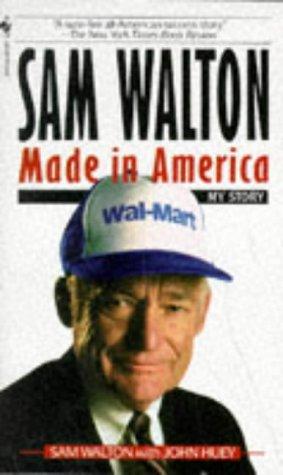
Walmart founder Sam Walton's own account of building the company from a single Arkansas store, emphasising frugality, relentless attention to operational detail, and a genuine willingness to copy and improve on good ideas from competitors rather than insisting on originality.
The lease he didn't read
Walton's first shop was a Ben Franklin franchise in Newport, Arkansas, bought in 1945 for $25,000, most of it borrowed from his father-in-law. He ran it hard, learned to buy direct from suppliers to undercut the franchise's own wholesale prices, and turned it into the best-performing store in the region. Then the landlord declined to renew, because Walton — twenty-seven and delighted with himself — had signed a five-year lease with no renewal clause and hadn't noticed. He had to sell the business he'd built and start over in Bentonville, a smaller town in a corner of the state nobody wanted.
He tells it plainly and without much self-pity, and it functions as the book's thesis statement: the story is not about vision, it's about a man who kept getting up. What makes the autobiography worth reading is that this tone holds throughout. Walton is far more interested in what he got wrong, what he copied, and what took him twenty years to work out than in presenting himself as someone who saw it all coming. Anyone who has read a run of founder memoirs will notice immediately how unusual that is.
In Bentonville he opened Walton's Five and Dime, spent fifteen years running variety stores, and only opened the first Walmart in Rogers, Arkansas in 1962 — the same year, as he points out, that Kmart, Target and Woolco all launched. He was not early, he was not first, and he had considerably less capital than any of them. He was also, for most of the 1960s, borrowed to the hilt: he describes taking Walmart public in 1970 largely because his personal debt had reached a level he could no longer sleep through, and the flotation cleared it and funded the expansion at the same time.
The strategy hiding in plain sight: small towns and distribution
Walton's actual strategic insight was not discounting, which everyone was doing. It was where to discount. The received wisdom held that a discount store needed a town of at least fifty thousand people to work. Walton went into towns of five and ten thousand — places the big chains had written off — where a single well-run discount store could take the whole market and, crucially, where no competitor would bother following him for years.
The second half of that insight is the one most readers underrate. Serving tiny scattered towns cheaply is a logistics problem, not a retail one, so Walton built distribution centres and then expanded outwards from them in rings, filling in the map so that every new store sat within a day's drive of a warehouse he already owned. He called it saturation. It meant trucks ran full, stock moved fast, and the cost of getting goods onto a shelf in the middle of nowhere came down to something the big chains couldn't match. Walmart's competitive advantage was never the shop floor — it was the supply chain feeding it, which is also why the company invested early and heavily in computerised inventory tracking and, later, its own satellite network.
There's a detail that captures the man: he flew his own small propeller plane low over the countryside, looking at traffic patterns and new housing, choosing store sites from the air because it was faster and cheaper than driving.
Underneath the geography sits an arithmetic Walton spells out plainly, and it is the clearest passage in the book. Buy an item for 80 cents, he says, and price it at a dollar rather than $1.20: you make half the margin per unit, but you sell roughly three times as many, and you finish a long way ahead. Put it in sterling and you can test it on your own numbers this afternoon. An item costing £8 sold at £12 makes £4 a unit, so a hundred of them make £400. The same item at £10 makes £2, but at three hundred units it makes £600 — and it has also put three times as many people through the door. The figures are illustrative; the discipline behind them is not. The model only works if the volume genuinely follows, and if your cost base is lower than the competitor you are undercutting. Walton's obsession with expenses was never thrift for its own sake. It was what bought him the right to charge less and still be there next year.
Copy shamelessly, then out-execute everyone
Walton describes, entirely without embarrassment, spending years walking around competitors' shops with a notebook and a tape measure, counting facings and pacing out aisle widths. He was once escorted off a rival's premises. He is explicit that most of Walmart's ideas were borrowed and then improved rather than invented, and he names his sources — above all Sol Price, whose FedMart and later Price Club he studied closely and whose warehouse-club format became Sam's Club. He admits he took the idea and more or less took the name too.
This runs hard against the founder-mythology instinct to prize originality, and it is probably the book's most useful lesson for a small business. Walton's edge was never secret knowledge nobody else had. It was the speed and rigour with which he executed ideas that were sitting in plain view, and the willingness to keep the ones that worked and drop the ones that didn't without ego getting involved.
Late in the book he sets out ten rules for building a business — commit, share your profits, motivate your partners, communicate everything, appreciate, celebrate, listen to everyone, exceed expectations, control expenses better than the competition, swim upstream. The last one is the least quoted and arguably the most Walton: go the other way, ignore the conventional wisdom, and accept that if everybody is doing it one direction there is a decent chance of finding your niche going the opposite way. Small towns were exactly that bet. He singles out the ninth as the one that mattered most: controlling costs better than anyone else is the advantage that covers all the others, because a genuinely efficient operation can make a great many mistakes and still recover. That is not a slogan for him. He drove a battered pickup, flew coach, shared motel rooms with his executives and ran a headquarters that visitors routinely described as shabby, long after he was one of the richest men in America. His argument was always that money not spent on appearances was money available to lower the price, and lowering the price was the entire proposition.
Associates, profit-sharing, and the Saturday morning meeting
Walton's culture machinery was deliberate and mostly cheap. Store managers travelled their patch Monday to Thursday, then came back to Bentonville for a Friday merchandising meeting and a 7.30am Saturday meeting where what they'd actually seen in the aisles reached the top of the company that same week. It was noisy, it involved cheerleading and stunts, and it kept head office from losing contact with the shop floor as the chain went from dozens to thousands of stores. He also famously lost a bet with David Glass that Walmart couldn't hit an 8% pre-tax margin, and paid up by dancing the hula on Wall Street in a grass skirt — the kind of thing that sounds like corporate whimsy but was doing real work in a business that ran on getting ordinary people to care.
The language was part of the machinery too. Staff were 'associates', never employees, and Walton is clear that he took the word and the underlying idea from a trip to Britain, where he saw a retailer treating its shop staff as partners and decided it explained the difference in how they behaved on the floor. The greeter at the door — now a fixture of the format — began as one store manager's fix for shoplifting and was adopted chain-wide because it worked and because it cost almost nothing, which is a fair summary of how most Walmart innovations arrived: from the bottom, cheaply, and only because someone at the top was in the habit of listening.
The profit-sharing and share-ownership plans he introduced from the early 1970s are presented as a mechanism rather than a perk: a shop assistant with a stake behaves differently about shrinkage, stock and a customer's question. And Walton is unusually candid that he came to it late. He writes that his single biggest regret was not being fairer to his earliest employees, who worked through the hardest years and were not included when the plans finally arrived. It is the most honest paragraph in the book, and it is worth noting that the fuller record of Walmart's labour practices is considerably less flattering than the version told here.
Key lessons
- Frugality applied consistently, even after enormous success, was a deliberate operating principle, not just an early-stage necessity.
- Walton was explicit about borrowing and improving good ideas from competitors rather than needing everything to be original.
- Deep, hands-on attention to store-level operational detail continued even as the company scaled into thousands of locations.
- Genuine respect and investment in frontline employees, formalised through profit-sharing, was presented as core to sustained performance, not just good PR.
Enormous scale was built on relentless, unglamorous attention to operational detail and frugality maintained even after success — not a single visionary insight, but sustained discipline over decades.
What this means for a UK small business
'Copy shamelessly, improve relentlessly' is the most immediately useful idea here for any owner who feels that borrowing a rival's good idea is somehow cheating. It isn't, and the advantage almost always sits in execution and follow-through rather than in the idea, which is why the idea being visible costs its owner so little. Go and look properly at what the best operator in your trade does — walk into their shop, read their quotes, sign up to their emails — then do it better and faster.
The small-towns insight translates directly, and arguably better here than in the US: a UK trade or service business will usually make more money dominating three postcodes than being the fourteenth option across a city. Pick the patch you can genuinely own, saturate it, and let density do the work on your travel time and your reputation.
And build the Saturday-meeting habit — some short, regular loop that gets what frontline staff actually saw this week in front of whoever makes the decisions — before you need it. Retrofitting it after growth has already disconnected the office from the work is far harder than starting it at six people.
What’s aged well
The operational and frugality lessons remain broadly applicable to retail and operationally intensive businesses.
What feels outdated
Some of the specific retail-era detail is dated, and later scrutiny of Walmart's labour practices adds context this autobiography doesn't fully address.
Where it falls short
This is Walton's own account, published the year he died, and it reads exactly as favourably to himself as that implies. The labour practices, supplier squeeze and effect on small-town independent retailers that later scrutiny raised serious questions about get almost no examination, and the unionisation fights are handled in a sentence. Some of the retail detail is now thirty years old and the world it describes — pre-internet, pre-Amazon, pre-supermarket price war — is genuinely gone. Read it for the operational discipline and the honesty about copying, and treat the character portrait as one side of a story with several other sides well worth seeking out.
The Business Stuff verdict
A useful first-person account of operational discipline, best read alongside a more independent perspective on the company's later history.
Three things to actually do after reading it
- Identify one good idea from a competitor worth adapting rather than dismissing purely because it wasn't your own.
- Review your own operational detail at the frontline, not just at the strategic level, however large the business has grown.
- Consider one way to formalise genuine investment in frontline employees beyond wages alone.
If you liked this, read next
Five similar books
- The Everything Store (Brad Stone)
- Grinding It Out (Ray Kroc)
- Pour Your Heart Into It (Howard Schultz)
- Titan (Ron Chernow)
- The E-Myth Revisited (Michael Gerber)
Common questions
Is a 1992 retail memoir still worth reading in 2026?
Yes, if you read it for how Walton operated rather than what he sold. The retail specifics are genuinely dated — this is a pre-internet, pre-Amazon world with different supplier economics — but the operating habits are not. Buying to a target price and taking the volume rather than the margin, keeping overheads structurally lower than competitors so you can price below them and still make money, building distribution before you build stores, and walking the shop floor every week are all intact. It is also unusually honest about failure and about copying, which most founder memoirs are not. Read it alongside something independent about Walmart's later history rather than on its own.
What are Sam Walton's ten rules for building a business?
They are the closing chapter, and they are deliberately plain: commit to your business, share your profits with your associates, motivate them, communicate everything you can to them, appreciate what they do, celebrate your successes, listen to everyone in the company, exceed your customers' expectations, control your expenses better than your competition, and swim upstream — go the other way when everyone else is following the crowd. Four of the ten are about how you treat staff, which tells you where Walton thought the leverage was. The expense rule is the one he attached numbers to: he argued you can make a lot of mistakes and still recover if you run leaner than everyone else.
Does the book deal with the criticism of Walmart?
Barely, and that is its biggest weakness. It was published in 1992, the year Walton died, and it is his own account with his own framing. The effect on independent retailers in small towns is addressed briefly and defensively, the long-running arguments about pay, scheduling and unionisation get little more than a passing mention, and the supplier squeeze that later became a standard business-school case is presented mainly as tough buying. None of that is hidden exactly — it simply is not examined. If you want the other side, read it as one half of a conversation and pick up an independent history of the company for the rest.
What can a one-shop business actually take from it?
Three things, and none of them need scale. First, pick the denominator Walton picked: control your costs relative to your direct competitors, not relative to last year, because that is what lets you price aggressively without losing money. Second, copy openly — Walton visited competitors constantly, took notes in their aisles, and adopted what worked without needing the idea to be his. Most owners waste years being precious about originality. Third, be physically present in the operation on a regular cycle. He kept walking stores when the company had thousands of them; if you have one, there is no excuse for managing it from a spreadsheet.