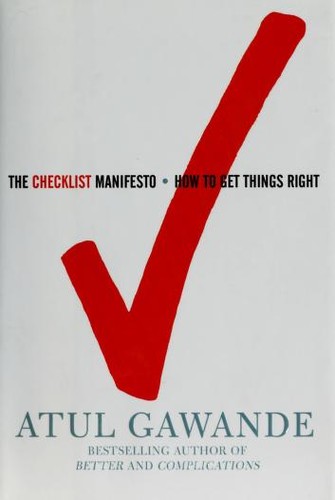
Surgeon and writer Gawande investigates why complex fields like aviation and surgery increasingly rely on simple checklists, despite expert practitioners' instinct that they shouldn't need one. The answer: as complexity grows, even highly skilled experts reliably miss small, obvious steps under pressure — and a good checklist catches exactly that.
Ignorance versus ineptitude
Gawande's framing device is a distinction he borrows from philosophy and then makes uncomfortably concrete. Failures come in two kinds. Errors of ignorance are the ones where nobody knew what to do — for most of medical history, most failures were these. Errors of ineptitude are the ones where the knowledge existed and simply wasn't applied correctly. His argument is that in a huge range of modern work, medicine included, the balance has flipped. We now know how to do far more than we can reliably execute, and the bottleneck is no longer discovery but delivery.
The scale of it is what makes the case. Modern medicine recognises thousands of drugs and thousands of procedures, and a patient in intensive care can require well over a hundred separate actions in a single day, each one an opportunity to miss something. No amount of additional training fixes that, because it isn't a knowledge problem. It's a problem of holding too many small, unglamorous, individually obvious steps in a human brain that is busy, tired and interrupted.
Aviation worked it out first
The founding story is the 1935 crash of Boeing's Model 299 prototype at Wright Field. The Army Air Corps' most experienced test pilot flew it, forgot to release a control lock, and killed himself and a colleague. The aircraft was written off in the press as too much aeroplane for one man to fly. The response wasn't more training — you could not have trained that pilot further — it was a short pre-flight checklist, printed on an index card, covering exactly the steps most likely to be missed. The aircraft became the B-17 and was flown safely by thousands of pilots with a fraction of that crew's experience.
Gawande spends real time on what separates a good checklist from a bad one, mostly through Daniel Boorman, the Boeing engineer whose job is writing them. Good checklists are short — roughly five to nine items, ideally readable in under a minute. They have precise pause points where the list gets used, and they target killer items: the steps that are both critical and commonly missed, not everything that could theoretically be done. They are worded in the language people actually use, and they get tested in real conditions and revised, because the first draft is always wrong. There are two types, and the distinction matters: read-do, where you work through it step by step as you go, and do-confirm, where you work from expertise and then pause to verify nothing was skipped.
The evidence, and the objection people actually have
Two studies carry the book. The first is Peter Pronovost's central-line checklist — five steps as basic as washing hands and using a sterile drape — trialled in Michigan intensive care units and published in the New England Journal of Medicine in 2006. Line infection rates fell sharply and stayed down, and the Keystone project is widely credited with saving over 1,500 lives and around $175 million in the first eighteen months. Pronovost's other finding was organisational rather than clinical: it only worked once nurses were explicitly authorised to stop a doctor who skipped a step.
The second is Gawande's own. Working with the WHO, his team built a nineteen-item surgical safety checklist with three pause points — before anaesthesia, before incision, before the patient leaves the room — and trialled it across eight hospitals in eight countries, from a flagship American teaching hospital to a rural district hospital in Tanzania. As published in the New England Journal of Medicine in 2009, major complications fell from 11.0% to 7.0% and inpatient deaths from 1.5% to 0.8%. The result that surprised even the authors was that it worked across the range: the best-resourced hospitals improved too.
One item in that checklist has nothing to do with clinical steps at all — everyone in the room says their name and their role before the operation starts. Gawande's account is that this small activation ritual measurably increased the likelihood that a junior member of the team would speak up when they saw something wrong. That is the book's quiet second argument. A checklist is partly a memory aid and partly a licence to talk.
The obstacle he is honest about is professional ego. Surgeons resented being handed a laminated card, and the objection is real: it feels like an insult to expertise. Gawande's answer is that the checklist isn't a substitute for judgement, it's a way of protecting the mental capacity that judgement needs by taking the routine off the top of the pile. Notably, when the trial teams were asked whether they'd want the checklist used if they were the patient on the table, agreement was near-universal — including among the surgeons who had disliked using it.
Discipline is not a heroic virtue
The chapter that gives the book its argumentative spine is the one about why a solution this cheap took so long to adopt. Gawande's answer is cultural rather than practical. Medicine, like most expert professions, is built on a self-image of skill, nerve and improvisation — the surgeon who saves the case by knowing what to do when the plan fails. Checklists ask for the opposite virtues: humility, discipline and teamwork, none of which anybody gets promoted for. He notes that we do not celebrate the pilot who ran the checklist correctly, and that this is exactly the problem.
He is candid about his own resistance and about being converted by his own trial. His account of the checklist catching a real problem in his own operating theatre — prompting the team to have blood ready for a case where they had assumed they would not need it, and then needing it — is the most persuasive passage in the book precisely because it is the author admitting the tool caught something he would have missed.
The other implementation lesson is that adoption is a team question, not an individual one. Pronovost's central-line work only held once nurses were explicitly empowered to stop a doctor who skipped a step, and the surgical checklist's introductions ritual exists to make the most junior person in the room more likely to speak. In both cases the checklist is doing something a document has no business doing: redistributing permission. That is why imposing one from above so reliably fails, and why the version written by the people who use it so reliably works.
Simple, complicated, complex
The most transferable chapter is the one that leaves medicine. Borrowing a distinction from Brenda Zimmerman and Sholom Glouberman, Gawande separates problems into simple (baking a cake — follow the recipe), complicated (putting a rocket on the moon — enormous but repeatable once solved) and complex (raising a child — every case is genuinely different). Checklists handle simple and complicated brilliantly. For complex work, a checklist can't script the answer, so it does something else: it makes sure the right people talk to each other at the right moments.
His construction industry chapter shows what that looks like. A modern skyscraper runs on two documents — a build schedule of tasks, and a submittal schedule of conversations, specifying which trades must confer, by which date, about which unresolved question. Nobody is trying to pre-plan every eventuality; they are scheduling the communication that surfaces the eventuality early enough to deal with. He tests the same idea in restaurant kitchens and in investment funds, where one fund manager describes his due diligence checklist changing not what he knew but which deals he ended up walking away from.
The book closes with US Airways 1549 on the Hudson. The popular story is one heroic pilot; Gawande's reading is that the crew ran their dual-engine-failure checklist under ninety seconds of extreme pressure, divided roles cleanly, and everybody lived because the system held. That is the whole manifesto: the point of the discipline is not to diminish expertise, it is to stop expertise being wasted on things a card can carry for you.
Key lessons
- Even highly skilled experts reliably miss small, obvious steps under pressure — it's not about ability, it's about the limits of memory under complexity.
- A good checklist is short, specific, and focused on the steps most likely to be missed, not an exhaustive list of everything.
- Checklists work best when built and refined by the people who'll actually use them, tested against real failures.
- The goal of a checklist isn't to replace expert judgement — it's to free up mental capacity for the judgement calls that actually need it.
Complex, high-stakes processes fail less from lack of skill and more from small, forgettable steps under pressure — a short, well-designed checklist is one of the highest-leverage quality tools available to any business.
What this means for a UK small business
Every UK trade or service business has a version of the Model 299 crash waiting to happen: the kitchen that goes out with one cabinet unchecked, the client taken on without an engagement letter or an ID check, the site job started before the permit was confirmed, the payroll run submitted without the starter form. None of these need more training. They need a short, specific list of the steps most often missed, written by the person who actually does the job.
Compliance is where it pays fastest here, because the deadlines are external and the penalties are automatic. A five-line new-client checklist that covers identity verification, engagement letter signed, deposit received and VAT status confirmed will pay for itself the first time it stops an unbilled job or a late registration. Keep it to the killer items — a checklist that tries to cover everything gets ignored within a fortnight, which is exactly the failure mode Gawande warns about.
The ego problem translates directly too. The most experienced person on your team is usually the most resistant, precisely because they have managed fine without a list for fifteen years — until one bad Friday they don't. Build the list with them rather than for them, and steal the activation trick: on any job with more than two people, thirty seconds of everyone saying who they are and what they're responsible for does more for site safety than a poster ever will.
What’s aged well
The core argument, grounded in aviation and surgery case studies, remains widely cited and applied across industries.
What feels outdated
Nothing significant; the logic is structural, not trend-dependent.
Where it falls short
It is a long magazine essay stretched into a book, and it shows — the middle chapters wander through construction, restaurants and investing largely to demonstrate that the idea generalises, which the reader accepted a hundred pages earlier. Gawande is also a much better storyteller than he is a sceptic of his own case: he spends far less time on where checklists don't help, and the failure modes he does acknowledge — too long, too generic, imposed without buy-in — get a paragraph rather than a chapter.
The bigger caveat has arrived since publication. A large Ontario study published in 2014 found no significant reduction in surgical mortality or complications after checklist use became mandatory across the province, and the broad conclusion since is that it is the culture change and genuine adoption that does the work, not the piece of paper.
The Business Stuff verdict
A genuinely persuasive, well-told case for one of the simplest, most underused tools in any process-driven business.
Three things to actually do after reading it
- Build a short, specific checklist for your single highest-stakes recurring process this week.
- Test the checklist against a real past failure and see whether it would have caught it.
- Involve whoever actually runs the process in refining the checklist, rather than writing it top-down alone.
If you liked this, read next
Five similar books
- The Goal (Eliyahu Goldratt)
- High Output Management (Andy Grove)
- Getting Things Done (David Allen)
- Traction (Gino Wickman)
- The E-Myth Revisited (Michael Gerber)
Common questions
Is The Checklist Manifesto still worth reading given the studies that failed to replicate it?
Yes, with one correction applied. A large Ontario study published in 2014 found no significant improvement in surgical deaths or complications after checklists were mandated across the province, which punctures the idea that the document itself is the active ingredient. The interpretation most people now accept is that checklists work where teams genuinely adopt them and use them as a prompt to talk, and do nothing where they're imposed as a compliance tick-box. That is arguably a more useful lesson than the original, and Gawande's rules for building one — short, specific, tested by the people using it — are exactly what separates the two cases.
What makes a good checklist rather than a useless one?
Five to nine items, readable in about a minute, targeting only the steps that are both critical and commonly missed. Anything comprehensive is already too long to survive contact with a busy day. Fix a precise pause point — before the van leaves, before the invoice goes out, before the client is onboarded — because a list with no trigger never gets used. Decide whether it is read-do, worked through step by step, or do-confirm, where you work normally then pause to verify. Write it in the words your team actually says out loud. Then test it on real jobs and expect to rewrite it twice; the first draft is always wrong.
Won't my experienced staff find a checklist patronising?
Probably, at first, and Gawande treats that as the main obstacle rather than a side issue. The response that works is not persuasion but authorship: the people who do the job write the list, decide what goes on it, and own revising it. A list handed down by a manager reads as a criticism of competence; one the team wrote reads as a way of not being blamed for something forgettable. It also helps to be honest about the target — the checklist exists for the bad Friday, the third callout of the day, the week somebody is covering two roles, not for the days when everyone is sharp.
How long does it take to read?
About four to five hours; it's a short book and Gawande writes fluently. If you only want the practical core, the aviation chapter, the chapter on Boeing's checklist designer and the simple-complicated-complex distinction give you nearly everything you need to build your own, and the construction and investing chapters are illustration rather than instruction. Most readers get more out of stopping halfway and drafting one checklist for their own business than out of finishing the book. Come back for the closing chapter on the Hudson landing, which is the best-told section and makes the argument about systems and expertise better than any of the summaries do.