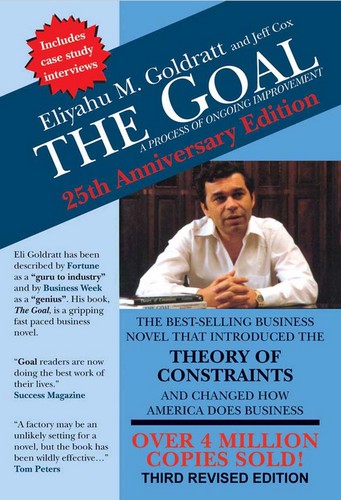
Told as a business novel following a plant manager racing to save his factory, Goldratt uses the story to teach the Theory of Constraints: every system has a bottleneck, and improving anything that isn't the bottleneck is largely wasted effort. Identify the constraint, exploit it, subordinate everything else to it, then elevate it — and repeat.
A business novel with a genuine theory inside it
Goldratt's unusual choice to teach operations management through fiction — a plant manager, Alex Rogo, given ninety days to save his factory before head office closes it, guided by a Socratic mentor named Jonah who never quite hands him the answer — turns out to be the book's strength rather than a gimmick. The story format forces Goldratt to show the theory being discovered under real pressure rather than stated as an abstract principle, and the Theory of Constraints lands harder for being earned scene by scene. Forty years on it is still on operations reading lists at business schools that would not touch a management paperback, which tells you something.
The device that makes it work is Jonah's refusal to answer directly. Every time Rogo arrives with a problem, Jonah returns a question, and the reader is doing the reasoning alongside the protagonist rather than receiving conclusions. It is a slightly maddening reading experience and a very effective teaching one, because the theory's steps are simple enough to state in a paragraph and almost impossible to actually apply until you have watched someone talk themselves out of the obvious wrong answers first.
It's worth being clear what the book is not. It is not a manual, it contains almost no numbers you can lift, and the prose is functional at best. What it is is a re-education in how to look at a process — and specifically, a demolition of the intuition that a system improves when each of its parts improves.
Every system has exactly one constraint
The core claim is deceptively simple: in any linked process, total output is capped by its single slowest step, not by the average capacity of all the steps combined. Speeding up a station that isn't the constraint doesn't increase what leaves the building — it just produces work that piles up in front of the next bottleneck, or worse, in front of the very same one. Goldratt's factory floor makes this visceral: machines running at impressive efficiency everywhere, orders still late, because nobody had identified which single resource actually determined the rate at which finished product shipped.
The two set-pieces that carry the argument are the reason people remember the book decades later. On a scout hike, Rogo watches the troop stretch out along the trail and realises the column's speed is set entirely by Herbie, the slowest boy, no matter how fast anyone at the front walks — and that closing the gaps means putting Herbie at the front and redistributing the weight out of his rucksack. The second is the matchstick-and-dice game, where a row of players pass matches down a line with the roll of a die setting each player's capacity. Even though every player has identical average capacity, the line falls progressively behind, because dependent events combined with statistical fluctuation mean the shortfalls accumulate and the surpluses don't. That is the whole argument for why a 'balanced plant' — every station sized to the same capacity — performs worse than one deliberately built around a known constraint.
The five focusing steps and the three measures
Goldratt's method for acting on this is deliberately cyclical rather than a one-off fix. Identify the constraint. Exploit it — get everything possible out of it without spending money, which usually means stopping it from processing scrap, stopping it idling through lunch breaks, and stopping it working on things nobody has ordered. Subordinate everything else to that decision, including deliberately slowing down non-bottleneck steps when running them flat out would only build inventory ahead of the constraint. Elevate the constraint — invest to increase its capacity, but only once exploitation is genuinely maxed out. Then return to step one, because a fixed constraint moves somewhere else and the process begins again. Goldratt adds a warning to the fifth step that most readers skip: do not let inertia become the constraint. Rules invented to protect an old bottleneck usually outlive it.
Underneath the steps sits a quiet demolition of conventional cost accounting. Goldratt replaces the usual efficiency and utilisation reports with three numbers: throughput, defined as the rate at which the system generates money through sales — not through production, which is the entire point of the definition; inventory, the money tied up in things bought to sell; and operating expense, the money spent turning the second into the first. Judge every proposed improvement by its effect on those three and most 'efficiency' initiatives collapse on inspection, because they increase inventory and operating expense while leaving throughput untouched. His line about measurement — tell me how you measure me and I will tell you how I will behave — is the book's most widely borrowed sentence, and it is aimed squarely at managers who cannot understand why their people optimise the wrong thing.
Why local efficiency is a trap
The novel's most quietly radical argument attacks an instinct nearly every manager has: that keeping every worker and every machine busy is obviously good practice. Goldratt shows it is frequently harmful. A plant where every station runs at full capacity generates excess work-in-progress piling up ahead of the real constraint, tying up cash, lengthening lead times and hiding quality problems for weeks — while looking impressively productive on every individual utilisation report. The uncomfortable corollary is that in a well-run system, non-bottleneck resources should be idle some of the time, and a manager who cannot tolerate visible idleness will reliably make their own operation slower.
Two operational consequences follow, and both transfer well beyond factories. The first is drum-buffer-rope: let the constraint set the pace of the whole system (the drum), hold a deliberate cushion of work in front of it so it never starves (the buffer), and release new work into the system only at the rate the constraint consumes it (the rope). The second is batch size. Rogo's plant halves its transfer batches and watches lead times fall dramatically, because large batches force everything downstream to wait for the whole batch to finish — an insight that shows up later, almost unchanged, in lean manufacturing, in Kanban, and in every argument for smaller software releases.
The final act is where Goldratt shows his hand about what the book is really for. Having saved the plant, Rogo asks what the actual techniques of management are, and the answer is not the five steps — it is the habit of asking what to change, what to change to, and how to cause the change. The Theory of Constraints is offered as a worked example of a thinking process, which is why the book survives its own dated setting.
The context helps explain the book's odd shape. Goldratt was a physicist by training who had built production-scheduling software, found that customers would not adopt it because it contradicted everything their cost accounting told them, and wrote a novel to change their minds. That origin accounts for both the missionary tone and the fact that the argument is aimed at a manager's instincts rather than at their spreadsheet. He went on to extend the same logic in sequels — It's Not Luck applying the thinking processes beyond the factory, and Critical Chain taking it into project management, where the constraint is a chain of dependent tasks and the fix is pooling everybody's private safety margins into one visible buffer at the end. That last idea is arguably more useful to a modern service business than the original book, and almost nobody reads it.
Key lessons
- Every process has a bottleneck; the output of the whole system is capped by that single constraint, not by the average of all the steps.
- Improving a non-bottleneck step feels productive but usually doesn't change overall output at all.
- The five focusing steps: identify the constraint, exploit it, subordinate everything else to it, elevate it, then repeat with the new constraint.
- Local efficiency (keeping every station busy) can actively hurt overall throughput if it isn't focused on the actual bottleneck.
Find the one constraint actually limiting your business's output, and put disproportionate effort there — everywhere else is a distraction until that constraint moves.
What this means for a UK small business
Swap 'factory floor' for any UK service delivery process and the constraint logic holds exactly. A kitchen fit-out business, an accountancy practice in January, an agency's production pipeline: find the one stage where work genuinely queues (the senior reviewer who signs off every job, the one fitter qualified for a particular install, the single person who can approve a client's final copy) and protect that stage's time fiercely, because every hour lost there is an hour of the whole business's output.
The exploit step is where the money is, and it costs nothing. If your constraint is a senior person, everything they do that someone cheaper could do is capacity you are throwing away — quoting, chasing, formatting, attending meetings for context. Strip it out before you even think about hiring another one of them, which is the elevate step and the expensive one.
The local-efficiency trap deserves a specific look from any owner proud of how busy the team looks. If everyone is flat out and jobs are still late, the problem usually isn't effort — it's that work is piling up in front of one under-resourced step while everyone else stays superficially productive. And the batch-size lesson is free: invoicing weekly rather than monthly, or reviewing jobs as they finish rather than in a Friday block, shortens cash cycles and lead times without adding a single hour of work.
What’s aged well
The Theory of Constraints logic is genuinely timeless and applies as well to a service business or agency workflow as to the 1980s factory floor it's set in.
What feels outdated
The novel's setting and dialogue are dated, though the underlying operational logic is not.
Where it falls short
The dialogue and 1980s American factory setting are dated and clunky as fiction — nobody is reading this for the prose — and the domestic subplot involving Rogo's marriage feels bolted on, doubling as an unintentional period piece about whose career mattered. The Theory of Constraints also applies far more cleanly to linear production and delivery than to genuinely creative or judgement-heavy work, where the bottleneck is not a machine you can point at and may move week to week.
Goldratt is also a more combative writer than he lets on: cost accounting is presented as straightforwardly wrong rather than as a system with different purposes, and the book gives no fair hearing to the alternatives. Read it for the way of seeing, not as the last word.
The Business Stuff verdict
An unusual format that works — genuinely changes how you look for the real bottleneck in any process, not just manufacturing.
Three things to actually do after reading it
- Map your core delivery process and identify the single slowest, most constrained step honestly.
- Stop improving a step that isn't the bottleneck until the actual bottleneck is addressed.
- Once you fix one constraint, immediately look for the next one — it will have moved somewhere else.
If you liked this, read next
Five similar books
- The Lean Startup (Eric Ries)
- The Phoenix Project (Gene Kim)
- Traction (Gino Wickman)
- The Checklist Manifesto (Atul Gawande)
- Scaling Up (Verne Harnish)
Common questions
Is The Goal still relevant if I don't run a factory?
Yes, and most of its modern readers don't. The constraint logic applies to any process where work passes through linked steps — a legal practice where every matter needs partner sign-off, an agency where one designer is the funnel, a builder where a single certified engineer gates every job. The factory setting is the delivery vehicle, not the subject. What transfers is the diagnostic habit: stop asking whether everyone is busy and start asking which single step determines how fast finished work reaches the customer. The parts that don't transfer are the shop-floor scheduling specifics and the machine-utilisation arithmetic.
Do I need to read the novel, or will a summary do?
A summary will give you the five focusing steps in ninety seconds and almost none of the benefit. The reason the book works is that Goldratt makes you watch a competent manager repeatedly reach for the obvious wrong answer — hire more people, buy another machine, push everyone harder — before the constraint logic clicks. The scout hike and the dice game do more work than any diagram, and they're what readers still remember twenty years later. That said, it is an easy read: most people finish it in six to eight hours, and it moves quickly enough that the fiction never feels like homework.
How does the Theory of Constraints relate to lean and agile?
They overlap heavily and arrived from different directions. Lean attacks waste across the whole value stream; the Theory of Constraints says focus only on the one step that caps output and treat improvements elsewhere as waste in themselves. Both land on small batches, limited work-in-progress and visible flow — Goldratt's rope, which releases new work only at the rate the constraint consumes it, is essentially a work-in-progress limit, which is why the Kanban community adopted him early. In practice they're complementary: constraints tell you where to point, lean tells you what to do once you're there.
What's the fastest way to apply it this week?
Walk your own process backwards from the customer and find where work sits waiting. Not where people are busy — where jobs queue. That queue is in front of your constraint, and it is usually a person rather than a machine. Then spend a week on the exploit step only: list everything that person does which someone else could do, and remove it. Do not hire, do not buy anything, do not restructure. Most small businesses find twenty to thirty per cent more capacity in that one exercise, and it costs nothing but the awkward conversation about who takes the work off them.