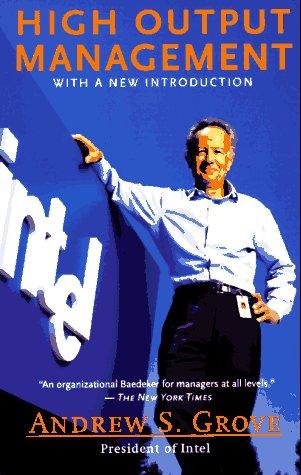
Written by Intel's former CEO, this is one of the most respected management books ever written, treating management as a genuine discipline with measurable output, not a vague soft skill. Grove covers production principles applied to knowledge work, meeting design, performance reviews and decision-making with unusual clarity and rigour.
Management as a production problem
Grove's opening move is to strip the mystique out of management by treating it as an engineering discipline with a measurable output. Not what the manager personally does — that is close to irrelevant — but the output of their team, plus the output of every neighbouring team they influence. That single reframe converts a vague question ('am I doing a good job?') into a concrete one: is more, and better, coming out of this group because I am here? Grove was an engineer before he ran Intel, and it shows in the best possible way. He applies throughput, bottlenecks and indicator tracking to offices, sales teams and product meetings with a rigour the genre almost never has.
The book's most famous device is the breakfast factory. You have to deliver a three-minute soft-boiled egg, buttered toast and coffee, all ready at the same moment. Grove uses it to introduce the limiting step: build the schedule around the longest lead-time operation and work backwards from it, because everything else can be fitted around the constraint but the constraint cannot be fitted around anything. Then he keeps returning to it — to explain batching, capacity, quality inspection and what happens when demand doubles — until the reader can see any operation the same way. It is a teaching device rather than a gimmick, and it does more work over 200 pages than most business books manage with a whole case study.
Out of the same analogy comes one of the most valuable operating principles in the book: find problems at the lowest-value-added stage possible. Rejecting a bad egg before it goes in the pan costs the egg. Rejecting it after it is served costs the egg, the labour, the customer's patience and possibly the customer. In a service business, catching a misunderstanding at the quote stage costs twenty minutes; catching the same misunderstanding after materials are ordered and two people are on site costs several hundred pounds and a difficult phone call. Grove's argument is that inspection should be pushed as far upstream as it will go, and that most organisations instead inspect at the end because that is where the complaints arrive.
Indicators, and knowing before it hurts
Grove is unusually good on measurement, largely because he is so alert to how it goes wrong. His rules: indicators should be measured in physical units where possible, they should be looked at daily or weekly rather than reconstructed monthly, and — the important one — they should be paired. Any indicator of quantity needs a matching indicator of quality, because a measure without its counterweight will be gamed, honestly and unconsciously, by good people. Count jobs completed on their own and jobs get closed prematurely. Count them alongside callbacks and rework and the picture stays honest.
He also pushes hard on leading indicators — measures that tell you what is coming rather than what has happened. Order backlog, quote-to-acceptance rates, machine downtime, staff hours booked next month. And on linearity: whether the work is arriving evenly or whether the month is a scramble in the final week, which is a quality and cost problem disguised as a scheduling one. The underlying claim is that a manager who only sees monthly financials is driving by looking in the mirror, and that the fix is a small handful of forward-looking numbers seen often enough to act on.
Leverage is the only useful measure of a manager's day
Every managerial act — a decision, a piece of information passed on, a value reinforced by example — has leverage, meaning the ratio of its impact to the time it took. Grove's answer to 'what should a manager spend the day on' is simply: whatever has the highest leverage, which is almost never the manager's own individual output. Training ten people in a skill they will use for years is enormously higher-leverage than the same hours spent doing the work personally, because the effect multiplies across every person and every future task. He is emphatic that training is the manager's job and not something to be outsourced to a course, on exactly these grounds.
The concept has a negative side he is equally blunt about. Managerial activity can have high negative leverage: a manager who dithers over a decision blocks the work of everyone waiting for it; a manager who arrives visibly rattled degrades the output of the whole room; a manager who meddles in work a competent person already owns destroys value in both directions. Grove's model gives owners a genuinely useful weekly test — rank the hours by leverage rather than urgency, and notice how much of the week went into activity with a multiplier of roughly one.
Meetings, decisions and task-relevant maturity
Grove treats meetings not as a tax on real work but as the medium in which management actually happens, which is why he designs them so carefully. He divides them into process-oriented meetings — one-to-ones, staff meetings, operational reviews, all scheduled and regular — and mission-oriented meetings, called ad hoc to produce a specific decision. His rule of thumb is that no more than about a quarter of a manager's time should go into the process-oriented sort; more than that and the scheduled machinery has become the job.
The one-to-one gets the most detailed treatment of any format in the book. It belongs to the subordinate, not the manager: they set the agenda, they hold the notes, and the manager's job is mostly to ask the question underneath the question. Grove suggests something closer to an hour than fifteen minutes, on the grounds that a short slot only surfaces what was already going to be raised anyway, and the valuable material — the supplier who has gone quiet, the client who sounded off on the phone, the thing that isn't quite a problem yet — comes out after the obvious items are exhausted. Frequency should vary with how experienced the person is at that particular work. Skipping one-to-ones to get more done is, in Grove's own output logic, trading a high-leverage hour for a low-leverage one.
On decisions, he offers a model that has aged extremely well and a checklist that has aged even better. The model is free discussion, then a clear decision, then full support from everyone — including the people who argued against it. The checklist is the six questions to settle before you start: what decision is being made, by when, who decides, who must be consulted first, who ratifies or can veto it, and who needs to be told once it's made. Most bad organisational decisions in small firms are not bad judgements; they are decisions where two of those six were never answered.
Finally, task-relevant maturity. Grove rejects the idea of a single best management style in favour of matching style to how experienced the person is at the specific task in front of them. Low maturity needs structured, close direction. Moderate maturity needs a mix of direction and mutual reasoning. High maturity needs objectives set and then genuine delegation with monitoring. The subtlety people miss is that this is task-by-task, not person-by-person: the same experienced employee can be high maturity on the work they've done for a decade and low maturity on the new system that went in last month, and managing both situations the same way harms them in opposite directions.
Key lessons
- A manager's output is the output of their team plus the output of neighbouring teams they influence — not their personal output alone.
- Meetings are a manager's core work medium, not a distraction from it — design them deliberately.
- The highest-leverage activities for a manager are training and giving feedback, because the impact multiplies across the whole team.
- Task-relevant maturity should determine management style — a skilled, experienced team member needs a very different approach from a new one.
Management is a genuine, learnable discipline with measurable leverage — treating it rigorously, rather than as an intuitive soft skill, produces dramatically better results.
What this means for a UK small business
The leverage lens is the most useful diagnostic in the book for an owner stretched across too many jobs. Rank the week's hours by leverage rather than urgency and the answer is nearly always that training someone to run the counter properly beats covering the counter yourself for the fortieth time. It is a direct antidote to the 'nobody does it as well as me' trap that keeps British small businesses permanently capped at owner capacity.
The lowest-value-added principle translates into money quickly. In practice, say a small building firm mis-specifies a job on the quote. Caught at quote stage it costs twenty minutes of someone's time — call it £15. Caught after materials are ordered and two people are on site, it costs a wasted day of labour at perhaps £400, restocking charges of maybe £150, and a customer who now needs managing. Moving one checking step upstream is worth more than any amount of effort spent handling the consequences downstream.
The one-to-one discipline works at four staff as well as at forty. A weekly slot with each person, agenda set by them, is the cheapest early-warning system a small employer can install — it surfaces the unhappy client or the supplier problem three weeks before it becomes an emergency email, and it costs a fraction of what the emergency would.
What’s aged well
Remarkably well for a 1983 book — widely cited by modern Silicon Valley leaders as one of the best management books ever written.
What feels outdated
Some manufacturing-era examples need translating to knowledge work, though Grove does much of that translation himself.
Where it falls short
Written from inside 1980s Intel, the production analogies take real translation work for a service business, and the chapters on dual reporting, hybrid organisations and formal performance-review mechanics assume a company with HR infrastructure and an org chart that a five-person firm simply does not have. Skip them without guilt. It is also dry — rigorous rather than entertaining — and it rewards a manager who has already decided management is a discipline worth taking seriously far more than it persuades a sceptical one. There is nothing on remote or hybrid working, and nothing on managing people you rarely see in person, which is a real gap in 2026.
The Business Stuff verdict
One of the most respected, rigorous management books available — dense but consistently rewarding.
Three things to actually do after reading it
- Audit your calendar for a week and check whether your highest-leverage activities (training, feedback) are actually getting protected time.
- Match your management style to each team member's task-relevant maturity, not a single default approach for everyone.
- Redesign your next recurring meeting around a specific, clear purpose rather than a habitual time slot.
If you liked this, read next
Five similar books
- The Hard Thing About Hard Things (Ben Horowitz)
- Measure What Matters (John Doerr)
- Radical Candor (Kim Scott)
- Multipliers (Liz Wiseman)
- Extreme Ownership (Jocko Willink & Leif Babin)
Common questions
Is High Output Management still relevant in 2026?
Yes, more than almost any management book of its age. The core ideas — that a manager's output is the team's output, that leverage should decide how the day is spent, that meetings are the medium of management rather than an interruption to it, and that style should match how experienced someone is at that specific task — are structural rather than technological, so nothing about modern software or remote work invalidates them. What has dated is the setting: semiconductor manufacturing, 1980s org charts and formal review processes built for a large company. The gap worth knowing about is remote and hybrid management, which the book never contemplates.
What does 'managerial leverage' actually mean?
It's the ratio between the impact of a managerial act and the time it took. Spending two hours doing a job yourself has a leverage of roughly one — you get two hours of output. Spending the same two hours training someone who will do that job weekly for the next three years has an enormous multiplier, because the effect repeats across every future occasion. Grove's practical use of the idea is as a weekly audit: list what you actually did, ask what the multiplier was on each item, and notice how much of the week went into work with no multiplier at all. Leverage can also be negative — a delayed decision blocks everyone waiting on it.
Do one-to-ones work in a business with only four staff?
They work better, not worse. The usual objection is that you see each other constantly so a scheduled meeting is artificial — but constant contact is almost entirely about live jobs, and the things that sink small businesses are the ones nobody raises in passing. Grove's format holds at any size: the slot belongs to the employee, they set the agenda, and you resist filling the silence. Keep it long enough to get past the obvious items, since the useful material surfaces after those run out. Weekly is fine for someone newer to the work; fortnightly is usually enough for an experienced hand on familiar ground.
Is it a hard read?
It's dense rather than difficult. There's no jargon and Grove writes clearly, but the book expects you to follow an argument built up over several chapters — the breakfast factory introduced early is still doing work two hundred pages later — so it doesn't skim well. Budget six to eight hours and read it with a pen. Several chapters aimed at large-company structures, particularly dual reporting and formal performance appraisal, can be skipped entirely by a small firm without losing the thread. Most readers find it repays a second reading a year later far more than a faster first one.