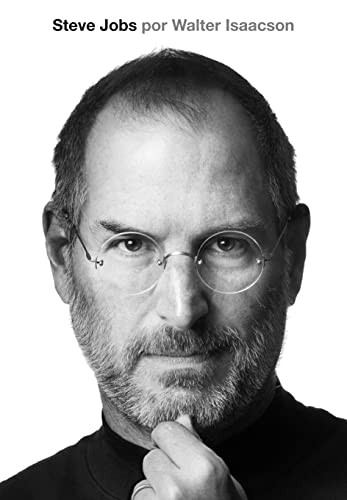
Written with Jobs's own cooperation but full editorial independence, this is the defining biography of Apple's co-founder — obsessive product focus, brutal interpersonal style, genuine visionary instinct, and the personal costs of all three, told across his full career including the wilderness years at NeXT and Pixar.
The bargain Isaacson struck
Jobs approached Isaacson, not the other way round, and the terms are why the book works. Jobs gave him extraordinary access — dozens of interviews, plus his family, his colleagues, his rivals and the people he had sacked — asked for no editorial control, and did not read the manuscript before publication. Isaacson therefore had the access of an authorised biography with the freedom of an independent one, and he used it. Jobs weeping, raging, screaming at staff, parking in disabled bays, denying paternity of his daughter Lisa for years while Apple shipped a computer named after her, and taking credit for other people's work all sit in the same chapters as the product genius, uncut.
It is worth understanding what that arrangement bought. Most business biographies are either authorised and toothless or independent and thin on primary material. This one is neither, and the result is that the difficult material is on the record from people who were there rather than inferred from a distance. It was published in October 2011, days after Jobs died, which is also why the final chapters carry a weight the rest of the genre rarely manages.
The reality distortion field, examined not celebrated
The phrase was coined by Bud Tribble on the original Macintosh team, borrowed from Star Trek, to describe Jobs's ability to convince people — himself included — that an impossible deadline was achievable and an impossible specification was buildable. Isaacson's real achievement is refusing to flatten it into either of the two easy readings.
He shows it working. Engineers repeatedly did things they had told Jobs were impossible, because he simply declined to accept the premise and stood there until they found a way. The original Mac shipped on a schedule that should not have been survivable. He shows it failing just as clearly: years of Jobs insisting that inconvenient facts were not facts, most seriously about his own pancreatic cancer, where he delayed conventional surgery for months in favour of diets and alternative treatments — a decision he later told Isaacson he regretted.
The lesson for anyone running a business is not 'be more like that'. It is that the same trait produced both outcomes and could not be separated out. High standards ruthlessly enforced got extraordinary work out of people who then, in many cases, burned out or left. The book lets both facts stand without reconciling them, which is considerably more honest than the versions of this story that circulate on LinkedIn.
Focus: the discipline of saying no
The most transferable business content sits in the 1997 return. Apple was weeks from running out of money and selling a sprawling, incoherent line — multiple Macintosh families with overlapping model numbers nobody could explain, printers, the Newton, licensed clones eating its own market. Jobs drew a two-by-two grid on a whiteboard: consumer and pro across the top, desktop and portable down the side. Four boxes, four products, everything else cancelled. The clone licences went. The Newton went. Most of the roadmap went, and a great many jobs went with it.
The same period produced the other great lesson in pragmatism. Jobs settled the long patent war with Microsoft and took a $150 million investment from Bill Gates, announced by video link at Macworld to audible booing from an audience who regarded it as surrender. It was the right call, made by someone whose reputation was for never compromising, and Isaacson is good on the distinction: Jobs was uncompromising about the product and entirely willing to be pragmatic about everything else. Most owners have that the wrong way round.
Isaacson returns repeatedly to Jobs's own framing: focus is not deciding what to do, it is deciding what not to do, and being proud of what you killed. At Apple's annual leadership off-site the team would produce a list of ten priorities and Jobs would strike seven of them. It is a genuinely hard discipline, because every cancelled product has an internal champion, a sunk cost and some real revenue attached — which is precisely why so few businesses ever do it.
Taste, simplicity and end-to-end control
The through-line from the 1984 Macintosh to the iPhone is Jobs's conviction that simplicity and taste were commercial weapons rather than decoration. Saying no to ninety per cent of what an engineering team wanted to add was, in his view, the actual product decision — defended over and over against internal pressure to add features and against an industry that measured products by specification lists.
The calligraphy story is the neatest illustration. Jobs dropped out of Reed College but sat in on a calligraphy class purely because it interested him, with no conceivable commercial purpose; a decade later it was the reason the Macintosh shipped with proportionally spaced fonts and typography anyone cared about. Isaacson uses it carefully — not as a claim that all curiosity pays off, but as an example of taste being cultivated long before there was any use for it.
Tied to this is the closed-system argument that ran through Jobs's whole career and remains the most consequential strategic bet in the book: hardware, software and eventually services controlled end to end, because the experience can only be as good as its weakest handover. Wozniak disagreed. The industry disagreed for two decades, and open licensing won the PC market decisively. Then integration won the phone. Isaacson does not declare a verdict, which is right — it is a real trade-off, and the book is more useful for showing the argument than it would be for settling it.
The wilderness years built the comeback
The most structurally useful lesson in the book is not personal at all. NeXT was widely considered a failure — beautiful machines, tiny sales, a hardware business eventually abandoned. Pixar bled money for years, having been bought from George Lucas as a hardware company that then could not sell hardware, and only became what it is when Toy Story landed in 1995.
Both were written off at the time by people who were, on the evidence available, being entirely reasonable. And both directly supplied the comeback: NeXT's operating system became the foundation of Mac OS X and everything descended from it, and Pixar gave Jobs the money, the credibility and — by his own account — the management maturity he had lacked in his twenties.
The lesson is not the greetings-card version where failure is secretly success. It is that the value of a long, unglamorous, apparently pointless period is often invisible until much later. That is a poor argument for persisting with something genuinely dead, and a decent argument for not writing off your own current slog on the basis of how it looks from outside this year.
The cost, plainly stated
Isaacson does not sanitise the management style, and it should not be read as a recommendation. Jobs sorted people into 'A players' and 'bozos' out loud, in front of them. He humiliated staff in meetings, took credit for other people's ideas, and was capable of calling someone's work worthless and then presenting it as brilliant a week later. Some of the best people in the industry did the finest work of their lives for him. Others were broken by it, and the book quotes them at length.
The personal chapters are harder still — the years of denying Lisa's paternity, the treatment of his own family, the long estrangements. Isaacson's closing assessment is not really a verdict so much as a refusal to trade one side against the other, which is the correct call and a large part of why this remains the best business biography most people will ever read.
Key lessons
- Obsessive focus on a small number of genuinely great products, rather than a broad portfolio, was core to Jobs's approach.
- Jobs's harsh, often cruel management style produced real results and real damage in roughly equal measure — the book doesn't pretend otherwise.
- The years at NeXT and Pixar, widely seen as failures at the time, directly built the skills and technology behind Apple's later comeback.
- Taste and simplicity, treated as genuinely core product principles rather than surface polish, differentiated Apple for decades.
Visionary product instinct and genuinely difficult, often damaging interpersonal behaviour are shown here as inseparable parts of the same person — worth understanding both, without pretending one cancels out the other.
What this means for a UK small business
The whiteboard grid is the cheapest thing in this book to apply and the one most likely to change something this week. Write out every service you sell and every customer type you sell it to, then ask which of them you would launch again from scratch today. Most small UK firms have crept sideways into offering too much — a plumber who also does bathrooms and boilers and a bit of tiling, an agency doing SEO and websites and social and now video — and are consequently excellent at nothing, competing on price in every one of those lines.
The taste argument is worth taking seriously in unglamorous trades, because that is where the bar is lowest. Turning up when you said you would, a quote that reads clearly, a van that is not filthy and an invoice that arrives on time will differentiate a British trades business more cheaply than any marketing spend, precisely because so few competitors bother.
The management style is a warning rather than a manual. Public humiliation and unpredictable rage are a live constructive-dismissal and discrimination risk under UK employment law at any size, and in a team of eight there is nowhere for it to be absorbed. The book itself shows the cost it exacted even with Apple's resources behind it.
What’s aged well
As a piece of biography it remains the definitive account; Apple's continued relevance keeps it broadly current.
What feels outdated
Nothing significant; some of Apple's later trajectory has unfolded since publication but doesn't undermine the account of Jobs's own life.
Where it falls short
At more than 600 pages it is a serious time commitment for a book with limited direct practicality. This is biography first and business book a distant second, and anyone hunting for extractable tactics will wade through long stretches of family history, board politics and product minutiae with no lesson attached. The later chapters have also aged: written in 2011, the book treats Apple's post-Jobs prospects as an open question that has since been answered.
The bigger structural weakness is that, editorial independence notwithstanding, Jobs was the primary source. On contested episodes — the split with Sculley, the early Apple equity, the treatment of Wozniak and of Lisa — his framing gets more airtime and more narrative sympathy than the people he wronged, several of whom have since published sharply different accounts.
The Business Stuff verdict
One of the best business biographies written — honest, well-researched and genuinely gripping, not a hagiography.
Three things to actually do after reading it
- Identify one product or offer you could simplify by cutting rather than adding.
- Reflect honestly on where your own leadership style produces results at a real interpersonal cost, and whether that trade is worth it.
- Look for a current 'failure' in your business that might, like NeXT, be quietly building capability for something later.
If you liked this, read next
Five similar books
- Shoe Dog (Phil Knight)
- Elon Musk (Walter Isaacson)
- The Everything Store (Brad Stone)
- Titan (Ron Chernow)
- Losing My Virginity (Richard Branson)
Common questions
Is this a business book or a biography?
A biography, unambiguously, and anyone buying it as a management manual will be frustrated. Long stretches cover family, health, board politics and product minutiae with no extractable lesson attached, and Isaacson makes no attempt to bolt one on. The business value is concentrated in a few places: the 1997 product cull, the arguments about focus and simplicity, the integration-versus-openness bet, and the way NeXT and Pixar turned out to matter. Everything else is context. If you want tactics, read something shorter. If you want to understand how one person's judgement, taste and cruelty produced what they produced, this is the definitive account.
What is the most useful lesson for a small business owner?
The cull. In 1997 Jobs reduced a sprawling product line to four boxes on a whiteboard and cancelled the rest. The equivalent exercise costs you an afternoon. For example: an agency sells nine services. Costed properly, two of them — retained SEO and paid search — produce most of the profit; three are break-even; four consume real delivery time and lose money once the owner's hours are counted at a realistic rate. Killing the losing four does not cost the business their revenue, because that revenue was never profit. It buys back the capacity that was being spent defending them, and it makes the firm describable in one sentence for the first time.
Should I manage the way Jobs did?
No, and the book is the best available argument against it. Public humiliation, unpredictable rage and telling people their work is worthless are a live constructive-dismissal and discrimination risk under UK employment law at any size, and in a team of eight there is nowhere for that behaviour to be absorbed the way it can be in a company of thousands. Isaacson also shows the cost plainly: brilliant people did the best work of their lives for Jobs, and others were broken by it and left. What is worth taking is the standard, not the delivery — refusing to ship something you know is not good enough is free, and being cruel about it is not.
What should I read alongside it?
Becoming Steve Jobs, by Brent Schlender and Rick Tetzeli, is the significant counterpoint. Its authors argue Isaacson overweighted the young, difficult Jobs and underplayed how much he genuinely changed during the NeXT and Pixar years, and several Apple executives publicly preferred it for that reason. Read together, the two books disagree productively about the same evidence. Lisa Brennan-Jobs's memoir Small Fry covers the family material from the other side and is a harder read for it. If you only want the business content, the chapters on the 1997 return in either biography will give you most of what is transferable.