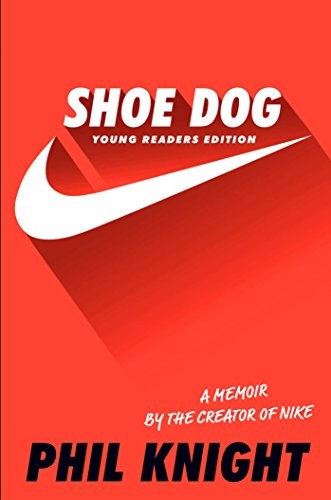
Knight's memoir of building Nike (originally Blue Ribbon Sports) from a car-boot side hustle selling Japanese running shoes into a global brand is one of the most honest founder accounts ever published — constant near-bankruptcy, a business partner relationship that nearly ended it more than once, and a founder who by his own account had no idea what he was doing for most of the journey. It's less a business book than a genuinely gripping story that happens to be full of business lessons.
The Crazy Idea, and a company that didn't exist
Knight's memoir opens in 1962 with a 24-year-old accounting graduate going for a run and deciding to act on what he calls his Crazy Idea: that Japanese running shoes could do to the German brands what Japanese cameras had done to the Germans in optics. The idea came out of a paper he'd written for a Stanford class. He borrowed money from his father, went to Japan, walked into the Onitsuka shoe company in Kobe, and — when asked who he represented — invented a company on the spot. Blue Ribbon Sports did not exist until the moment he said its name out loud in a meeting room.
That single scene tells you what kind of book this is. There is no founding myth of destiny here. Knight presents himself, credibly and consistently, as a nervous, socially awkward young man with no plan beyond the next order, who spent years selling shoes out of the boot of his car at track meets while working as an accountant to pay the bills. Bill Bowerman, his old track coach at Oregon and the man who would become his co-founder, came in for a few hundred dollars and a handshake, mostly because he wanted better shoes for his runners. It was a side hustle run by two people with day jobs.
What separates Shoe Dog from almost every other founder book is that the uncertainty never gets tidied up in hindsight. Most memoirs are written backwards from the outcome, so every decision reads as prescient. Knight keeps the fog in. He genuinely didn't know whether any of it would work, right up until it obviously had, and he is willing to put that on the page decades later when he could easily have written himself as a visionary instead.
Profitable, growing, and permanently three weeks from dead
The drumbeat of the book — relentless, almost exhausting — is that Blue Ribbon was growing fast and was profitable and still very nearly died, over and over, because it kept running out of cash. This is the most commercially useful thing in it, and it is delivered as lived terror rather than as a lesson.
The mechanism is simple and brutal. Knight would order shoes from Japan, pay for them long before they arrived, sell them, and immediately plough every penny plus more borrowed money into a bigger order. Growth consumed cash faster than the business generated it. He was permanently at the limit of his credit line, permanently one nervous bank manager away from the whole thing stopping. When the bank finally lost its nerve — closing the account and, in one of the book's worst moments, reporting him to the FBI over suspected cheque-kiting — the company had done nothing dishonest and was still nearly finished by it. He was rescued by Nissho Iwai, the Japanese trading house that ended up financing the growth the American banks wouldn't.
There is a second near-death of a completely different kind: a retroactive customs bill from the US government, running to millions of dollars under an obscure valuation rule, that arrived with no warning and would have wiped the company out if paid in full. It was eventually settled for a fraction of the demand, but the episode is a reminder that the thing that nearly kills a growing business often isn't the competitor you were watching.
Losing the supplier the whole business depended on
The other structural lesson, and one every small business should sit with, is what happens when your entire operation rests on one relationship you don't control. For a decade Blue Ribbon existed only because Onitsuka let it. Every shoe came from one factory under an agreement that was renegotiated, informally and stressfully, more or less continuously — and Knight describes the slow, sickening realisation that his supplier was quietly sounding out other American distributors while still taking his orders.
His response was to build his own brand in secret as an insurance policy, which is how Nike came to exist at all. When the split came, it came badly and ended in court, and the company had to survive simultaneously losing its only supplier, launching an unknown brand, and fighting a lawsuit. Blue Ribbon won the case, but the more instructive fact is that a decade of extraordinary growth was built on a foundation that could have been pulled away at any point by a phone call from Kobe. Single-supplier and single-customer dependency is one of the most under-priced risks in small business, and Knight lived it.
The Buttfaces: loyalty to a cast of oddballs
The people are the other half of the book. Jeff Johnson, the first full-time employee, wrote obsessive handwritten letters to individual customers and kept index cards on their running habits — a one-man CRM in 1966 — and Knight found him faintly exhausting for years before recognising what he'd built. Bowerman poured rubber into his wife's waffle iron looking for a better sole and produced one of the most famous product innovations in sportswear. Various others were, by Knight's own affectionate description, misfits: a paraplegic ex-serviceman, an overweight lawyer, a former athlete or two, none of whom would have got past a modern HR screen.
This group held annual meetings they called Buttface — a name chosen precisely so nobody could take themselves too seriously — where they shouted at each other, insulted each other, drank, and made the actual strategic decisions. Knight's implicit argument, made through story rather than lecture, is that the company's eventual scale rested on years of unglamorous loyalty to unpolished people, sustained with no guarantee of payoff, rather than on any single masterstroke. He kept people who were difficult because they were good. They stayed through years of being underpaid.
Everything iconic was a rushed guess at the time
The name and the swoosh arrived exactly as unglamorously as everything else. When the Onitsuka relationship broke down and they had to launch their own brand at short notice, Knight preferred a different name and accepted 'Nike' — from Jeff Johnson's suggestion, reportedly out of a dream — largely because they'd run out of time. The logo was commissioned from a design student, Carolyn Davidson, for a modest hourly fee totalling thirty-five dollars; Knight's recorded reaction was that he didn't love it, but it would grow on him. She was given stock years later, once it was obvious what she had made.
This is the book's quiet, best lesson. The artefacts we now read as inevitable and brilliant — the name, the tick, the waffle sole — looked at the time like reasonable guesses made under deadline pressure by tired people with no certainty at all. Knight never says this outright; he just tells it straight and lets you notice.
The final act shifts register. The 1980 flotation makes Knight and his early colleagues wealthy, and the book turns to what it cost: a marriage stretched thin, sons who saw very little of him, and the death of his son Matthew in a diving accident. The closing chapters are unusually ambivalent for a success memoir, and they are the reason the book outlives the genre. It is a genuinely well-written story that happens to be full of business lessons, rather than a business book with anecdotes bolted on.
Key lessons
- Near-collapse is far more common on the way to a huge outcome than survivorship-bias business stories usually let on.
- Cash flow, not profit, was the thing that nearly killed the business repeatedly — a growing, profitable company can still run out of money.
- Loyalty to early, unglamorous partners and suppliers mattered more to the eventual outcome than any single strategic masterstroke.
- Knight didn't have a grand plan for most of the journey — he adapted, repeatedly, in real time, under real pressure.
- A founder's self-doubt is normal and survivable; the story doesn't pretend Knight was ever fully confident he'd make it.
The gap between how a successful company's story gets told afterwards and how genuinely uncertain and precarious it actually felt at the time is enormous — and worth remembering when your own business feels precarious.
What this means for a UK small business
The cash-flow lesson is the most transferable thing in the book. Knight's company was profitable and growing on paper for years while being days from insolvency, and UK owners hit the same wall in miniature: a new contract needing stock and staff paid for months before the invoice clears, a busy quarter that leaves nothing for the VAT bill, a growing order book eating every penny of working capital. Profit and solvency are separate problems, and the second is what closes businesses. If Shoe Dog does one thing for you, let it be building the cash-flow forecast you've been avoiding — then stress-testing what happens if your biggest customer pays 30 days late.
The loyalty theme translates just as directly. The supplier who extended credit in year one, the first client who took a chance on you, the employee who stayed through a lean 18 months — Knight's book is an argument that these relationships are worth more over a decade than the savings from switching on this quarter's price. That is a genuinely useful corrective for owners under margin pressure.
And if you are still running the thing as a side hustle around a day job, wondering when it becomes real: Knight did that for years, badly, while frightened. It is a more honest picture than most of what you'll read.
What’s aged well
As a piece of writing and a genuine account of founder experience, it hasn't dated at all — arguably the best-written book on this list.
What feels outdated
None of the specific business lessons feel dated; it's a story, not a framework, and stories don't really go out of date.
Where it falls short
It is a memoir, not a framework, so anyone wanting extractable, structured lessons has to do that work themselves — Knight tells stories and largely leaves you to draw the conclusions. It is also emphatically one-sided: co-founders and early staff appear only as Knight sees them, the Onitsuka fallout is told entirely from his side, and Nike's later sweatshop and labour-practice controversies get a brief, unsatisfying acknowledgement rather than a reckoning.
There is survivorship bias baked in, too. A thousand founders took the same reckless bets and went under, and none of them wrote a beautifully edited memoir about it. Read it for honesty about how uncertain it felt, not as evidence that betting the company repeatedly is sound practice.
The Business Stuff verdict
The best-written book on this list, and a genuine gut-check for any founder who assumes everyone else has it more figured out than they do.
Three things to actually do after reading it
- Write down the closest your business has come to genuinely failing, and what actually got it through — it's worth remembering deliberately.
- Identify one early relationship (supplier, partner, first customer) worth investing more loyalty into, the way Knight did.
- Notice one decision you're delaying because you don't feel confident enough yet — Knight rarely felt confident either.
If you liked this, read next
Five similar books
- The Hard Thing About Hard Things (Ben Horowitz)
- Delivering Happiness (Tony Hsieh)
- Losing My Virginity (Richard Branson)
- Elon Musk (Walter Isaacson)
- Bad Blood (John Carreyrou)
Common questions
Is Shoe Dog a business book or a memoir?
It is a memoir, and that is the point. There are no frameworks, no numbered steps and no chapter summaries — Knight tells the story of building Nike from 1962 to the 1980 flotation and leaves you to extract the lessons yourself. Plenty are there: cash flow, supplier dependency, hiring odd people and keeping them, what growth actually costs. But you have to notice them, which is real work compared with a book that lists them for you. Read it if you want the emotional truth of running something precarious. If you want a structured playbook, read The Hard Thing About Hard Things instead — same honesty, far more explicit instruction.
What's the single most useful lesson for a small business?
That a profitable, growing business can still run out of money and die. Blue Ribbon Sports was expanding fast and selling everything it could import, and it was repeatedly days from collapse because growth consumed cash faster than the business produced it — every penny went straight into a bigger order that had to be paid for long before it sold. UK owners hit the same wall in miniature every time a large contract requires stock, wages or subcontractors to be paid before the invoice clears. Profit and solvency are separate problems, and only one of them closes companies. Knight's account is the most visceral illustration of it in business writing.
Does it deal with Nike's sweatshop controversies?
Barely, and this is the book's clearest weakness. The narrative largely ends around the 1980 flotation, before the labour-practice scandals of the 1990s, and where Knight does address them it is brief and defensive rather than a genuine reckoning. If you want that story you need to read journalism, not this. The same one-sidedness applies throughout: the split with the Japanese supplier Onitsuka is told entirely from Knight's side, early colleagues appear only as he remembers them, and a man writing thirty years later has every incentive to present his own judgement calls generously. Read it knowing whose account it is.
Is it worth reading if I'm not a founder?
Yes, mainly because it is exceptionally well written — probably the best-written book on this list — and works as a story regardless of whether you run anything. But its real value is aimed squarely at people carrying business risk personally, because the thing it does better than any other founder book is convey how uncertain and frightening the process felt while it was happening, rather than how inevitable it looks now. If you are an employee curious about how companies get built, you will enjoy it. If you are lying awake over a bank facility, it will do something more useful than that.