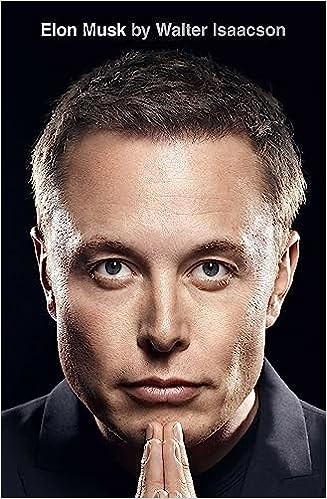
Isaacson spent two years with extensive access to Musk across Tesla, SpaceX, X (Twitter) and Neuralink, producing a detailed, warts-and-all account of an extremely intense, demanding operating style, genuine engineering obsession, and the personal volatility that runs through both his companies and his public life.
Two years of access, and what it bought
Isaacson spent two years shadowing Musk across Tesla, SpaceX, X and Neuralink, and the access shows in granular, frequently uncomfortable detail: 3am confrontations on factory floors, real-time decisions during the Twitter acquisition, the childhood in South Africa that Musk himself credits — and that the book interrogates — for the operating style that followed. Unlike Isaacson's Jobs biography, this covers a subject still very much mid-story, which makes it read more like an extended dispatch than a settled verdict.
The organising idea Isaacson lands on is what he calls demon mode: a state Musk enters where empathy switches off, urgency becomes absolute, and people around him are treated as obstacles or instruments. The book's genuine question — the one that makes it worth reading for anyone running anything — is whether the demon mode and the achievements are separable. Isaacson clearly wants to believe they might be, and repeatedly presents evidence that they aren't. He never fully resolves it, which is either the book's honesty or its evasion depending on your view.
For a business reader, the useful frame is to treat this as a case study in a particular operating philosophy that has produced extraordinary results at extraordinary cost, and to be deliberate about which parts you're borrowing.
The algorithm
Musk's own stated production philosophy is quoted at length and is the most directly transferable thing in the book. Question every requirement — and specifically, attach a name to it, because a requirement from 'the legal department' can't be argued with while a requirement from a named person can. Delete every part or process step you can, and if you aren't putting at least 10% of what you delete back in, you didn't delete enough. Simplify what remains. Then speed up cycle time. Then, and only then, automate.
The order is the entire point, and it's the part most businesses get backwards. Automating a bad process just produces bad output faster and more expensively. Isaacson documents Musk learning this the hard way during the Model 3 ramp, when the over-automated production line — robots doing work humans did better — became the bottleneck he'd built to remove, and had to be partly torn out.
The 'delete' step is where Musk is most ruthless and most controversial. His default assumption when told a part or a rule is necessary is that it probably isn't, and the burden of proof sits with whoever wants to keep it. This produced real breakthroughs — reusable boosters, in-house battery cells, radically cheaper launch costs — and real disasters, where rules deleted for speed turned out to be load-bearing for safety or compliance. Both outcomes come from the same instinct, which is precisely the problem with adopting it selectively.
Deadlines as a weapon, deliberately
Musk sets deadlines that he and his engineers privately know are close to impossible, on the explicit theory that a comfortable deadline produces comfortable, unurgent work. Isaacson doesn't pretend this is a misunderstanding or an accident — it's a deliberate management technique, and one Musk has used consistently for two decades.
The book documents it working. The Model 3 production ramp, brutal as it was, hit volumes that established manufacturers thought were years away, including the period where Musk slept at the factory and a production line was built in a tent in the car park because the permanent building couldn't be finished in time. The tent line worked. That's the awkward fact that makes the technique hard to dismiss.
It also documents the cost with equal clarity: burnout, high turnover, senior people who did their best work under Musk and then left in pieces, decisions made under artificial time pressure that didn't need to be made under any pressure at all, and public deadline claims — full self-driving in particular — that have been missed repeatedly for years with real reputational and legal consequences. The honest summary is that the technique extracts a genuine surge of output and spends down a finite reserve of people to do it.
The Twitter chapter, and what it tests
The acquisition of Twitter is the book's set-piece and its most valuable stress test of everything else in it, because for the first time Isaacson watches the method applied to a business Musk didn't build and doesn't fully understand. The same moves come out: question every requirement, delete aggressively, cut headcount to a fraction of what it was, demand an immediate commitment to long hours from whoever remained, rip out infrastructure that engineers insisted was load-bearing. Some of it worked — the site didn't collapse, which a great many people confidently predicted it would, and the cost base fell dramatically.
But the differences are as instructive as the similarities. Rockets and cars have physics as the arbiter: delete a part, and either the thing flies or it doesn't, and you find out quickly. A social network's constraints are advertisers, regulators, moderation and the accumulated trust of users, none of which give you a clean pass/fail within a fortnight. Deleting those requirements produced consequences that took a year to surface, by which point the advertiser exodus and the brand damage were extremely difficult to reverse.
For a reader trying to extract method from personality, this is the most useful section of the book, because it shows where the method's limits are. First-principles deletion is powerful in domains where the feedback loop is fast and the constraint is physical. It's considerably more dangerous where the constraint is other people's willingness to keep dealing with you.
First principles and vertical integration
The recurring intellectual move across SpaceX and Tesla is Musk refusing to accept 'that's how the industry does it' as an answer. The canonical example is the rocket: rather than accept the market price, he priced the raw materials — aluminium, titanium, copper, carbon fibre — found they came to a small fraction of the finished cost, and concluded the gap was convention and supply-chain markup rather than physics. The same reasoning got applied to battery cells, to seats, to launch insurance, to almost everything.
Vertical integration follows directly from it. If suppliers charge a multiple of material cost and move at their own pace, bring it in-house — which SpaceX and Tesla did far further than competitors dared, building their own engines, avionics, seats, software and eventually cells. It's expensive, capital-hungry and deeply unfashionable in an era of outsourcing everything, and it gave both companies cost structures and iteration speeds their rivals couldn't match — largely because owning the process means you can change it on a Tuesday rather than renegotiating a contract. It's also, notably, the part of Musk's method most cleanly separable from his personality, which is what makes it the most useful part of the book for readers who want the thinking without the theatre.
Isaacson's closing suggestion — that the recklessness and the results share a root, that the man who ignores the rule about not launching in cold weather is the same man who ignores the rule that rockets can't be reused — is the thing to sit with. It isn't a management manual. It's evidence that one particular high-cost operating model works, on rockets, sometimes, and a fairly grim account of what it costs the people inside it.
Key lessons
- Extremely aggressive deadlines, even ones that are missed, are used deliberately to force faster problem-solving than a comfortable timeline would.
- First-principles thinking — questioning assumed constraints from scratch rather than accepting industry convention — repeatedly produced breakthrough approaches.
- Musk's demanding, sometimes abusive management style is shown producing both extraordinary output and serious organisational and personal costs.
- Vertical integration and in-house manufacturing, taken further than most competitors dared, was a recurring, deliberate strategic choice across his companies.
Extreme intensity — in deadlines, in first-principles questioning, in personal demands on both himself and his teams — runs through Musk's genuine breakthroughs and his genuine damage in roughly equal measure, and the book doesn't try to resolve that tension neatly.
What this means for a UK small business
The algorithm — question, delete, simplify, speed up, automate, in that order — is directly usable by any owner staring at a clunky internal process. The mistake nearly every business makes is buying software to automate step one, before deleting the steps that shouldn't exist. Run it literally on your next onboarding or invoicing workflow: name who requires each step, delete what can't be defended, then look at software. Most firms find a third of the process was inherited from a client who left in 2019.
The first-principles habit is worth applying to costs you've never questioned — the supplier you've used for eleven years, the software renewal nobody has re-tendered, the margin you assume the trade works on. Pricing something from its component cost upwards is a genuinely useful exercise even when the answer turns out to be that the existing price is fair.
The deadline tactic is the part to leave. UK employment law, a ten-person team and no share options mean pushing people the way Musk pushes his gets you resignations, a tribunal risk and a reputation in a small local market. Take the method, not the management style.
What’s aged well
Too recent to assess with real distance; covers ongoing, still-unfolding situations that will continue to develop after publication.
What feels outdated
Not outdated, but incomplete by nature — a snapshot of an ongoing story rather than a settled retrospective.
Where it falls short
Written and published mid-story, the book can't offer the settled judgement the Jobs biography could — the Twitter/X fallout was still unfolding as it went to press, and Musk's trajectory since publication complicates parts of the narrative further. Isaacson's access came with proximity, and it shows: the framing often reads closer to Musk's own justifications than a fully arm's-length account would be, and the harshest episodes tend to be explained rather than judged. At 600-plus pages there's also a lot of chronology for the amount of insight, and the psychological thesis about demon mode is asserted more often than it's tested.
The Business Stuff verdict
A detailed, access-driven account, genuinely useful for understanding Musk's operating style, though readers should expect an unfinished story.
Three things to actually do after reading it
- Question one assumed industry constraint in your own business from first principles rather than accepting convention.
- Consider whether an aggressive deadline on one project would force faster problem-solving, or simply cause burnout — the line matters.
- Reflect on where your own management intensity produces results versus where it produces unnecessary damage.
If you liked this, read next
Five similar books
- Steve Jobs (Walter Isaacson)
- The Everything Store (Brad Stone)
- Shoe Dog (Phil Knight)
- Titan (Ron Chernow)
- The Ride of a Lifetime (Robert Iger)
Common questions
What can a small business actually take from this book?
The algorithm, applied literally to one bad process. Question every requirement and name the person who imposed it, delete what nobody will defend, simplify what survives, speed it up, and only then automate. Take a client onboarding process that currently runs to fourteen steps: in practice, naming an owner for each step usually kills three or four outright — a form nobody reads, an approval inherited from a client who left years ago, a duplicate record. Getting to eight steps before you buy software is worth more than any system you could buy to run the original fourteen faster. Most firms do this the other way round and automate the mess.
Should I copy the deadline tactic?
No. It works for Musk because of conditions you do not have: enormous mission pull, share options that make the grind financially rational, and a queue of replacements for everyone who burns out. In a UK firm of ten people, deliberately impossible deadlines produce resignations, sick leave, tribunal exposure and a reputation in a small local labour market that takes years to repair. There is a defensible version of the underlying insight — comfortable deadlines produce unurgent work, so timelines should be tight enough to force decisions — but tight is not impossible, and the difference between the two is whether your team can see a way to succeed.
Is it a fair portrait, or an authorised one?
Somewhere between the two, and closer to authorised than Isaacson probably intended. The access was extraordinary and the reporting is detailed, including episodes that reflect badly on Musk — the cruelty to staff, the abrupt firings, the family conflict. But proximity shapes framing, and the book tends to explain the worst behaviour through the demon-mode thesis rather than judge it, which functions as a kind of exoneration. Read it alongside Ashlee Vance's earlier biography for a more arm's-length view of the same operating style. Treat this one as a very well-sourced primary account rather than a settled verdict on the man.
Does first-principles thinking work outside engineering?
It works wherever the constraint is physical or arithmetic, and much less well where the constraint is other people. Pricing something from raw material cost upwards is genuinely useful for a manufacturer, a builder or anyone with a supplier they have never re-tendered — and the exercise is worth doing even when the answer is that the current price is fair. Where it goes wrong is regulation, trust and relationships, where the rule you cannot see a reason for often encodes something learned expensively by someone else. The Twitter chapters are the case study: the same deletion instinct that made rockets cheaper made a social network's advertiser base disappear.