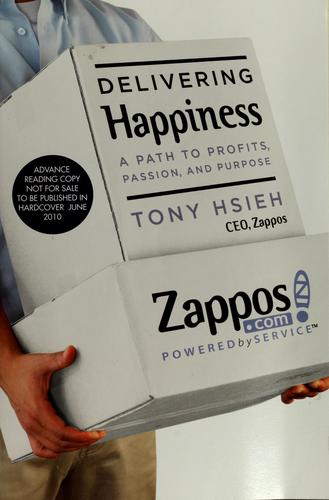
Hsieh, the late CEO of Zappos, tells the company's story from early founder hustle through to a culture built so deliberately around customer service and employee happiness that Amazon eventually acquired it largely to learn from that culture. The book argues that profits, passion and purpose can reinforce each other rather than trade off, if a business is genuinely willing to make customer happiness a core value rather than a slogan.
Customer service as the entire strategy
Hsieh's core argument inverts how most businesses treat service: not a cost centre to be minimised with scripts and average-handling-time targets, but the actual product. Zappos set no time limit on customer service calls, tracked no handle-time metric, published its phone number prominently at a moment when most e-commerce firms were burying theirs, and gave reps standing permission to do whatever a caller genuinely needed — including directing them to a competitor when Zappos didn't have the shoe. The retold stories of a rep staying on an extraordinarily long call, or sending flowers to a bereaved customer unprompted, are not presented as stunts. They are the predictable output of trusting frontline staff rather than scripting them.
The economics behind it are more deliberate than the anecdotes suggest, and this is the part worth studying. Free shipping in both directions and a 365-day returns window are, on paper, an expensive way to sell footwear. Hsieh's bet was that the real obstacle to buying shoes online was the risk of getting the size wrong, that removing the risk entirely would convert browsers into buyers, and that the resulting word of mouth would out-perform any advertising budget. Customers ordering several sizes and returning most of them was a marketing cost, booked in the wrong column.
The related decision was less glamorous and probably more important. Zappos began by drop-shipping from manufacturers and abandoned it, taking on their own warehouse despite the capital cost, because they could not control the experience if somebody else held the stock. It is the clearest statement of the book's real principle: if the customer experience is the strategy, you cannot outsource the parts of it that can go wrong.
Culture has to be built on purpose
Hsieh's second argument is that culture isn't a natural byproduct of good people getting along. It has to be explicitly defined, written down and actively defended as the company grows, or it drifts into whatever the loudest recent hires brought with them. Zappos's ten core values were developed collaboratively rather than handed down from the top, and were used as the actual operating filter for hiring, firing and promotion rather than as a poster in the break room. The annual culture book — employees writing their own unedited entries, criticism included — is offered as the proof that the values are real rather than aspirational.
The uncomfortable operational consequence is that Zappos would let go of a technically strong performer who didn't fit the values. Hsieh's contention is that a skilled hire who damages the culture costs more than their individual output is worth once the effect on everyone around them compounds — a claim most owners agree with in the abstract and almost never act on, because the individual output is measurable and the compounding damage isn't.
The hiring process was built to match. Candidates went through two separate assessments — one on whether they could do the job, one purely on cultural fit — with either able to veto, and the recruiter was explicitly not allowed to trade a strong technical score against a weak values score. Every new hire, whatever the role, went through the same weeks of call-centre training and took live customer calls, on the reasoning that a company whose strategy is service cannot have senior people who have never heard a customer complain.
The famous mechanism is The Offer: a cash payment to new recruits to quit during onboarding, no hard feelings. It started small and rose over time into the low thousands of dollars, and its purpose was self-selection — anyone who would take the money was, by definition, there for the paycheque rather than the mission, and would cost more than that in the long run. It is the single most-copied idea in the book, and it works precisely because the number is large enough to be a genuine temptation.
Profits, passion and purpose
The book's structure mirrors its argument: it moves through profits, then profits and passion, then profits, passion and purpose, and Hsieh's claim is that these compound rather than trade off. The final section is where he leaves business memoir and heads into the positive-psychology literature, drawing on the research distinguishing pleasure, engagement and meaning as the three routes to happiness — and pointing out that most businesses chase the first for their customers and offer their staff none of the three.
His applied version is a short framework: people are happier at work when they have perceived control, perceived progress, connectedness, and a sense of being part of something larger than themselves. It is not original and he doesn't claim it is, but the operational translation is genuinely useful — a call centre rep with no script has perceived control, and a rep with a handle-time target has none.
The memoir half is more engaging than most business autobiography, largely because Hsieh is candid about the near-death experiences. The worm farm and the pizza business at Harvard set up a founder who was always running experiments; LinkExchange, sold to Microsoft in 1998 for a reported $265 million, is presented not as the triumph but as the cautionary tale — a company he stopped wanting to go to, because the culture had been allowed to happen by accident. That failure is the origin of everything he did afterwards. The Zappos cash crisis of the early 2000s, when he sold his own property to make payroll, is told with the numbers left in.
What the Amazon deal actually proved, and what it didn't
The arc closes with Amazon's acquisition in 2009, a deal valued at around $1.2 billion in stock, structured to leave Zappos operating independently with its brand and culture intact. Hsieh reads this as vindication: the acquirer wanted the culture, not just the customer list. It is a fair reading, and it is also the point at which a sceptical reader should notice that the whole book is an argument whose evidence is a single case, told by the person with the most invested in that case being read a particular way.
The move to Las Vegas belongs to the same logic and is the part most readers underrate. Hsieh relocated the company out of the Bay Area partly because Las Vegas was a 24-hour city with a deep pool of people who already did customer service for a living — a genuinely strategic decision dressed up as a lifestyle one. He later committed a reported $350 million of his own money to redeveloping the surrounding downtown area, on the theory that a company's culture is downstream of the community it sits in. Whatever one makes of how that turned out, it is the most complete statement of his actual belief: that the environment produces the behaviour, and that most managers try to fix the behaviour instead.
There is a further complication the book cannot address because it predates it. The Holacracy experiment that followed in the mid-2010s — an attempt to run Zappos without conventional managers — proved genuinely divisive and prompted a substantial number of staff to take a repeat of The Offer and leave. And Hsieh's own story ended badly: he stepped away from Zappos in 2020 and died later that year, aged 46, after a period that subsequent reporting described as deeply troubled. None of this invalidates the operating principles, which stand or fall on their own. But a book whose thesis is that a well-designed culture produces happiness reads differently now, and pretending otherwise would be dishonest about what the reader is holding.
Key lessons
- Customer service can be a genuine strategic differentiator, not just a cost to minimise — Zappos built its brand almost entirely on it.
- Company culture has to be defined and defended deliberately from the very beginning; it doesn't happen by accident as a business grows.
- Employees given genuine autonomy to solve customer problems, without rigid scripts, create the kind of memorable service that turns into word of mouth.
- Hire and fire for culture fit as seriously as for skill — a skilled hire who damages the culture costs more than they contribute.
- Profits, passion and purpose can be mutually reinforcing rather than competing priorities, if the business is built around them deliberately.
Treating customer happiness as a genuine core value, backed by real autonomy and investment, can become a business's most durable competitive advantage.
What this means for a UK small business
UK service businesses — a salon, a trades firm, an independent retailer — compete against bigger players on precisely the dimension Zappos proved you can win on cheaply: how it feels to be a customer when something goes wrong. Empowering a front-of-house team to fix a problem on the spot without a manager's sign-off costs nothing and produces the kind of story that gets repeated at the school gate and in the local Facebook group far more reliably than a discount code does. Set a spending limit they can use without asking — fifty pounds, a free treatment, a redelivery — and the decisions stop landing on you.
The core-values exercise is worth doing properly rather than settling for 'we're a friendly company'. Write down what you would actually let someone go for, then check your last few hiring and firing decisions against it honestly. Most UK small businesses have never done this and default to hiring on skill and CV alone, which is exactly the gap Hsieh argues costs more than it saves.
One warning on the returns model: it works on retail margins with volume behind it. Before copying a generous no-quibble policy, run the numbers on your own gross margin and your realistic return rate, because a service business or a low-margin retailer can give away its entire profit in goodwill without ever seeing the word-of-mouth payback that made it work for Zappos.
What’s aged well
The core argument for culture and service as strategy remains widely cited and influential across small business and startup circles.
What feels outdated
Some of the specific Zappos anecdotes and the broader context around the company's later years add complexity that the book, written at an earlier high point, doesn't cover.
Where it falls short
It's a memoir by the man who built the culture, so it is naturally short on friction, disagreement and failed experiments an independent account would surface, and the second half drifts into happiness-science territory that is thinner than the business material preceding it. The evidence is a single company that succeeded, which is a survivorship problem no amount of charm resolves.
It also predates Zappos's later, more divisive Holacracy reorganisation and Hsieh's own troubled final years, neither of which fits the tidy arc. And the service-without-limits model assumes margins many small UK businesses simply don't have — the philosophy travels better than the tactics.
The Business Stuff verdict
A genuinely engaging read that makes the business case for culture and service better than most drier culture books manage.
Three things to actually do after reading it
- Write down your business's actual core values — not aspirational ones, the ones you'd genuinely fire someone over violating.
- Give your customer-facing team one new piece of genuine autonomy to solve a common problem without needing sign-off.
- Review your last hiring decision against culture fit as seriously as you reviewed it against skill.
If you liked this, read next
Five similar books
- Start with Why (Simon Sinek)
- The Culture Code (Daniel Coyle)
- Setting the Table (Danny Meyer)
- Shoe Dog (Phil Knight)
- Raving Fans (Ken Blanchard)
Common questions
Can a small business actually copy the Zappos service model?
The principles yes, the specific tactics rarely. What transfers cheaply is the part that costs nothing: giving frontline staff genuine authority to resolve a problem without escalating, removing metrics that punish them for spending time with a customer, and hiring for attitude over CV. What doesn't transfer is the economics — free two-way shipping and a 365-day returns window were funded by retail volume and venture capital, and a small firm copying the policy without the margin can give away its profit without ever generating the word of mouth that paid for it at Zappos. Take the authority, leave the returns policy.
Does 'pay people to quit' really work?
It works as a self-selection filter, and it only works if the amount genuinely tempts someone. At Zappos the offer grew into the low thousands of dollars, made during onboarding, no hard feelings — the logic being that anyone who takes it was there for the money and would have cost far more than that over a year of half-hearted work. Small businesses can run a scaled version, though the cash is often the wrong lever at that size; a franker version of the same idea is an explicit end-of-probation conversation where leaving is presented as a genuinely acceptable outcome rather than a failure.
Is the book undermined by what happened to Zappos and to Hsieh afterwards?
It complicates it rather than invalidating it, and the honest answer is that you should know before reading. The book was published in 2010. The Holacracy experiment that followed in the mid-2010s — running the company without conventional managers — was divisive enough that a significant number of staff took a repeat of the quit offer and left. Hsieh departed Zappos in 2020 and died that year aged 46, after a period reporting later described as very troubled. The operating ideas about service and hiring stand on their own evidence. What deserves scepticism is the larger promise that a designed culture reliably delivers happiness, including to the person designing it.
How long is it, and is it a business book or a memoir?
Both, roughly half and half, and it reads quickly — most people finish it in five or six hours. The first half is straight memoir: the worm farm, the Harvard pizza business, LinkExchange and its sale to Microsoft, then the Zappos cash crises. The second half turns into the culture and happiness argument, and is where the business content actually sits. It is a considerably more enjoyable read than most culture books because there's a story pulling you through, but if you only want the operating principles, the chapters on core values, hiring and the quit offer carry almost all the practical weight.