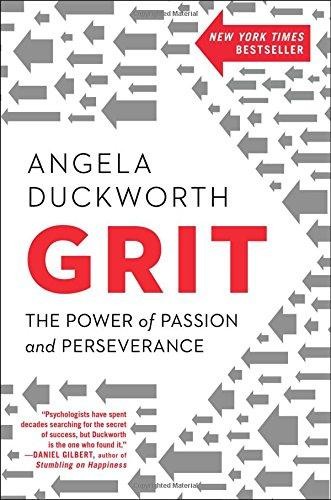
Psychologist Duckworth's research finds that 'grit' — a combination of sustained passion and perseverance toward long-term goals — predicts success better than talent alone across a wide range of fields, from West Point cadets to spelling bee contestants. The book explores how grit is built, not just identified.
Talent is not achievement, and we keep confusing them
Duckworth's research career began with an irritation: talent gets all the credit, and her data kept refusing to support it. At West Point, the Whole Candidate Score — an elaborate composite of academic, physical and leadership measures used to select cadets — turned out to predict almost nothing about who would survive the brutal summer training programme known as Beast Barracks. A short questionnaire she had written, asking about persistence and consistency of interest, predicted it considerably better. The same pattern showed up among spelling bee finalists, rookie teachers in tough schools, and salespeople.
Her explanation comes in two deliberately simple equations: talent times effort produces skill, and skill times effort produces achievement. Effort appears twice, talent once. The implication is not that talent is irrelevant — Duckworth is careful about this — but that it is systematically over-weighted, because effort is invisible and talent looks like magic. She cites Chia-Jung Tsay's studies of musicians, in which expert judges said they valued hard work over natural ability, and then rated the same performance more highly when told the player was a natural. We say we admire grafters and we reward apparent effortlessness. Duckworth calls this the naturalness bias, and its real cost is that people who don't feel gifted quietly conclude the door is shut.
Passion means direction, not intensity
The popular shorthand for grit — gritting your teeth, toughing it out, going harder — misses most of what she actually measured. Her Grit Scale has two halves, and the one people ignore is consistency of interest over years. Someone who throws themselves at a new venture every six months with enormous intensity scores low. Someone pointed in the same direction for a decade at a moderate pace scores high. Grit is a marathon trait routinely mistaken for a sprint one.
The mechanism she offers is the goal hierarchy. Low-level goals are the things on today's list; mid-level goals are the projects those serve; at the top sits one goal functioning as a compass — the thing everything below it is ultimately in service of. Gritty people, in her account, have an unusually clear top-level goal and are unusually ruthless about everything beneath it. They abandon tactics constantly. What they don't do is change the compass. That reframing matters, because it makes quitting a specific job, product or method entirely compatible with grit; what isn't compatible is a top-level goal that resets every year.
How interest is actually built
Duckworth spends real effort demolishing the idea that passion arrives fully formed. Follow-your-passion advice assumes the passion is already there, findable, waiting to be uncovered. Her interviews with people at the top of demanding fields describe something much less romantic: a mildly interesting early exposure, followed by years of active development, during which the interest deepened because they got better at it and came to understand it more richly.
She sets out four psychological assets that develop roughly in order. Interest comes first — you have to genuinely enjoy some part of it, and discovery here requires experimentation rather than introspection. Then practice, and specifically the deliberate kind. Then purpose: the conviction that the work matters to people other than you, which is what carries an interest through the years when it stops being fun. Then hope — not optimism that things will work out, but the belief that your own effort can change the outcome, which is what gets you through setbacks rather than around them. The sequence is useful diagnostically. An owner who has lost motivation usually hasn't lost interest; they've lost purpose or hope, and those are different problems with different fixes.
Deliberate practice, and why it feels bad
Drawing heavily on Anders Ericsson's work, Duckworth distinguishes practice from deliberate practice. Most people, once competent, simply repeat what they can already do — more rounds of golf, more of the same sales calls. Deliberate practice means identifying a specific weakness, working at the uncomfortable edge of current ability, getting immediate feedback, and repeating the bit you are bad at until it improves. Then choosing a new weakness.
She is honest about the catch, which is that deliberate practice is unpleasant. Her own research found experts rated it as highly effortful and distinctly not enjoyable — while rating the flow states they experience during performance very highly indeed. Deliberate practice is what buys the flow; it does not feel like it at the time. Her practical advice is to stop trying to make it enjoyable and instead make it habitual: same time, same place, every day, so it starts before your reluctance has time to argue.
Hope, and the psychology underneath it
The fourth asset, hope, is where Duckworth's own academic lineage shows — she did her doctoral work under Martin Seligman, whose research on learned helplessness established that animals and people who repeatedly experience setbacks they cannot influence stop trying even once the situation changes. Hope, in this tradition, is not cheerfulness. It is the learned expectation that your effort connects to the outcome, and it can be trained or destroyed by experience.
She ties this directly to Carol Dweck's work on mindset. A fixed mindset — treating ability as a quantity you either have or don't — makes every setback a verdict on you, and the rational response to a verdict is to stop. A growth mindset treats the same setback as information about method, and the rational response to information is to adjust and try again. Duckworth's chain runs growth mindset to optimistic self-talk to perseverance over adversity, and each link is trainable.
The practical version is unromantic: what you say to yourself after something goes badly is a habit, and habits can be rewritten. "I'm not built for this" and "that approach didn't work" describe the same event and produce entirely different next weeks. For a founder, this is the most immediately usable idea in the book, because the setbacks are guaranteed and the interpretation is the only variable you control.
Growing grit from the outside in
The final section is the most useful for anyone running a team, because it argues that grit is substantially environmental rather than fixed. Reviewing the parenting research, Duckworth lands on the combination that works: demanding and supportive at the same time — high standards paired with genuine warmth and explanation, rather than either soft encouragement or hard pressure alone. The same quadrant describes good managers and good coaches.
Her family's Hard Thing Rule is the concrete mechanism. Everyone, adults included, commits to one difficult thing requiring deliberate practice. You may not quit on a bad day, only at a natural end point — the season, the term, the contract. And you choose your own hard thing. It builds exactly the capability the book is about, without turning persistence into someone else's imposition.
Her last argument is the one with the most leverage: the most reliable way to become grittier is to join a group where grit is simply the norm. Identity does work that willpower cannot. "I'm the sort of person who finishes things" survives a bad week far better than a resolution does, and inside a team that expectation turns out to be contagious in both directions.
Key lessons
- Grit — sustained passion plus perseverance over years, not intensity in a single burst — predicts achievement better than raw talent.
- Talent without effort is only potential; effort applied consistently is what actually converts potential into achievement.
- Interest has to be developed and deepened over time, not just discovered once and assumed to be permanent.
- A 'hard thing' rule — deliberately choosing to stick with something difficult rather than switching at the first setback — builds grit over time.
Long-term success is driven more by sustained passion and effort over years than by raw talent — which means grit, unlike talent, is something you can deliberately build.
What this means for a UK small business
For an owner three or four hard years in and still not "there", the most useful reframe in the book is that the flat, unglamorous grind is the predictor rather than a symptom of something being wrong. Duckworth's data says the ventures that compound are the ones pursued in the same direction through the boring middle, not the ones abandoned for the next promising idea. The goal-hierarchy distinction is what stops that becoming an argument for stubbornness: changing the service, the pricing or the target market is a tactical change and entirely compatible with grit. Changing what the business is ultimately for, every eighteen months, is not.
It is also a better hiring lens than most small firms use. Instead of scanning a CV for job titles, ask a candidate about something they stuck with through a stretch that was difficult and dull — a qualification taken while working full time, a side project, a sport. What you learn is whether they persist once the work stops being fun, which is the thing that actually matters in a small team where nobody can hide.
And the demanding-plus-supportive quadrant is a fair test of your own management. Most owner-managers over-index on one side: high standards with no warmth, or plenty of warmth with standards that quietly slipped years ago.
What’s aged well
The research remains widely cited, though some of the specific measurement claims have faced the same replication scrutiny common across psychology research generally.
What feels outdated
Nothing significant given recent publication and continued relevance.
Where it falls short
Grit has taken real academic fire since publication. Later meta-analyses found its predictive power considerably smaller than the book's framing implies, and critics have argued persuasively that it overlaps heavily with conscientiousness — a trait psychology already had a name for and a much longer evidence base on. Duckworth herself has publicly pushed back on some of the more sweeping applications, particularly in schools.
The book also under-addresses circumstance. Sticking with one path for a decade is a far easier prescription for someone with savings and a supportive household than for someone one bad month from real trouble, and the implicit reading — that people who don't persist simply lacked grit — does not survive contact with that. There is padding, too: the core argument is largely made by the halfway point.
The Business Stuff verdict
A well-argued, research-grounded case for perseverance as a genuinely trainable trait, not just a fixed personality quirk.
Three things to actually do after reading it
- Identify one long-term goal you've switched away from at the first real setback, and consider recommitting deliberately.
- Apply the 'hard thing' rule — pick one difficult pursuit and commit to finishing what you start with it.
- Revisit and deepen an existing business interest rather than chasing a new one at the first sign of difficulty.
If you liked this, read next
Five similar books
- Mindset (Carol Dweck)
- Can't Hurt Me (David Goggins)
- The Obstacle Is the Way (Ryan Holiday)
- Atomic Habits (James Clear)
- Man's Search for Meaning (Viktor Frankl)
Common questions
What is the single most useful idea for a small business owner?
The goal hierarchy, used as an audit of where the week actually went. Take an illustrative example: an owner logs a 46-hour week and sorts it into buckets. Seventeen hours delivering client work, nine on quotes and invoices, eight firefighting things that went wrong, six in meetings that could have been emails, four on general email, and two on the thing that is supposedly the point of the whole business. Price the owner's time at a modest £60 an hour and that week put £120 behind the top-level goal and £2,640 behind everything else. Duckworth's argument is not that you should work more hours. It is that grit is consistency of direction, and two hours in forty-six pointing at the goal is not persistence — it is drift with a strong work ethic attached to it.
Given all the criticism, is grit actually a real thing?
Real, but considerably smaller than the book implies. Meta-analyses published since 2016 have found grit's correlation with performance notably weaker than the popular framing suggests, and psychologists have argued convincingly that it overlaps heavily with conscientiousness, a trait the field had already been measuring for decades. Duckworth herself has pushed back on schools using grit scores to sort children. What survives the criticism is the practical core: sustained direction beats episodic intensity, deliberate practice beats mere repetition, and the interpretation you put on a setback changes what you do next. Read it as a well-argued case for those three things rather than as the discovery of a new human trait.
Doesn't this just encourage people to flog a dead horse?
It would, if passion meant sticking with a particular tactic — but Duckworth's own framework says the opposite. Her goal hierarchy separates the top-level goal, which should hold steady for years, from everything beneath it, which should be abandoned the moment it stops working. Gritty people in her research change methods constantly. An owner who kills a failing product line, drops an unprofitable service or exits a bad market while pursuing the same underlying aim is behaving exactly as the book prescribes. What it argues against is resetting the aim itself every eighteen months, which is a different failure entirely and a far more common one among people who describe themselves as entrepreneurial.
Can you actually hire for grit?
Not from a questionnaire — the Grit Scale is transparently self-reported and any candidate can see which answers look good. What works better is asking about a stretch that was difficult and boring rather than difficult and dramatic: a qualification finished while working full time, a sport trained at for years with no prospect of being good at it, a project continued long after the initial enthusiasm wore off. Then ask what nearly made them stop, and what they did instead. You are listening for how setbacks were interpreted — as verdicts or as information — because that is the trainable part, and it is what predicts what happens in month seven of a hard job.