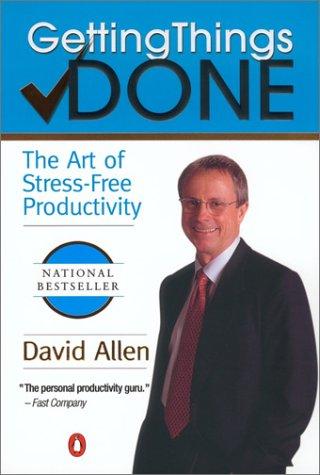
Allen's GTD methodology is built on a simple premise: your mind is for having ideas, not holding them — once every commitment is captured in a trusted external system and clarified into next actions, mental clutter and background anxiety drop dramatically, freeing capacity for actual focused work.
Your mind is for having ideas, not holding them
The premise Allen builds everything else on is that the human mind is a spectacularly bad office. It reminds you of things at random — the supplier you meant to chase surfaces at 3am, not at your desk — it has no sense of priority, and it cannot tell the difference between a commitment you made to a paying client and one you made to yourself about clearing the garage. Both sit there with roughly equal weight. Allen calls these open loops: anything you have told yourself you should, might or must do that has not been either finished or captured somewhere reliable. Each one runs as a background process, and the sum of them is a low, unattributable hum of unease that cannot be resolved by doing any single item on the list, because no single item is what's causing it.
The load-bearing word in GTD is trusted. Allen is emphatic that a half-kept system is worse than no system at all, because the mind keeps running its own parallel copy as insurance the moment it has any reason to doubt the external one — and then you are carrying both the anxiety and the admin. This is why the rules that read as pedantic on a first pass matter more than they look: everything goes in, no exceptions; every captured item gets processed to an actual decision rather than just re-read and put back; the whole thing gets reviewed on a fixed schedule whether it feels necessary or not. They are not tidiness for its own sake. They are the price of the psychological release the method is really selling. Most people who conclude GTD doesn't work never got it to the point where their own mind believed it.
What Allen is offering, then, isn't really a productivity system in the get-more-done sense. His stated goal is a state he calls mind like water — a response proportionate to whatever is in front of you, no more and no less, with nothing left over rattling around behind it. The measure of success isn't output. It's how little you're carrying. That reframing is worth holding onto, because it explains why GTD feels like unusually heavy machinery for what is nominally a to-do list. It isn't trying to make you faster. It's trying to make your head quiet enough to think properly.
Capture, clarify, organise, reflect, engage
The five-stage workflow is the engine, and the stages are deliberately separated because collapsing them is the classic failure. Capture means getting every task, idea, worry and commitment out of your head and into an in-tray the moment it appears, with zero filtering, sorting or judgement — the whole point is that capture has to be frictionless enough that you'll do it when you're busy, tired or mid-conversation. Allen wants as few in-trays as you can manage and all of them emptied regularly, which is a different thing from read regularly.
Clarify is where the real work happens, and it runs as a decision tree. Is this actionable? If no, it's rubbish, reference material, or a someday/maybe — three different destinations, none of them your task list. If yes, what is the very next physical action? If that action takes under two minutes, do it now, because tracking it will cost more than doing it — the famous two-minute rule, which is less a productivity hack than an argument about overhead. Otherwise, delegate it and record it on a waiting-for list, or defer it onto a next-actions list. And if the thing needs more than one action to finish, it isn't a task at all, it's a project, and it goes on a projects list — but it still needs a single next action defined, or it will sit there indefinitely.
Organise means putting each output in a discrete, single-purpose bucket. The calendar is sacred and holds only things that genuinely must happen on that day or at that time — no aspirational scheduling, because a calendar you routinely fail to honour is a calendar you stop believing. Next actions are grouped by context — calls, errands, at the computer, agenda-for-Sarah — so that whatever situation you find yourself in, you can see only the things that are actually possible right now. Waiting-for is tracked separately, with dates. Reference material lives somewhere else entirely; Allen is strict about this, because the single most common shape of a broken list is one that's half tasks and half articles you meant to read.
Engage is the doing, and Allen's answer to how you prioritise is deliberately deflationary: in the moment, you choose by context, then time available, then energy available, and only then by priority. If you have eleven minutes and a train seat, the question isn't what's most important in your life, it's what on this list can actually be done in eleven minutes on a train.
The next-action question is the actual engine
If you took one thing from the book, it should be this. The gap between "plan the launch" and "draft three subject lines for the launch email" looks trivial and isn't. The first is a project wearing a task's coat. Every time your eye passes over it, your brain does an unconscious cost estimate, fails to find a starting point, feels a small flinch, and moves on to something easier. Do that twice a day for six weeks and you have a list that you have trained yourself to ignore — which is precisely how people end up with a beautifully maintained system they no longer open.
Allen's reframing here is genuinely useful: a lot of what gets diagnosed as procrastination is actually a definition problem, not a willpower problem. The test he offers is physical and visual — you should be able to picture yourself doing the action, know where you'd be, and know what you'd have in your hand. "Sort the insurance" fails that test. "Find the renewal letter in the top drawer" passes it, takes ninety seconds, and unblocks the thing that's been nagging for a month.
The same discipline sharpens delegation, which is where most owners are vaguest. "Ask Dave about the quote" becomes a waiting-for entry with a date attached, so that the follow-up is a system's job rather than something you have to remember to remember. Applied consistently, this is the difference between a business where things get chased and one where things quietly get dropped and nobody can say when.
Altitude, planning, and the review that holds it all up
Alongside the workflow, Allen offers two structural ideas that get less airtime and deserve more. The first is the natural planning model: purpose, principles, outcome, brainstorming, organising, next actions — the sequence, he argues, that your brain already uses whenever it plans anything successfully, including deciding to go out for dinner. Most formal business planning inverts it, starting with a template or a Gantt chart and only arriving at why we're doing this somewhere near the end, if at all. The second is his horizons of focus: runway (current actions), then projects, then areas of responsibility, then one-to-two-year goals, then three-to-five-year vision, then purpose. His genuinely useful, slightly deflating observation is that most people trying to fix their life from 50,000 feet would get more out of clearing the runway first.
And then there is the weekly review, which is the part everyone nods at and nobody does. Allen breaks it into three moves: get clear (empty every in-tray to zero), get current (walk the project list, the next-action lists, the waiting-fors, and the calendar both backwards and forwards a couple of weeks), and get creative (look at someday/maybe and see if anything wants promoting). It typically takes an hour or two. It is the single point at which stale items get killed, orphaned projects get a next action, and the system earns back the trust it spends during the week.
Skip it consistently and GTD decays quietly rather than dramatically. The lists stay there. They just stop being true, your mind notices before you consciously do, and it resumes carrying the load itself. That is the exact failure state the whole apparatus was built to prevent, which is why Allen is blunt that the review isn't an optional refinement — it's the thing you are actually buying.
Key lessons
- Capture every commitment, task and idea in a trusted external system — nothing should be relying on memory alone.
- Clarify captured items into a concrete next physical action, not a vague intention — 'plan the launch' isn't actionable, 'draft launch email' is.
- Organise next actions by context (calls, computer, errands) so you can act on whatever's realistic in the moment.
- A weekly review keeps the whole system trustworthy — without it, the system quietly decays and stops being reliable.
Mental clutter from unclear, uncaptured commitments creates background stress that quietly drains focus — a trusted external system removes that drag entirely.
What this means for a UK small business
An owner running client work, a couple of staff, suppliers, quotes and their own admin genuinely is holding dozens of open loops at once, with no PA and no chief of staff to absorb any of it. The capture habit is the cheapest possible fix for the I-know-I'm-forgetting-something feeling that comes with that: one inbox, everything in it, decided later. It costs nothing and works within a week.
The next-action discipline is worth pointing squarely at compliance and admin, which is where vague tasks go to rot in a small business. "Sort the pension" has probably been on someone's list since spring; "email the provider to confirm our re-enrolment date" gets done before lunch. Same for "do something about the VAT", "chase the aged debtors", "look at the insurance renewal" — all projects, none of them tasks, all of them dodgeable indefinitely until they're written as a single physical action.
The weekly review is the piece that maps onto how a small firm actually runs. An hour on a Friday afternoon walking the job list, the waiting-fors and the next fortnight's calendar catches the client who's gone quiet, the quote nobody followed up and the deadline that's closer than it felt — which is exactly the set of things that otherwise become next month's emergency.
What’s aged well
The core capture-clarify-organise-review methodology remains a gold standard, widely adapted into modern task management tools.
What feels outdated
Some of the original physical filing system advice needs translating to digital tools, though the underlying logic transfers directly.
Where it falls short
Set-up is genuinely heavy — Allen suggests a two-day initial pass to get everything captured and processed, which most readers never do, and the method only really pays out once it's complete. The weekly review is then a permanent tax that most people abandon inside a couple of months, at which point you have the overhead without the trust. The book is also from 2001, and while the workflow logic has aged well, the implementation chapters are full of physical filing, labellers and software of the era that need real translating to a modern toolkit. And GTD is deliberately near-silent on prioritisation between projects: it's superb at making sure nothing is dropped, and much weaker on whether the things you're diligently not dropping are worth doing at all.
The Business Stuff verdict
A genuinely comprehensive system — takes real effort to set up properly, but repays that effort for anyone drowning in loose commitments.
Three things to actually do after reading it
- Do a full 'mind sweep' this week — capture every open commitment currently living only in your head.
- Convert your top five vague to-do items into specific, concrete next physical actions.
- Schedule a fixed weekly review slot to keep your task system trustworthy rather than letting it decay.
If you liked this, read next
Five similar books
- The One Thing (Gary Keller & Jay Papasan)
- The Checklist Manifesto (Atul Gawande)
- Eat That Frog! (Brian Tracy)
- Essentialism (Greg McKeown)
- Deep Work (Cal Newport)
Common questions
Is Getting Things Done still worth reading now the tools have all changed?
Yes, because the part that matters is tool-agnostic. Capture, clarify, organise, reflect, engage is a decision process rather than a piece of software, and it maps onto Todoist, Things, a Notion database or a paper notebook without modification. What has dated is the implementation detail — Allen's chapters on physical filing cabinets, label makers and the software of 2001. The 2015 revised edition updates most of those references without touching the method, so buy that one. If you already own a digital task manager you half-use, this book is mainly a long argument about how to feed it properly, and that argument has not aged at all.
Can I get anything out of GTD without setting up the whole system?
Yes, and most people should start there. Three pieces work immediately in isolation: one capture inbox that everything goes into, the two-minute rule, and rewriting every stalled item on your list as a concrete next physical action. That alone unsticks a surprising number of tasks that have been sitting there for months. What you will not get is the thing Allen is actually selling — the mental quiet that comes from a system complete enough that your brain stops keeping its own backup copy. That requires the full capture, the full processing and the weekly review, because there is no partial version of trust.
How is GTD different from time-blocking or the Eisenhower matrix?
They solve different problems and pair well. GTD is a capture-and-decide system: exceptionally good at making sure nothing is dropped and every commitment has a defined next step, and deliberately near-silent on whether those commitments are worth having in the first place. Prioritisation methods like the urgent/important matrix start roughly where GTD stops — they assume you already know what is on your plate and want to rank it. Plenty of people run GTD as the intake layer with something else on top for choosing. Running a prioritisation method with no capture system underneath it is where most people come unstuck.
How long does it take to set up properly?
Allen suggests blocking out two full days for the initial pass — collecting every loose commitment from every drawer, inbox and mental corner, then processing the pile item by item to a decision. Most people never do it, and that is the single biggest reason GTD gets abandoned: a half-captured system does not earn trust, so the mind keeps duplicating it and you carry the admin without the relief. If two days is unrealistic, a defensible compromise is one long Saturday for the capture and a couple of evenings to process it, followed by a genuine weekly review from that point onwards.