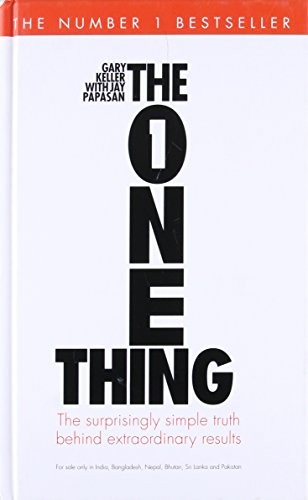
Built around one repeatable focusing question — 'what's the one thing I can do such that by doing it, everything else becomes easier or unnecessary' — Keller and Papasan argue that success comes from narrowing focus to a single priority at a time, not from spreading effort across many goals simultaneously.
The question, and the domino behind it
Keller and Papasan build an entire book around a single sentence: what is the ONE thing I can do such that by doing it everything else will be easier or unnecessary? Read quickly, it sounds like ordinary prioritisation advice. Read properly, it is not. 'What is most important?' produces a ranked list. This question demands a causal claim — which action, once taken, makes other items on the list shrink or disappear entirely. Those are different questions, and they usually have different answers.
The image behind it is a line of dominoes. A domino can topple one roughly half again its own size, so a small first tile, given a long enough line, eventually knocks over something enormous. The authors' argument is that most people spend their working lives pushing on separate dominoes scattered across a field rather than lining them up. Do five unrelated useful things this week and you get five useful things. Do the right first thing and you get a chain.
They split the question into two versions, and the second is the more useful. The big-picture ONE Thing — what is my ONE Thing? — sets direction. The small-focus version — what is my ONE Thing right now, this quarter, this week, this morning? — sets action. Answer only the first and you have a mission statement. Answer only the second and you have a busy, directionless week. The book insists on both, connected.
The six lies
Part one is structured as six false beliefs the authors say stand between people and results, and it is the section with the most teeth.
Everything matters equally. It does not, and the tell is that to-do lists treat items as equal weight when they never are. Their fix is to run Pareto past its usual stopping point: do not settle for the 20% that produces most of the value, keep applying the filter to that 20% until you are down to one.
Multitasking. There is no such thing as attending to two things at once; there is only rapid switching, and switching costs time and accuracy. This is the least original chapter — the point is by now well established — but it is made cleanly and briefly.
A disciplined life. The claim here is genuinely counterintuitive. Successful people are not more disciplined across the board; they have used a burst of discipline to install a small number of habits which then run without further effort. You need discipline long enough to build the habit, not forever. The authors put habit formation at around 66 days on average, citing published research rather than the folk figure of 21 days.
Willpower is always on call. Their position is that willpower is a resource that depletes over the course of a day, so the ONE Thing should be scheduled when it is at its highest — usually first thing — rather than left for the exhausted end of the afternoon. The practical advice survives even if you are sceptical of the underlying psychology.
A balanced life. The most contentious chapter, and the one owners react to most. Keller and Papasan argue that extraordinary results require periods of deliberate imbalance, where one priority takes disproportionate attention and other things run at good-enough. The goal is counterbalancing — returning to the neglected things before they break — rather than a permanently even split. They draw a useful distinction between work counterbalance, where you can go long and hard between corrections, and personal counterbalance, where the gaps must be short because relationships and health do not tolerate extended neglect.
Big is bad. Their answer to fear of scale: thinking big costs nothing, and the ceiling you set for yourself is usually the ceiling you hit.
Goal setting to the now
The most practically useful chapter, and the one readers remember. It is a chain worked backwards: someday goal, five-year goal, one-year goal, monthly, weekly, daily, and then what am I doing right now. At every step you ask the same question — based on that, what is the ONE thing I can do this month such that the year's goal becomes easier or unnecessary?
What makes it work is that it forces the abstract and the immediate into contact with each other. Plenty of owners have a five-year ambition and a full Tuesday with no traceable line between the two. Running the chain makes the absence of that line obvious, which is uncomfortable and useful in equal measure. If you cannot derive this morning's first task from the five-year goal, either the goal is not real or the morning is not.
Better questions, and the three commitments
Between the lies and the mechanics sits a chapter on the quality of the answer you give the focusing question, and it is more useful than it first appears. The authors grade answers into three kinds. A doable answer is one already within reach of your current skills and knowledge — it is safe and it changes very little. A stretch answer is at the top end of what you could manage, and it moves things. A possibility answer sits beyond what anybody currently knows how to do, and finding it means going outside your own head: looking at what the best in the field are already doing, reading the research, and asking people who have solved the problem before. Their point is that most people answer the focusing question honestly and still get a mediocre result, because they only ever consider answers they already had.
The three commitments follow. Mastery, framed as a path you stay on rather than a destination you reach, which is what justifies giving the same activity a protected block every day for years. Moving from E to P — from the entrepreneurial default of doing something the natural way, at the ceiling of your instinct, to a purposeful approach where you deliberately find a better model and adopt it, which is what breaks through a plateau. And living the accountability cycle rather than the victim cycle: the difference between the person who, when the number is missed, looks for what they will do differently, and the one who explains why it was never possible. The chapter is standard motivational fare in places, but the E-to-P distinction is genuinely sharp and it names something most owners can recognise in themselves.
Time blocking, and the four thieves
The central instruction is mechanical rather than philosophical: block time for your ONE Thing in the diary before anything else gets in, treat the block as no more breakable than a meeting with your most important client, and defend it when it is attacked. Their suggested dose is four hours a day, early — more than most owners will realistically manage, but the principle survives being scaled down to ninety minutes. Anything left to compete for leftover time against reactive daily demands loses every time, because reactive demands arrive with somebody else's urgency already attached to them.
Two refinements are worth having. Block rest before you block the work, so the year has its holidays in it before the diary fills. And block a weekly planning hour, which is the review that keeps the goal chain from the previous section honest rather than aspirational.
The four thieves of productivity close the book. An inability to say no. A fear of chaos — because focusing hard on one thing means visibly letting other things pile up, and most people flinch at that. Poor health habits, which drain the energy the block runs on. And an environment, physical and social, that does not support the goal. The chaos one is the sharpest and the least discussed. If you protect a block properly, other things genuinely will slide, and the authors' point is that this is the price of the method, not evidence that it is failing.
Key lessons
- The focusing question — what's the one thing that makes everything else easier or unnecessary — cuts through a cluttered priority list fast.
- Multitasking is largely a myth; genuine focus on one thing at a time produces better results than switching between many.
- Time-block your most important 'one thing' first, protected, before the rest of the day fills in around it.
- Success is sequential, not simultaneous — going small on the right thing beats going broad on many things at once.
A single well-chosen focusing question — what's the one thing that makes everything else easier — cuts through competing priorities faster than any elaborate planning system.
What this means for a UK small business
The focusing question is a genuinely fast Monday-morning diagnostic. Of everything on this week's list, what is the one thing that, done, would make several other items unnecessary or trivial? For a lot of owners the honest answer is something like 'put the prices up', 'sack the client who eats a day a week', or 'hire the second pair of hands' — a domino that, once tipped, removes a dozen smaller frustrations rather than adding a thirteenth task.
The deliberate-imbalance idea also gives owners permission for something they usually feel guilty about: letting several things run at good-enough for a quarter while one genuinely important project gets disproportionate focus. A new service line, getting the bookkeeping straight, recruiting a manager — these do not get done in the gaps between other work, and pretending otherwise is why they sit on the list for two years.
Where UK owners have to adapt the method is the four-hour block. If you are the person who answers the phone, that is not available. The workable version is ninety protected minutes before opening, with the phone diverted and the block in the shared calendar so the team can see it — and the weekly planning hour on a Friday afternoon, which is the piece owners skip and then wonder why the chain broke.
What’s aged well
The core focusing question remains a widely used, practical tool referenced across productivity and business writing.
What feels outdated
Nothing significant; the core idea is simple enough not to date.
Where it falls short
The core idea is one sharp tool wrapped in a full-length book, and the padding shows. Chapters restate the same point with fresh anecdotes, several drawn from the authors' own estate agency business, Keller Williams, in ways that do not generalise cleanly to other sectors.
The research is also thinner than the confident tone suggests. The willpower-depletion material leans on ego-depletion psychology that has struggled badly to replicate since the book was published, and the habit-formation figure is presented with more precision than the underlying study supports — the research it comes from found enormous variation between individuals, not a reliable 66-day rule.
Read it for the focusing question, the goal chain and the time-blocking discipline. The rest is skimmable without loss.
The Business Stuff verdict
A simple, memorable tool that's easy to actually apply, even if the surrounding book repeats the idea at some length.
Three things to actually do after reading it
- Ask the focusing question about your business right now, and write down the honest answer.
- Time-block your identified 'one thing' first in the day, before anything else fills the calendar.
- Review your task list and cut anything that isn't genuinely in service of your current one thing.
If you liked this, read next
Five similar books
- Essentialism (Greg McKeown)
- Deep Work (Cal Newport)
- Eat That Frog! (Brian Tracy)
- Getting Things Done (David Allen)
- Atomic Habits (James Clear)
Common questions
Is The One Thing just one good idea stretched into a book?
Largely, yes — and knowing that in advance makes it a better read. The focusing question, the domino image, the goal chain from someday back to right now, and the time-blocking chapter are the book. That is perhaps eighty pages of genuine material inside a three-hundred-page package, and much of the rest restates the point with fresh anecdotes, a lot of them drawn from the authors' own estate agency business. If you want the argument rather than the reinforcement, read the opening section and the time-blocking chapter properly and skim the middle. Few people who actually applied the question call it a waste, but plenty finish feeling the point arrived early and then waited for them.
Is the 66-day habit claim in the book reliable?
No, not as stated. The figure comes from a University College London study led by Phillippa Lally, which asked people to adopt a simple daily habit and tracked how long it took to feel automatic. The median landed around 66 days, but individual results ranged from under three weeks to well over two hundred days, depending on the person and the difficulty of the habit. Quoting the median as though it were a rule is exactly the sort of tidying-up self-help books do routinely. The practical takeaway — expect a new discipline to need a couple of months of protection rather than a fortnight — is sound. The apparent precision is not.
Can you really time-block when customers ring all day?
You can, but not the four-hour morning block the book describes. In a shop, a salon or a trade, the version that survives contact with reality is smaller and earlier: ninety protected minutes before the phones start, one or two days a week, with somebody genuinely covering rather than nominally covering. The book's own defence is worth taking seriously — a block only holds if you decide in advance what is allowed to break it, and almost nothing qualifies. Where owners actually fail is not the concept but the recovery: one interrupted block gets treated as proof the whole idea does not work here. Rebooking it the same day is the discipline that matters.
Do I need this if I have already read Deep Work or Essentialism?
Probably not all three. They are the same argument at different altitudes: Essentialism on choosing what to abandon, Deep Work on the cognitive case for uninterrupted concentration, and The One Thing on a single repeatable question plus the calendar habit that protects the answer. Keller and Papasan are the most immediately practical and the least rigorous of the three; Newport is the most evidence-led; McKeown is the best on saying no. If you want a tool rather than a theory, this is the one to pick up. If you have read the other two and actually applied them, this will feel familiar and you can lift the focusing question in five minutes.