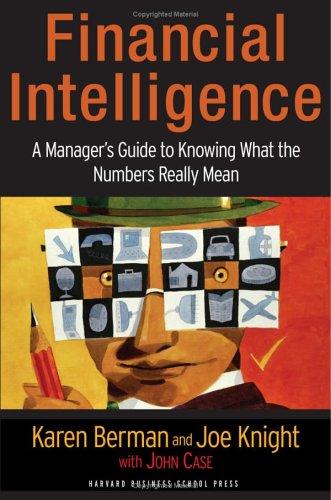
Written for managers without formal finance training, this book explains the logic and genuine limitations behind financial statements — including the judgement calls and assumptions baked into every number — so readers can interpret their own accounts with real confidence instead of taking them as objective fact.
Finance is an art, and the art is where the judgement hides
Berman and Knight's opening argument is quietly subversive: financial statements are not measurements. They are estimates, assembled from judgement calls made by fallible people working within a set of rules that permit a considerable range of defensible answers. The authors are not accusing anyone of fraud. They are pointing out that the moment you accept a number is the product of a decision, you can start asking who decided, on what basis, and what would change if they had decided differently.
They identify three places where the judgement lives, and it's worth knowing them by name. The first is revenue recognition — when exactly a sale counts. A twelve-month contract billed upfront, a long job invoiced in stages, a subscription cancelled in month three: each has a defensible answer and the answer materially changes this year's profit. The second is what counts as a cost now versus an asset to be written down over time. Capitalise a spend and this year looks better; expense it and it doesn't. The third is estimates and assumptions proper — depreciation schedules, bad-debt provisions, how overhead gets allocated across departments or product lines.
The matching principle sits underneath all of it: costs should be matched to the revenue they helped generate, which is why accruals exist and why the profit figure is always, unavoidably, an opinion about timing. The authors' framing — that finance's own practitioners know this perfectly well and non-financial managers usually don't — is what turns their book from a glossary into something more useful. Reading accounts with appropriate scepticism is a different skill from reading them at all, and it's the one that lets you push back on a number instead of nodding at it.
Joe Knight's day job as CFO of a real manufacturing business runs through the examples, which keeps the book anchored in decisions someone actually had to make rather than textbook abstractions.
Three statements, three different questions
The practical spine of the book is teaching a non-financial manager to stop treating the income statement, balance sheet and cash flow statement as three versions of the same answer. They answer three genuinely different questions: did we make a profit on paper over this period, what do we own and owe at this exact moment, and did cash actually move.
On the income statement they push readers past the top and bottom lines to the middle. Gross profit tells you whether the thing you sell makes money at all. Operating profit — revenue less cost of sales less operating expenses, before interest and tax — is the honest measure of how the business itself performs, stripped of how it happens to be financed and what the tax position is. Two businesses with identical operating profit can report wildly different net profit purely because one is loaded with debt.
The balance sheet gets the same treatment. Assets equal liabilities plus equity is an identity, not an insight; the insight is that equity is not cash, book value is not market value, and goodwill on an acquisition is a plug figure representing what someone paid over the value of the identifiable assets. Retained earnings are not sitting in the bank waiting for you.
The cash flow statement is the one they most want readers to take seriously, split into cash from operations, investing and financing. The split matters: a business showing healthy total cash movement because it borrowed or sold an asset is in a completely different position from one generating cash from trading, and only the operations line tells you whether the business works. Their signature worked example is a company whose sales are growing and whose profit is real, and which nevertheless runs out of money — because growth means buying stock and paying staff before customers pay you, and every extra pound of sales widens the gap. Profit and cash are not the same thing, and a growing, profitable business is one of the most common ways to go under. If the reader takes one idea from the book, the authors clearly want it to be this one.
They are also usefully sceptical about EBITDA, which they treat as a number invented to make businesses look better than they are. Stripping out interest, tax, depreciation and amortisation removes real obligations and real wear on real assets, and calling the result a proxy for cash flow is, in their phrase, an abuse of the term. Machines wear out whether or not you excluded the depreciation.
Ratios only mean something next to something else — and the cash cycle
A ratio in isolation is close to meaningless. Berman and Knight insist on two comparisons before any number is allowed to mean anything: against your own trend over time, and against others in your specific industry, because acceptable margins, stock turns and debtor days vary enormously by sector. A gross margin that would be alarming in a professional services firm is entirely normal in food retail.
They group ratios into families — profitability, leverage, liquidity and efficiency — and then spend their most useful pages on the efficiency ones, because those are the levers an operating manager can actually pull. Days sales outstanding is how long customers take to pay. Days inventory outstanding is how long stock sits. Days payable outstanding is how long you take to pay suppliers. Put them together and you get the cash conversion cycle: DSO plus DII minus DPO, the number of days your money is tied up in the business before it comes back.
It's a genuinely actionable formula because every term is something you can influence. A business collecting in 55 days, holding 40 days of stock and paying suppliers in 30 has a 65-day cash cycle — meaning it is funding just over two months of trading out of its own pocket, permanently, and every pound of growth makes that hole bigger. Pull collections to 35 days and stock to 30 and the cycle drops to 35 days, releasing cash without selling a single extra unit. That is the same lesson as the cash flow chapter, expressed as something you can put on a monthly dashboard.
The section on return on investment is the other genuinely practical part, and it demystifies three tools non-financial managers are usually shown and rarely taught. Payback period asks how long until the spend returns itself, and is crude but honest. Net present value asks what a stream of future cash is worth in today's money once you accept that a pound in three years is worth less than a pound now. Internal rate of return expresses the same calculation as a percentage so it can be compared against the cost of borrowing. Berman and Knight's contribution is less the maths than the warning that all three run on estimated future cash flows supplied by whoever is proposing the project — so the sensitivity of the answer to those assumptions matters far more than the decimal places in the output.
Financial intelligence as something the whole company has
The final section argues that all of this is wasted if it stays in the finance function. Berman and Knight are open advocates of a version of open-book management: share the real numbers with the people whose daily decisions move them, teach them what the numbers mean, and connect individual roles to the figures they influence. Their argument is straightforwardly commercial rather than sentimental — a warehouse manager who understands what days-of-stock does to cash makes different ordering decisions, and a salesperson who understands gross margin stops discounting to hit a revenue target.
They define financial intelligence as four skills stacked on each other: understanding the foundation (what the statements are), understanding the art (where the judgement calls sit), understanding analysis (ratios and return on investment), and understanding the big picture (how the economy, the industry and the context change what the numbers mean). It is a deliberately unglamorous definition, and the book's real achievement is that a reader who does the work genuinely acquires all four.
Key lessons
- Financial statements involve real judgement calls and assumptions, not objective, indisputable fact — knowing where those live matters.
- The difference between the income statement, balance sheet and cash flow statement, explained without jargon, changes how you read all three.
- Ratios only mean something in context — compared to your own trend over time and to your specific industry, not in isolation.
- Working capital management is where a lot of otherwise-profitable small businesses quietly run into trouble.
Financial statements are built on judgement calls, not pure objective fact — genuinely understanding where those judgement calls sit is what turns 'financial literacy' into real financial intelligence.
What this means for a UK small business
The profit-versus-cash distinction matters most here because it is exactly the gap that catches UK owners out. You can be comfortably profitable on the P&L and still be short on the day a quarterly VAT bill lands, because the cash is sitting in unpaid sales invoices rather than in the bank — and unlike most costs, VAT and PAYE are money you were only ever holding on behalf of HMRC. Reading debtor days as a cash metric rather than a credit-control annoyance is the direct, usable takeaway.
The cash conversion cycle is the piece of this book most worth putting to work. Most UK small firms have never calculated it, and it is the number that explains why a good year can feel like a squeeze: growth consumes cash before it produces it. Work it out once, then track it monthly alongside turnover.
The ratios-in-context lesson also answers the question owners ask their accountant most often and rarely get a satisfying answer to — 'is this margin normal?' It isn't answerable without a sector comparison, and this book explains why, in plain English, better than most.
What’s aged well
The fundamentals-focused approach remains a well-regarded, frequently recommended primer for non-financial managers.
What feels outdated
Nothing significant; core accounting logic doesn't really change.
Where it falls short
It was written for managers inside larger American corporations, and it shows. Plenty of worked examples involve departmental budgets, divisional P&Ls and internal reporting structures that simply don't exist in a five-person firm in Burnley, and the terminology leans US throughout — inventory rather than stock, income statement rather than P&L, no VAT anywhere. It is an excellent primer on reading statements and a poor guide to running a small company's actual cash position week to week: there's nothing on managing a bank balance, chasing payment, or the specific rhythm of UK tax deadlines. Read it for comprehension, then pair it with something hands-on and British.
The Business Stuff verdict
One of the clearest ground-up explanations of financial statements for a non-accountant, still widely recommended.
Three things to actually do after reading it
- Sit down with your last set of accounts and identify one judgement call or assumption baked into a number you'd previously taken as fact.
- Compare one of your own ratios against your own trend over the past year, not just a single snapshot.
- Review your working capital position specifically, not just overall profitability.
If you liked this, read next
Five similar books
- Simple Numbers, Straight Talk, Big Profits! (Greg Crabtree)
- Accounting Made Simple (Mike Piper)
- Profit First (Mike Michalowicz)
- The Intelligent Investor (Benjamin Graham)
- How to Read Your Management Accounts in 15 Minutes
Common questions
Is Financial Intelligence useful in the UK when the examples are American?
Yes, because the accounting logic is identical even where the vocabulary is not. You will read inventory for stock, income statement for P&L and receivables for debtors, and there is no VAT anywhere in the book — but accruals, depreciation, the gap between profit and cash, and the judgement baked into every estimate all behave the same way under UK rules. What you will not get is the local machinery: VAT returns and the quarterly cash swing they create, Corporation Tax timing, or Making Tax Digital. Read it to understand what the numbers mean and let your accountant handle the compliance. It is a comprehension book, and the comprehension crosses the Atlantic intact.
Do I need this if I already have an accountant?
Especially if you have an accountant. The purpose of the book is not to let you prepare your own accounts, it is to let you interrogate the ones you are handed — to know which figures rest on a judgement call, to ask why the depreciation policy is what it is, and to notice when a healthy profit sits next to a bank balance moving the wrong way. Most owners nod through their management accounts because they cannot tell which numbers are facts and which are assumptions, so they ask nothing and learn nothing. This book shows you where the assumptions live. It makes every subsequent conversation with your accountant more useful, which is a strong return on a few evenings.
What is the difference between profit and cash, in plain English?
Profit is an opinion about a period; cash is a fact about a bank account. You record a sale when you invoice it rather than when you are paid, so a business can invoice thirty thousand pounds in March, book the profit, and still struggle to pay wages in April because the money does not land until June. Depreciation runs the other way, reducing profit without any money leaving the building. That gap is why profitable businesses fail, and why the cash flow statement is the one most owners never open. The practical consequence: growth consumes cash, because you pay staff and suppliers before your customers pay you. Growth is a cash event long before it is a profit event.
How long does it take to read, and is there a version for owners?
Around six or seven hours, and it is built to be dipped into rather than read straight through — the sections are self-contained, so you can read the one on the income statement, go and look at your own, then come back. There is also Financial Intelligence for Entrepreneurs by the same authors, which is essentially the same material with the corporate departmental examples swapped for owner-run businesses; if you run your own firm, start with that one. Whichever you choose, read it with your last set of accounts open beside you. Every concept is worth roughly double when it has one of your own numbers attached to it.