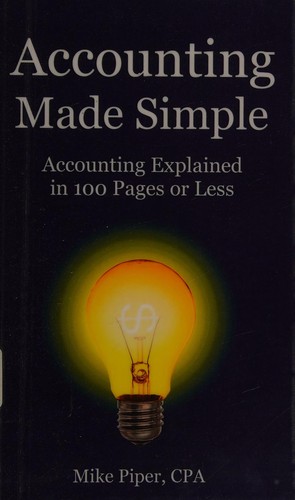
True to its title, this is a genuinely short, no-nonsense explanation of core accounting concepts — the accounting equation, financial statements, depreciation, and basic terminology — aimed at someone who's never studied it and just wants the fundamentals in plain English.
The equation the whole thing hangs off
Piper builds the entire book from one line — Assets = Liabilities + Equity — and then refuses to let go of it. Every chapter that follows is really that same equation seen from a different angle. Buy £4,000 of stock on a supplier account and assets and liabilities both rise by £4,000; the equation holds. Pay the supplier and both fall by £4,000; it holds again. Sell that stock for £7,000 cash and assets rise by £3,000 net, while equity rises by the same £3,000 as profit. Nothing else happens in accounting. Every transaction a business will ever make is one of those moves.
That matters more than it sounds, because it is the thing that stops double-entry bookkeeping looking like arbitrary ritual. Most people meet debits and credits as rules to memorise — debit the receiver, credit the giver, and something about assets working the opposite way round to liabilities. Piper's route in is better: debits and credits are simply the mechanism that keeps the equation balanced. If one side of a transaction moves, something else has to move to match. Once you can see the equation underneath, you can reason your way to which account moves instead of trying to recall a rule you half-remember.
He also draws out the equity side properly, which introductions often skip. Equity is not a pot of money sitting somewhere. It is what would be left for the owners if everything owed to everybody else were settled. It rises when the business makes a profit, rises when the owner puts money in, falls when the owner takes money out, and falls when the business loses money. For an owner-director who has spent years treating the business current account as 'the money', that single reframing is worth the couple of hours the book takes.
Three statements, three different questions
The core teaching move is that the income statement, the balance sheet and the cash flow statement each answer a different question, and reading any one of them on its own will mislead you. The income statement asks: across this period, did the business make more than it spent? The balance sheet asks: at this exact moment, what does the business own and what does it owe? The cash flow statement asks: across this period, where did the actual money come from and where did it go?
Piper is careful about the period-versus-moment distinction, which is where beginners usually come unstuck. A balance sheet is a photograph taken at midnight on 31 March. An income statement is a film of the twelve months leading up to that midnight. The statement of retained earnings — which gets its own short chapter and is normally the missing link — is the bridge between them: profit from the film flows into the equity section of the photograph, less anything paid out to the owners.
The cash flow statement gets the clearest treatment, split the standard three ways. Cash from operating activities is the business actually trading. Cash from investing activities is the business buying or selling long-term assets. Cash from financing activities is money arriving from lenders and owners, or going back out to them. The point Piper is quietly making is that a business can report a healthy profit while operating cash flow is negative — because customers have not paid yet, or because every spare pound has gone into stock — and that combination is the single most common way an otherwise decent small business dies. He does not dramatise it. He just makes the mechanism visible, which is more useful.
Where accounting stops being arithmetic and starts being judgement
The middle of the book covers the parts people find genuinely confusing, and this is where the short format earns its keep.
Cash versus accrual accounting. Under cash accounting you record a sale when the money lands. Under accrual accounting you record it when the work is done and the invoice raised. Accrual gives a truer picture of a period's trading and is what any set of statutory accounts uses — but it opens the gap between profit and cash that then confuses people forever afterwards. Nearly every 'we're profitable but there's no money in the bank' conversation traces back to this one distinction.
Depreciation. This is the clearest single explanation in the book. Buy a £24,000 van and the cash leaves on day one. But the cost is spread across the years the van is actually used — say £4,000 a year for six years on a straight-line basis. So in years two to six, reported profit falls by £4,000 with no money moving at all. Piper walks through the main methods (straight line, declining balance, units of production) without pretending the choice is neutral. Different methods produce different profit figures from identical trading, which is the moment a reader realises accounting involves decisions, not just arithmetic.
Inventory and cost of goods sold. Same lesson, sharper. FIFO, LIFO and weighted average are three different ways of deciding which units you 'sold' when your purchase prices have moved, and they will produce different gross profit from the same actual sales. Worth flagging for UK readers that LIFO is not permitted under UK GAAP or IFRS — Piper writes to US rules throughout — but the underlying point, that stock valuation is a choice with consequences, applies here just as much.
Ratios: the chapter that turns numbers into a diagnosis
The financial-ratio chapter is where the book stops explaining and starts being useful. Piper groups them the conventional way. Liquidity ratios — the current ratio, the quick ratio — ask whether the business can meet what falls due in the near term. Profitability ratios — gross margin, net margin, return on assets, return on equity — ask whether the business is any good at turning activity into money. Leverage ratios — debt to equity, interest cover — ask how much of the business is funded by other people, and how comfortably that debt is being carried.
His genuinely important point is that no ratio means anything in isolation. A current ratio of 1.3 is neither good nor bad. It is only interesting against last year's 1.6, or against what is normal for that trade. A restaurant, a wholesaler and a design agency have structurally different balance sheets, and comparing across them produces noise rather than insight. Trend and peer group are the whole game, and a reader who takes only that away from the chapter has still got their money's worth.
Why the rules exist at all
One short chapter does more work than its length suggests: the one on why accounting has rules in the first place. Piper runs quickly through the principles that sit underneath any set of published accounts — the going concern assumption, that the business is expected to keep trading and its assets are therefore not valued at what they would fetch in a fire sale; the matching principle, that costs are recognised in the same period as the revenue they helped produce, which is where accrual accounting and depreciation both come from; conservatism, which says that where two treatments are defensible you take the less flattering one; materiality, which is permission to stop being precise about amounts too small to change anybody's decision; and consistency, which is the requirement to keep doing it the same way year on year.
The reason this matters to an owner rather than a bookkeeper is comparability. Rules exist so that one company's accounts can be read against another's and against its own from three years ago. Without them, every set of statements would be a different language and none of the ratio analysis in the next chapter would mean anything. It also explains something owners often find irritating — why an accountant will not simply book a cost where it would be most convenient. The convenience is exactly what the rules are there to remove.
What a hundred pages actually buys you
Piper is explicit that the real product here is vocabulary. Accrual versus cash. Gross versus net. Current versus non-current. Capital versus revenue expenditure. Asset versus expense. Once an owner holds those words with confidence, a meeting with an accountant turns into a two-way conversation about decisions rather than a monologue the owner nods along to. That is a modest ambition, honestly stated, and the book hits it squarely — which is more than can be said for a great many business books three times the length.
Key lessons
- The accounting equation (Assets = Liabilities + Equity) underlies every financial statement you'll ever look at.
- The three core financial statements each answer a different question and need to be read together, not separately.
- Depreciation and amortisation are accounting concepts, not literal cash movements — worth understanding the difference clearly.
- Basic accounting terminology, once demystified, makes conversations with an accountant far more productive.
You don't need a course to understand accounting basics — a short, plain-English explanation of the fundamentals is enough to follow your own numbers with real confidence.
What this means for a UK small business
The fundamentals here — the accounting equation, the gap between profit and cash, what depreciation actually is — apply identically whether the entity is a UK limited company or a US LLC, even though Piper's tax examples are American throughout. Read it as thirty minutes of homework before a first proper meeting with an accountant, so that meeting can be spent on decisions rather than definitions.
For a sole trader or a first-time company director looking at management accounts or a VAT return for the first time, this closes the vocabulary gap faster than anything else on this list. The specific UK layer it cannot give you sits on top of the same foundations: your accounts are prepared under FRS 102 or FRS 105 rather than US GAAP, capital allowances rather than accounting depreciation determine what you actually get tax relief on, and if you are VAT registered on the standard scheme your VAT return runs on invoice dates, not payment dates — which is precisely the accrual-versus-cash distinction turning up in real life with a filing deadline attached.
Practical use: read it on a Sunday, then open your own last set of accounts and find each of the three statements in them. If you can name what every heading is and say which of the three questions it answers, the book has done its job.
What’s aged well
The fundamentals covered are genuinely timeless, as basic accounting principles don't change.
What feels outdated
Nothing significant given the evergreen nature of the content.
Where it falls short
It is deliberately thin — a primer, not a reference. There is no UK tax content, no VAT treatment, nothing on Companies House filing or the difference between statutory accounts and management accounts, and nothing at all about actually running a set of books month to month. The US framing is constant and occasionally actively wrong for a UK reader, LIFO being the clearest example.
It also stops exactly where an owner's real problems start. Understanding what a cash flow statement is does not tell you how to forecast one, and that forecast is what a growing business genuinely needs. Read it as the vocabulary lesson it is designed to be, then move to something built for running a business's numbers. Treating it as a complete education would be a misuse of what the author actually promised.
The Business Stuff verdict
A quick, useful primer for absolute beginners — best paired with more business-specific reading afterwards.
Three things to actually do after reading it
- Write out the accounting equation for your own business using real, current numbers.
- Identify one accounting term you've nodded along to without fully understanding, and look it up properly.
- Bring one specific question from the book to your next conversation with your accountant.
If you liked this, read next
Five similar books
- Financial Intelligence (Berman & Knight)
- Simple Numbers, Straight Talk, Big Profits! (Greg Crabtree)
- The Personal MBA (Josh Kaufman)
- Profit First (Mike Michalowicz)
- The Intelligent Investor (Benjamin Graham)
Common questions
Is it useful in the UK when the book is written to US rules?
Yes, for the fundamentals, which is what it is for. The accounting equation, the three statements, accrual versus cash, depreciation, ratios and the reasoning behind the rules are identical whether the entity is a UK limited company or a US corporation. What does not transfer is the tax and reporting layer: your statutory accounts are prepared under FRS 102 or FRS 105, capital allowances rather than book depreciation determine your tax relief, and LIFO stock valuation, which Piper explains, is not permitted here. Read it for the vocabulary and the mechanics, then get the UK-specific treatment from your accountant or from HMRC guidance.
Will it teach me to do my own bookkeeping?
No, and it does not claim to. This is a book about reading accounts, not producing them. It will not show you how to run a purchase ledger, reconcile a bank feed, code a transaction in Xero or QuickBooks, or prepare a VAT return. What it gives you is the conceptual map underneath all of that — why a transaction has two sides, what the balance sheet is actually a picture of, why profit and cash differ. That map makes bookkeeping software far less mysterious, but you will still need software-specific training or a bookkeeper. Think of it as the theory paper, not the practical.
Do I need it if I already have an accountant?
Arguably you need it more. The problem with having an accountant is that meetings become a monologue you nod along to, because the vocabulary is theirs and not yours. A hundred pages of this book turns that into a two-way conversation about decisions: why the profit figure and the bank balance disagree, what the depreciation line is doing, whether the current ratio has moved and what that says about the next six months. It is the cheapest possible investment in getting value out of fees you are already paying, and it takes an evening.
How long does it take to read?
About two hours. It is roughly a hundred pages and deliberately kept that way — the whole design of the book is that it can be read in one sitting without prior knowledge. The chapters are short, each covers a single idea, and the worked examples are small enough to follow without a calculator. The best way to use it is to read it straight through in an evening and then immediately open your own most recent accounts and find each of the three statements in them. If you can name every heading and say which question it answers, the book has done its job.