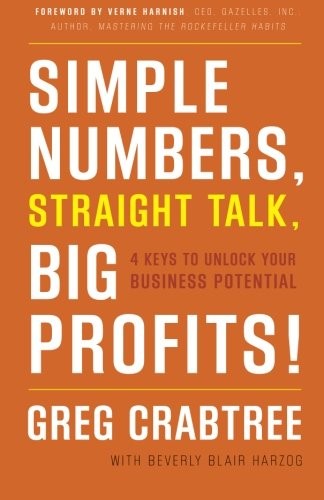
Written by a practising accountant, this book focuses on four keys to understanding a small business's real financial health, with particular emphasis on labour efficiency — how much revenue and profit each pound of labour cost is actually generating — a metric most owners never calculate.
Pay yourself a market wage before you look at anything else
Crabtree is a working accountant to small businesses rather than an author with a theory, and the book opens with the rule that makes everything after it legible: put a genuine market-rate salary for the job you actually do into the accounts, and only then ask whether the business is profitable. Not the tax-efficient minimum, not whatever you happened to draw — the amount you would have to pay a competent outsider to do your job.
The reason is that without it, the profit figure is meaningless. A business that only shows a profit because the owner is underpaid is not a profitable business; it is a badly paid job with extra risk attached, and the accounts have been quietly disguising that fact. Crabtree's experience is that a large share of small firms discover, on doing this properly for the first time, that they are running at or below break-even and have been for years, financing the gap out of their own wages. He is equally firm about the other direction: once you are taking a proper salary, do not then treat the profit as more salary. Salary is the price of your labour, profit is the return on the capital and the risk, and mixing them means you can never tell which one is working.
This single adjustment reframes the rest of the book. Every subsequent measure — labour efficiency, profit targets, cash — is calculated on numbers that include the owner's real cost, which is why Crabtree's version of them says something the statutory accounts do not.
Labour efficiency: the ratio that explains why growth is not helping
The book's signature contribution is the Labour Efficiency Ratio: gross profit divided by labour cost. In a service, trade or professional business, labour is overwhelmingly the largest cost, so the question that matters is not how much revenue you generated but how much gross profit each pound of wages produced.
Crabtree's insight is that revenue growth is a vanity metric if it was bought with proportionally more labour. A firm that doubles turnover and doubles its wage bill has not become more efficient — it has become bigger, with the same economics, more management overhead and considerably more ways to go wrong. He splits the measure in two, and the split is where the diagnostic power sits: direct labour (the people who actually deliver the work) tells you whether your pricing and delivery model works, while management labour tells you whether the supervision you added to handle growth is being paid for by that growth. Plenty of businesses have perfectly healthy direct-labour efficiency and are being drowned by a management layer added faster than the revenue justified.
The practical use is the trend, not the absolute number. Benchmarks vary wildly between a construction firm and an accountancy practice, so comparing yourself to somebody else's ratio is close to useless — but comparing this month against the same month last year tells you whether the model is improving or degrading, and it tells you well before the profit and loss does. Crabtree's recommendation is to price and staff against the ratio rather than against the feeling of being busy, and to treat a falling ratio during a growth phase as a stop signal rather than an acceptable cost of expansion.
Profit is a target you set, not a residue you discover
Crabtree argues that a target pre-tax profit margin should be set deliberately and then worked backwards into pricing, staffing and cost control — not calculated after the fact as whatever happened to be left. His rules of thumb are blunt and widely quoted in small-business coaching: roughly, a business running at around 5% pre-tax profit is merely existing, around 10% is a good business, and around 15% is a genuinely strong one. Those are his benchmarks rather than universal law and need reading against your own industry's norms, but the discipline behind them travels: if you have not decided what profit the business is supposed to make, you will not hit it by accident.
He pairs this with a stern view of tax. Owners who resent the tax bill are, in his framing, resenting the scoreboard — the bill is a function of having made money, and the only reliable way to shrink it is to make less. What matters is planning for it as a known, predictable call on cash rather than being ambushed by it, and never confusing money that belongs to the tax authorities with working capital.
The four forces of cash, and the core capital target
The most useful chapter for anyone who has been profitable and still short of money is Crabtree's sequencing of what profit gets spent on, in order: pay the tax, repay debt, build the business's cash reserve, and only then take distributions. Owners who take money out ahead of that queue are the ones who end up borrowing to fund growth they have already spent.
The reserve target is the concrete number here: Crabtree's core capital target is roughly two months of operating expenses held in cash with nothing drawn on the credit line. Below that, the business is fragile and every decision gets made under pressure — you take the wrong client, you accept the bad payment terms, you cannot fund the working capital a good contract needs. At or above it, the owner starts making decisions from choice rather than from cash-flow panic, which he treats as the real prize rather than the balance itself.
The underlying point is that growth consumes cash before it produces any. More work means more wages and more materials paid out weeks or months before the customer pays in. A business growing fast on thin margins can be profitable on paper every single month it is heading towards insolvency, and the four forces exist to stop the owner spending profit that was already committed to funding that growth.
Crabtree is also good on the awkward middle stage most growing firms hit, where the owner can no longer personally supervise the work but the business is not yet big enough to carry a proper management layer. Revenue rises, a manager or two gets hired, and profitability goes backwards for a year or more. His argument is that this is predictable rather than a failure — the overhead arrives in a lump while the revenue to cover it arrives gradually — and that the answer is to plan the funding for it deliberately, using the labour ratios to see when the new layer has started paying for itself, rather than being surprised by a bad year and cutting the very capacity that was supposed to enable the next stage.
A worked example, in outline
Take an illustrative services firm turning over £600,000 with gross profit of £300,000, a wage bill of £180,000 including the owner's proper £55,000 market salary, and overheads of £90,000. Labour efficiency is £300,000 ÷ £180,000, or £1.67 of gross profit per £1 of labour cost; pre-tax profit is £30,000, which is 5% — Crabtree's existence line. Now win a contract adding £120,000 of revenue that needs two more delivery staff at £60,000 combined and a supervisor at £35,000. Gross profit might rise to £360,000 while labour rises to £275,000, so efficiency falls to £1.31, and the extra overhead swallows the gain. Turnover is up 20% and the year feels like a success; the business is working harder for less. The ratio flags that in month one. The annual accounts flag it fourteen months later. That gap is the entire argument of the book.
Key lessons
- Labour efficiency — revenue generated per pound of labour cost — is one of the most revealing, underused metrics in small business.
- A target profit margin should be set deliberately by size of business, not left as a residual afterthought.
- Owner's pay needs to be clearly separated from business profit to see the business's real performance.
- Growth that doesn't improve labour efficiency is often growth that dilutes profitability rather than building it.
Most small business owners never calculate labour efficiency, yet it's one of the clearest signals of whether the business model actually works as it grows.
What this means for a UK small business
The Labour Efficiency Ratio is the single most transferable idea here. Run it on last month's numbers — gross profit divided by total labour cost, with your own market-rate salary included — and it will usually tell you something your P&L does not, particularly in trades, agencies and professional firms where people are the main cost.
The pay-yourself-properly rule needs a UK translation. Many directors take a small PAYE salary plus dividends for tax reasons, which is sensible tax planning but wrecks the management accounts: the business looks far more profitable than it is because your real cost is sitting in the dividend line. Keep the tax structure, but run a second, management view with a notional market salary for yourself in the wage bill. That is the number that tells you whether the business actually works.
The core capital target maps neatly onto UK cash realities. Two months of operating costs in the bank, with the overdraft undrawn, is demanding but sane — and remember the reserve has to sit behind the VAT you are holding, the PAYE due on the 22nd of the month and the corporation tax due nine months and a day after the year end. Money that belongs to HMRC is not a cash buffer, however healthy the balance looks the week before a quarterly VAT payment.
What’s aged well
The core metrics remain directly useful and are increasingly referenced in small-business financial coaching.
What feels outdated
Nothing significant; the metrics are structural, not trend-dependent.
Where it falls short
The tax and structure detail is thoroughly American — S-corporations, distributions versus salary under US payroll tax rules, and the specific arbitrage those create — and none of it maps onto a UK limited company. Those passages need discarding rather than adapting, and a reader who does not spot that will draw the wrong conclusions about how to pay themselves.
It is also narrower than the subtitle suggests. It is genuinely excellent on labour efficiency, owner pay and the cash sequence, and thin to absent on pricing strategy, marketing, sales or anything to do with what the business actually sells. The benchmark percentages are asserted with more confidence than one practitioner's client base can really support, and the writing is workmanlike rather than good. Read it as a sharp single-issue book, not an operating manual.
The Business Stuff verdict
A genuinely useful, accountant's-eye view of small business numbers that most owners have never been shown.
Three things to actually do after reading it
- Calculate your own labour efficiency ratio this month, even roughly, if you've never done it before.
- Set a deliberate target profit margin for your business size, rather than accepting whatever's left over.
- Separate your own pay clearly from business profit in how you review the numbers.
If you liked this, read next
Five similar books
- Profit First (Mike Michalowicz)
- Financial Intelligence (Berman & Knight)
- Accounting Made Simple (Mike Piper)
- Five Numbers Every UK Business Owner Should Know
- The Personal MBA (Josh Kaufman)
Common questions
How do I actually calculate the Labour Efficiency Ratio?
Divide gross profit by total labour cost for the same period, with your own market-rate salary included in the labour figure. For example, gross profit of £300,000 against a wage bill of £180,000 gives £1.67 of gross profit per £1 of labour. Crabtree splits it further: direct labour, meaning the people who actually deliver the work, tells you whether your pricing and delivery model works, while management labour tells you whether the supervision you added to cope with growth is paying for itself. Do not compare your number to another industry's — the useful comparison is this month against the same month last year, because the trend tells you whether the model is improving long before the annual accounts do.
How much should a small business owner pay themselves?
Crabtree's rule is the market rate for the job you actually do — what you would have to pay a competent outsider to replace you — put into the accounts before you assess whether the business is profitable at all. His reasoning is that a business that only shows a profit because the owner is underpaid is not a profitable business; it is a badly paid job with extra risk attached. In the UK this needs translating, because many directors take a small PAYE salary plus dividends for perfectly sensible tax reasons. Keep that structure for tax, but run a second management view with a notional market salary for yourself in the wage bill. That version tells you the truth.
What is the core capital target, and is two months realistic in the UK?
Crabtree's target is roughly two months of operating expenses held in cash with nothing drawn on the overdraft. Below that, every decision gets made under pressure: you take the wrong client, accept bad payment terms, and cannot fund the working capital a good contract needs. It is demanding but reachable, and the UK complication is what has to sit behind it. The VAT you are holding is not yours, the PAYE is due on the 22nd of the month, and corporation tax falls nine months and a day after year end. A balance that looks healthy the week before a quarterly VAT payment is not a reserve, so calculate the target on money that is genuinely free.
Is the book useful in the UK given how American it is?
The metrics are structural and travel intact — labour efficiency, owner pay, profit targets by size and the four forces of cash all work identically here. The tax and entity material does not. Anything about S-corporations, distributions versus salary under US payroll tax rules and the arbitrage between them should be skipped rather than adapted, because the equivalent UK decisions about salary, dividends and corporation tax work on completely different rules. Read it with a pencil for the ratios and a UK accountant for the structure, and be aware that the profit benchmarks are one practitioner's rules of thumb from his own client base rather than a researched standard.