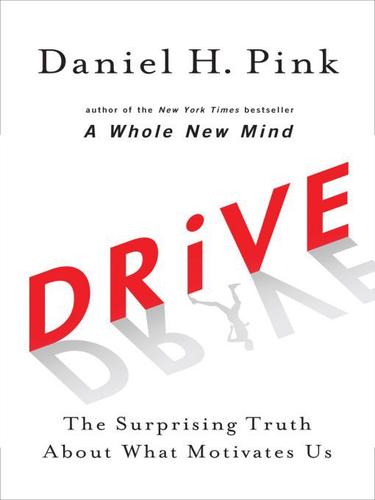
Pink synthesises decades of motivation research to argue that for complex, creative work, traditional carrot-and-stick incentives frequently backfire, and genuine motivation instead comes from three factors: autonomy, mastery, and purpose. For simple, mechanical tasks, financial incentives still work reasonably well — it's complex work where they fall short.
The operating system nobody has updated
Pink's organising metaphor is that motivation runs on an operating system, and most organisations are still running a version written for a different kind of work. Motivation 1.0 was survival. Motivation 2.0 was reward and punishment — the carrot and the stick — and it was a genuinely good fit for the routine, rule-based, largely mechanical work that dominated the twentieth century. His claim is that the work has changed and the operating system has not. When a job is a set of instructions to be followed faster, if-then rewards work well. When it requires judgement, invention or any kind of stepping back from the problem, they stop working and frequently make things worse.
The evidence he assembles comes mostly from the decades of self-determination research by Edward Deci and Richard Ryan, whose starting point was a finding that made no sense under Motivation 2.0: pay people to do something they were already enjoying, and they will do less of it once the payment stops. The reward does not add to the intrinsic interest — it replaces it. Deci's puzzle experiments in the early 1970s put students to work on a shape puzzle they found genuinely absorbing, paid one group per solved puzzle, and then watched what everyone did in an unsupervised break. The paid group, once payment ended, lost interest faster than the group who had never been paid at all. Pink calls this the Sawyer Effect, after Tom Sawyer's fence: rewards can turn play into work, and their absence can turn work into play.
The candle problem, and the seven deadly flaws
The demonstration everybody remembers is Karl Duncker's candle problem. You are given a candle, a box of drawing pins and some matches, and asked to fix the candle to a wall so that it burns without dripping wax on the table below. Most people try to pin the candle directly to the wall or melt it into place. The solution requires seeing the box not as a container for pins but as a shelf: empty it, pin it to the wall, stand the candle in it. Sam Glucksberg's version added an incentive — cash for the fastest solvers — and the incentivised group took materially longer. The reward narrowed their focus at precisely the moment the task required a wide one. Rerun it with the pins already tipped out of the box, so the insight is no longer needed, and the incentive helps again, exactly as Motivation 2.0 predicts.
That pattern — rewards help on the mechanical version, hurt on the version needing insight — is the empirical spine of the book, and Pink stacks other work on top of it, including studies run with large bonuses in rural India where the biggest incentives produced the worst performance on cognitive tasks, and the well-known Israeli nursery study where introducing a fine for late pick-up increased lateness, because a moral obligation had been quietly converted into a priced transaction.
From this he draws the seven deadly flaws of if-then rewards, and they are worth stating plainly because they are the practical warning list: they can extinguish intrinsic motivation, diminish performance, crush creativity, crowd out good behaviour, encourage cheating and shortcuts, become addictive so that each payout has to be bigger than the last, and foster short-term thinking at the expense of everything measured over a longer horizon. Anyone who has watched a sales commission scheme quietly reshape which customers get looked after will recognise most of that list.
Pink's constructive alternative on pay is more nuanced than the summaries suggest. He does not argue against money. He argues for getting money off the table: pay fairly and slightly generously against the market, benchmark it properly, remove any sense of unfairness, and then stop using it as a lever. Where you do want to recognise something, he prefers 'now that' rewards — unexpected, after the fact, non-contingent — over the 'if-then' promises made in advance, because a surprise thank-you does not turn the work into a transaction the way a pre-announced bonus does.
Autonomy, mastery and purpose
Motivation 3.0 is built on three elements, and Pink is specific enough about each that they are testable rather than inspirational.
Autonomy means real control over four things: task (what you work on), time (when), technique (how) and team (with whom). Consultation is not autonomy. His showcase examples are the Results-Only Work Environment pioneered at Best Buy, where people were judged purely on output rather than hours or presence, and Atlassian's FedEx Days, where engineers got twenty-four hours to work on anything they liked provided they delivered something the next day — an idea that later became the company's ShipIt days, and which sits alongside Google's 20% time as evidence that structured autonomy produces work the normal roadmap would never have commissioned.
Mastery is the pull of getting better at something that matters. Pink builds it from three claims: mastery is a mindset, borrowing Carol Dweck's finding that people who believe ability is fixed avoid the difficulty that would improve it while people who believe it grows seek it out; mastery is a pain, requiring deliberate practice over years rather than passion in bursts; and mastery is an asymptote, meaning you approach it without ever arriving, which is both the frustration and the entire appeal. He ties this to Mihaly Csikszentmihalyi's flow — the state where challenge and capability are closely matched — and argues that a manager's most useful and least practised skill is setting tasks that sit right at that edge, neither boring nor overwhelming.
Purpose is the sense that the work serves something beyond the transaction. Pink's practical version has three parts: goals that are not purely financial, language that is not purely commercial, and policies that let people act on the purpose rather than just hear about it. His argument is that purpose has moved from a decoration to a differentiator, particularly in recruitment, and that the organisations getting it right treat profit as the result of doing the work well rather than the point of doing it.
Type I, Type X, and what you actually do on Monday
The shorthand Pink uses to bind it together is Type I versus Type X behaviour. Type X is fuelled by external rewards bolted on to the work. Type I is fuelled by the work itself. Crucially, he insists Type I is not a personality type but a response to how the environment has been designed — which is what makes the book actionable rather than fatalistic. You are not stuck with the people you have; you are stuck with the system you have given them.
The final third is a toolkit, and it is one of the better appendices in the genre. It includes the one-question performance review, where you ask simply whether you are better than you were last month and at what; the practice of holding a regular conversation about progress rather than an annual verdict; giving people a day a quarter to work on anything they choose provided they show the result; and a list of diagnostic questions for testing whether a job actually contains any autonomy. None of it requires budget, which is precisely why it is usable in a business of six people as readily as one of six hundred.
What an if-then bonus actually costs
Pink argues the money is doing less work than owners think it is, and the cleanest way to see that is to price a bonus scheme properly. Here is an illustrative one: a six-person firm sets aside a £12,000 discretionary pot, £2,000 a head, as the reward for a good year.
The business does not spend £12,000. A bonus is earnings, so employer National Insurance at 15% applies on top — £1,800 — taking the real cost to £13,800. At the other end, a basic-rate employee loses 20% income tax and 8% employee National Insurance, so their £2,000 arrives as £1,440. Across six people that is £8,640 landing in pockets from £13,800 leaving the bank: about 63p of felt reward per pound spent.
Then apply Pink's actual finding. That £13,800 buys a spike in goodwill that decays within weeks, and if you repeat it, it stops being a reward and becomes the baseline — the year you cannot afford it, you have engineered a pay cut nobody agreed to. Meanwhile the levers he says do the real work on skilled labour cost nothing: letting the engineer sequence their own week, letting the bookkeeper redesign month-end, saying out loud why the standard of the work matters.
The honest version of this is not “stop paying people.” Pink is explicit that pay has to be fair and off the table as a grievance first. It is that once salaries are right, the next £13,800 buys more engagement spent on capability, equipment or genuine control over the work than it does routed through payroll as a bonus — and unlike the bonus, none of that has to be repeated next year to avoid causing offence.
Key lessons
- For complex, creative work, financial incentives beyond a fair baseline often fail to improve, and can even reduce, performance.
- Autonomy — genuine control over how work gets done — is a stronger driver of engagement than external reward for skilled work.
- Mastery — the drive to keep improving at something that matters — motivates sustained effort more reliably than bonuses.
- Purpose — a genuine sense that the work matters beyond the paycheck — is the third leg of intrinsic motivation.
Beyond a fair baseline salary, more money doesn't reliably produce better performance on complex work — autonomy, mastery and purpose do, and most workplaces are still designed around the wrong incentive.
What this means for a UK small business
Pink's own caveat matters as much as his thesis: for genuinely mechanical, repetitive work — packing, basic data entry, routine processing — carrot-and-stick incentives still function reasonably well. The failure mode is applying that same logic to a bookkeeper, a marketer or a tradesperson solving a materially different problem every day, then wondering why the bonus scheme has not lifted anything.
For a UK owner the practical sequence is: fix pay as a hygiene factor first — benchmark it, get salaries to a level nobody on the team is quietly resentful about, and be transparent about how the number was arrived at — then stop leaning on money as the main motivational tool. With employer National Insurance and the National Living Wage taking up so much of the room to manoeuvre in a small firm, this is welcome news rather than an evasion: the levers Pink recommends are mostly free. Letting an engineer choose the order of the week's jobs, letting a bookkeeper redesign the month-end process, or letting someone spend a Friday afternoon on a tool that would make their own job faster all cost nothing.
The purpose point is the one most small firms leave on the table entirely. A trades business that never says out loud why the standard of the work matters, or a practice that never explains what a client's life looks like when the accounts are right, is competing for staff purely on wage — the one dimension where the bigger employer down the road will always win.
What’s aged well
The research remains widely cited and influential in modern management and HR thinking.
What feels outdated
Nothing significant; the core research holds up well.
Where it falls short
Pink is a synthesiser, not an original researcher, and the book leans hard on a small set of studies revisited from several angles — the candle problem alone gets more mileage than any single experiment can really bear. It has also aged in specific, checkable ways: Best Buy abandoned the Results-Only Work Environment in 2013, and Google's 20% time became far more restricted than the book implies, which does not disprove the argument but does undercut the showcase examples.
The deeper weakness is that the framework is a far better diagnostic than an implementation guide. Pink is excellent on why money-only incentives fail and noticeably thin on what to do when your existing commission structure is already baked into contracts, when autonomy collides with a client's deadline, or when the person in front of you simply wants more money and less meaning.
The Business Stuff verdict
A genuinely important corrective to reflexive bonus-and-incentive thinking, especially for knowledge and creative work.
Three things to actually do after reading it
- Review whether your current incentive structure is actually suited to complex work, or copied from a simpler-task model.
- Give one team member genuine autonomy over how, not just what, they deliver on their next project.
- Articulate the purpose behind a task you've only ever explained in terms of what needs doing.
If you liked this, read next
Five similar books
- To Sell Is Human (Daniel Pink)
- Multipliers (Liz Wiseman)
- Radical Candor (Kim Scott)
- The Culture Code (Daniel Coyle)
- Flow (Mihaly Csikszentmihalyi)
Common questions
Does Drive mean I should stop paying bonuses?
No, and Pink is explicit about it. His argument is to pay people fairly and slightly above the market, benchmark it openly so nobody is stewing over whether they are underpaid, and then stop using money as the day-to-day motivational lever. Where you want to recognise good work, he prefers unexpected rewards given after the fact to bonuses promised in advance, because the promise is what turns the work into a transaction. For genuinely routine, repetitive work, straightforward incentives still function. The failure case is a pre-announced if-then bonus attached to work that needs creativity or judgement, which is most of what a small professional team does.
Has the research behind Drive held up?
Partly, and this is the fair challenge to the book. The core self-determination findings from Deci and Ryan are robust and have been replicated for decades, though the size of the crowding-out effect is genuinely contested — it is strongest for tangible rewards, expected in advance, on tasks people already found interesting, which is narrower than the sweeping version Pink sometimes implies. The showcase examples have aged worse than the science: Best Buy dropped its Results-Only Work Environment in 2013, and Google's 20% time was heavily curtailed. Treat the mechanism as well-supported and the corporate case studies as of their time.
Is autonomy, mastery and purpose usable in a business of five people?
Yes, and arguably more easily than in a large one, because there is no HR policy to renegotiate. Autonomy in a small firm means letting someone own an outcome rather than a task list — the whole client, the whole job, including the order they do it in. Mastery means picking one skill per person that gets deliberately built this year, and having a short conversation about progress monthly instead of a review annually. Purpose means saying out loud, specifically, what good work does for the customer. The constraint in a small business is not money, it is the owner's habit of staying in control of how everything is done.
How long does it take to read?
About four hours for the main argument, which runs to roughly 250 pages across three parts. Pink helpfully closes with a toolkit section that includes a chapter-by-chapter summary and even a page-length version you could read in a couple of minutes, so it is unusually easy to sample before committing. If you are short of time, read part one on why rewards backfire and the toolkit at the back, and skim the middle. The audiobook is a reasonable option; the ideas are conversational and survive listening well, though the toolkit is more useful in print where you can go back to it.