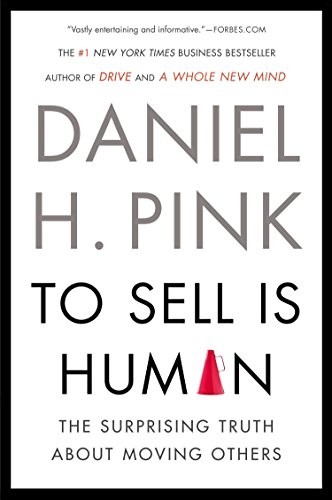
Pink argues that far more people are 'in sales' than job titles suggest — persuading a colleague, pitching an idea, convincing a customer — and that the profile of an effective modern seller has shifted from old stereotypes of pushiness towards attunement, buoyancy and clarity.
Nearly everyone is 'in sales' now
Pink's opening move is a definitional land-grab, and the whole book stands or falls on whether you accept it. He starts with the Fuller Brush Man — the door-to-door archetype who defined selling for most of the twentieth century — and points out that the job vanished, along with the encyclopaedia salesman and the vacuum-cleaner rep, at roughly the moment everyone assumed the internet had finished selling off for good. Except employment in sales never collapsed. Pink reports that around one in nine American workers still holds a formal sales job, a proportion that has stayed stubbornly stable. More importantly, when he commissioned survey work asking people what they actually do all day, the other eight in nine reported spending something like 40% of their working time on what he calls non-sales selling: persuading, convincing, influencing, moving other people to part with resources — time, attention, effort, agreement — in return for something.
That reframe does a lot of work. If selling is simply moving others, then the ops manager talking a warehouse team into a new process, the developer arguing for a rewrite, the trustee talking a landlord into a rent break and the parent negotiating bedtime are all doing the same core activity, and the accumulated knowledge about how to do it well stops being the private property of one department.
Pink also argues the ground has shifted underneath the profession itself. The old sales advantage was information asymmetry — the dealer knew what the car was worth and you didn't — and the Latin tag for that world was caveat emptor, buyer beware. The internet flattened the asymmetry to the point where the buyer often walks in better briefed than the rep. Pink's replacement is caveat venditor: seller beware. When every claim can be checked in thirty seconds and every bad experience published in sixty, the only durable strategy is being straight with people, and the pushy techniques built for the asymmetric world now actively lose business.
ABC no longer means Always Be Closing
Blake's speech in Glengarry Glen Ross gave a generation its mantra, and Pink spends the middle of the book dismantling it and installing a new ABC in its place: attunement, buoyancy, clarity.
Attunement is perspective-taking — working out what the world looks like from the other chair. Pink's key distinction is between empathy, which is feeling what they feel, and perspective-taking, which is thinking what they think; he argues the second is the commercially useful one because it stays cognitive enough to act on. The counter-intuitive finding is about power. The research he cites suggests people who feel powerful are measurably worse at perspective-taking, because they have never needed to be good at it. Deliberately lowering your own sense of power going into a conversation makes you better at reading it. The practical consequences follow: use your head as much as your heart, mimic strategically and unobtrusively rather than performing a technique, and accept that the person who talks less usually reads the room better.
Buoyancy is what keeps you upright in what Pink calls the ocean of rejection. His most useful contribution here is on self-talk, and he pointedly rejects standard affirmation advice. Instead of declarative self-talk — 'I'm going to nail this' — he backs interrogative self-talk: asking yourself 'Will I nail this?' The question format, on the research he cites, outperforms the assertion, because a question forces you to assemble the actual reasons and the actual plan, whereas a statement merely asserts an outcome your brain may quietly disbelieve. He pairs it with explanatory style: whether you read a rejection as permanent, pervasive and personal, or as temporary, specific and external, is what determines whether you make the next call.
Clarity is the leg most readers underrate. Pink's argument is that when buyers had less information, the valuable skill was problem-solving — answering questions they already knew to ask. Now that buyers can answer those themselves, the valuable skill is problem-finding: telling someone about a problem they hadn't identified, or reframing the one they thought they had. He draws on the classic research on art students, in which those who spent longest working out what to draw before drawing it — the problem-finders — went on to more successful careers than the technically superior problem-solvers. In commercial terms, the pitch that wins is often the one that changes what the buyer thinks the question is.
Ambiverts, and the death of the pushy-extrovert myth
The book's most-quoted finding is also its most liberating. Everyone assumes extroverts make the best salespeople, and the assumption is entrenched enough to shape hiring. Pink reports research measuring salespeople's extraversion against their actual revenue, and the result is not a straight line. Revenue peaks in the middle of the scale, among ambiverts — people with a roughly balanced mix of introverted and extroverted traits — and falls away at both ends. Strong introverts don't push enough. Strong extroverts talk too much, listen too little and overshoot, which is precisely the behaviour that produced the stereotype in the first place.
Pink's point is not that half the population is a secret closer. It is that the traits which actually correlate with moving people — asking, listening, calibrating, knowing when to stop talking — are learnable behaviours rather than fixed personality settings, and that the loud-and-relentless model was never the evidence-based one. It was simply the one that looked like selling.
Pitching, improvising and serving
The final third is the practical section, organised around three verbs: pitch, improvise, serve.
On pitching, Pink argues the elevator pitch is obsolete — nobody gets an uninterrupted lift ride any more — and offers six successors, three of which earn their place in a small business. The one-word pitch forces brutal reduction: what single word do you own? The question pitch works when your case is genuinely strong, because a question the listener answers for themselves is more persuasive than the same claim asserted at them. And the Pixar pitch borrows the studio's story spine — Once upon a time… Every day… One day… Because of that… Until finally… — which is a remarkably good template for explaining what your business does to someone who has never heard of it.
On improvisation, Pink lifts the 'yes, and' discipline from improv comedy, and the underlying argument is about scripts. A rehearsed pitch assumes you already know the objection, and the real conversation almost never follows the script, so the ability to build on what the other person actually said beats the ability to recite. The improv rule to make your partner look good is a quiet reframe of what a sales conversation is for.
On serving, Pink closes with two tests to apply to any attempt at moving someone. If the person you're selling to agrees, will they be better off? And when your interaction is over, will the world be a better place than when you began? He calls the pair servant selling, and the point is not moral decoration. In a caveat venditor world where buyers can verify everything and broadcast anything, being the seller who passes both tests is the strategy, not the sentiment.
Putting it to work: one extra yes a month
The return on this book is easiest to see priced out. Take a small electrical contractor quoting twelve jobs a month at an average value of £1,800 and winning four of them — a 33% conversion rate and £7,200 of won work. All three ABC behaviours are free: restating the customer's problem back to them before pricing it, saying plainly which of the three options is wrong for them and why, and writing off a lost quote as specific and temporary rather than as evidence of being bad at this. Suppose together they take the contractor from four wins to five. That is one extra job, £1,800 a month, £21,600 a year, on exactly the same twelve enquiries and the same marketing spend. The figures are illustrative, but the arithmetic is the real argument: at small-business volumes the entire payoff from getting better at persuasion is roughly one extra yes a month, which is a far lower bar than becoming a salesperson.
Key lessons
- Far more people are 'in sales' in a broad sense — moving others through persuasion — than formal sales job titles suggest.
- Attunement (understanding another's perspective), buoyancy (staying resilient through rejection) and clarity (framing the real problem) define modern effective selling.
- Ambiverts — a mix of introvert and extrovert traits — tend to outperform pure extroverts in sales, against the common stereotype.
- Framing choices as a smaller number of clear options, rather than many, tends to make people more likely to decide at all.
Persuasion is a near-universal skill, not a niche job title — and the traits that make someone genuinely effective at it are more nuanced than the pushy stereotype suggests.
What this means for a UK small business
The reframe earns its keep the moment you apply it to people who don't have 'sales' anywhere in their job title. In a ten-person UK firm, the receptionist handling a hesitant caller, the electrician explaining why the quote is £400 more than the one down the road, and the practice manager persuading a client to send their records before the deadline are all doing attunement, buoyancy and clarity work — usually with no training at all, because nobody has ever called it selling. Half a day teaching the whole team to restate the customer's position before answering it is one of the cheapest revenue interventions available to a small business.
The ambivert finding matters for hiring. UK owners routinely recruit the loudest candidate in the room and then wonder why the quieter one who asked better questions outsells them. Pink's research suggests the quiet one is nearer the sweet spot, and that the behaviours can be taught to either.
And caveat venditor is simply a description of the market UK small businesses now trade in. Every prospect has read three competitors' websites and two Google reviews before they ring. The honest quote, with the awkward bits included, wins more often than the clever one — and it survives contact with the review that gets written afterwards.
What’s aged well
The reframing of selling as a universal human skill has held up well and is widely referenced.
What feels outdated
Nothing significant given the broad, evergreen framing.
Where it falls short
Pink's house style — a striking study, a brisk gloss, straight on to the next — means the evidence gets less scrutiny than the confident tone implies, and one instance has aged badly. The buoyancy chapter leans on the 'positivity ratio', the claim that a precise ratio of positive to negative emotions marks the tipping point into flourishing; the mathematics underpinning that ratio was publicly demolished shortly after the book was published, and the paper's ratio claim was retracted. The ambivert result, meanwhile, rests largely on a single study of a single call centre.
The book is also deliberately broad rather than deep. It is an excellent argument for taking persuasion seriously across a whole business, but anyone actually running a sales function will need a proper methodology sitting alongside it.
The Business Stuff verdict
An accessible, well-argued case for taking persuasion seriously even if you don't carry a sales title.
Three things to actually do after reading it
- Identify one non-sales role in your business (ops, support, delivery) that would benefit from basic persuasion skills training.
- Practise attunement by genuinely restating the other side's position before making your own case in your next pitch.
- Simplify your next set of options down to two or three clear choices instead of an overwhelming list.
If you liked this, read next
Five similar books
- Influence (Robert Cialdini)
- Made to Stick (Chip & Dan Heath)
- Never Split the Difference (Chris Voss)
- Drive (Daniel Pink)
- Exactly What to Say (Phil M. Jones)
Common questions
Is To Sell Is Human still worth reading in 2026?
Yes - the central argument has aged better than most business books from 2012. Pink's claim that buyers now hold as much information as sellers, and that pushy technique therefore loses business, describes the market small firms trade in today far better than it described the market he was writing about. What has dated is the packaging: the studies get a brisk gloss rather than real scrutiny, and one of them has since been retracted. Read it as a well-argued case for treating persuasion as a general business skill, and as a source of three or four genuinely usable tools, rather than as a piece of research. It is also short, which counts for something.
How reliable is the research behind the ambivert claim?
Thinner than the book's confident tone suggests. The finding that revenue peaks among people in the middle of the extraversion scale comes largely from one study of salespeople at a single software call centre, which is a narrow base for something now repeated everywhere as settled fact. The direction of travel is plausible and matches what most owners observe - the loudest person in the room is rarely the best closer - but treat it as a useful corrective to a bad hiring stereotype, not as a hiring rule. The positivity ratio Pink cites in the buoyancy chapter is worse: the mathematics behind it was publicly demolished and the ratio claim retracted shortly after the book came out.
Can the new ABC be used by a small team with no sales training?
Yes, and it is probably the cheapest use of the book. Attunement, buoyancy and clarity are behaviours rather than personality traits, so each converts into something a five-person firm can practise this week. Attunement: before answering a customer, restate their position in your own words and check you have it right. Buoyancy: after a lost quote, write one sentence on why the loss was specific and temporary rather than proof you are bad at this. Clarity: ask what problem the customer thinks they have, then say plainly whether that is the real one. None of that needs a CRM, a script or a budget, and it works on colleagues and suppliers as well as buyers.
How long does it take to read, and is it better than Pink's Drive?
About five hours - it is roughly 250 pages of light, anecdote-led prose, and the chapters are short enough to take one at a time. Each of the practical chapters ends with a toolkit of exercises you can skim first and come back to. Whether it beats Drive depends on the job you want it to do. Drive is the tighter book with the more original argument, and it changed how a lot of people think about incentives and motivation. To Sell Is Human is broader and more immediately applicable - if you run a small business where everybody talks to customers, this is the one that changes next week's behaviour.