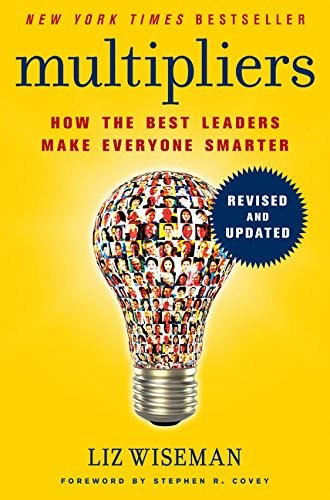
Wiseman's research distinguishes 'Multiplier' leaders, who amplify the intelligence and capability of the people around them, from 'Diminisher' leaders, who — often unintentionally — shrink it through micromanagement, over-involvement or always having the answer first. The book maps five practices that separate the two.
Multipliers and Diminishers
Wiseman's research question was deceptively simple: why do some leaders get roughly the same intelligence and effort out of a team that another leader, given the identical people, would get twice as much from? Her answer splits leaders into two types. Multipliers amplify the capability already in the room — people report thinking harder, contributing more, and using more of their actual ability around them. Diminishers, often without any intent to harm, quietly shrink that capability — people report holding back, waiting to be told, using less of what they've got. The gap Wiseman and her co-author Greg McKeown reported across their interview sample wasn't a rounding error: they put it at roughly double the effective capability out of the same talent pool.
The framing matters more than the number. Most leadership books ask how a leader can be more effective personally. Wiseman asks a different question — what happens to everyone else when you walk into the room — and that reframe is the book's real contribution. It moves the unit of measurement from the leader's output to the team's, which is the only measurement that scales. A leader who is personally brilliant and leaves a team of people who have stopped thinking has, on this accounting, destroyed value rather than added it.
Wiseman came to this from seventeen years running Oracle University, which shows in the material. The examples are drawn from people managing knowledge workers who have real options — engineers, consultants, product people — and the underlying economics only work in that setting. If your team is doing genuinely routine work with no judgement in it, the difference between a Multiplier and a Diminisher is much smaller. The moment the work requires people to spot something you didn't specify, the gap opens up.
The five disciplines of a Multiplier
Wiseman maps five concrete practices, each with a Diminisher counterpart, and the pairs are what make the framework usable rather than merely descriptive. The Talent Magnet finds and deploys people's native genius — the thing someone does easily, freely and without being asked, which is usually invisible to them because it feels like no effort — rather than deploying them against their job title. The Diminisher equivalent is the Empire Builder, who hoards good people to prove their own importance and then underuses them.
The Liberator creates space for people's best thinking by demanding rigour without demanding compliance, which in practice means being willing to be wrong in front of the team and saying so. The counterpart is the Tyrant, who creates enough anxiety that people spend their energy managing the leader's reaction rather than the problem. Wiseman's point here is subtle and often missed: the Liberator is not the soft option. They generate more pressure to do excellent work, not less — the pressure is just aimed at the standard rather than at the person.
The Challenger plants hard questions rather than handing out easy answers, and sets a challenge big enough that nobody in the room already knows how to do it. The Know-It-All counterpart answers every question personally because it is faster, and trains the team to stop bringing questions. The Debate Maker frames a real decision, forces genuine argument with evidence before anyone commits, and then decides — against the Decision Maker who consults a small inner circle and announces the outcome, leaving everyone else to execute something they don't understand and therefore can't adapt.
The Investor is the one most worth stealing outright. Wiseman's version of delegation is not handing over a task while retaining the worry; it is handing over ownership of the outcome, including the right to fail at it, while staying available as a resource. Her practical device is to leave the other person holding fifty-one per cent — a genuine majority stake in the problem, so that when it comes back to you unsolved, the correct move is to hand the pen back rather than take it. The Micromanager counterpart keeps the fifty-one per cent, delegates the typing, and wonders why nobody shows initiative.
Why the Diminishers are usually well-meaning
The book's most useful discomfort is that almost none of Wiseman's Diminishers think of themselves as diminishing anyone. They are not the tyrants of management folklore. They are competent, busy people who genuinely believe they are helping — and helping is exactly the mechanism. The manager who jumps in the moment someone struggles removes the productive struggle that builds capability. The one who adds a final polish to every piece of work teaches the team that their work is never the finished article. The one who responds to every message within ninety seconds becomes the bottleneck for decisions the team could have made themselves.
In the revised edition Wiseman gives this its own name — the Accidental Diminisher — and catalogues the recognisable types: the Idea Guy whose creativity floods every meeting until nobody else's suggestion feels worth voicing; the Always-On leader whose energy fills all available airtime; the Rescuer who protects people from failure and from learning at the same time; the Pacesetter who sets the standard by personal example so far ahead of everyone else that the team concludes it's unreachable and stops trying; the Optimist whose relentless 'we've got this' leaves no room to say that actually, we haven't.
Because none of it is malicious, it is far harder to self-diagnose than outright tyranny — and Wiseman is honest that self-assessment is close to useless here. Diminishers rate themselves as Multipliers with striking consistency. Her practical fixes are blunt and slightly humiliating: ask the team directly, in a way that makes an honest answer safe; count how much of your own meeting you spent talking; look at how many decisions came to you last week that didn't need to.
Where the framework earns its keep
The most actionable chapter is the one on extreme questions. A Multiplier's default response to a problem someone brings is a question, not an answer — and not a gentle coaching question, but a properly hard one that neither party can answer immediately. This is a specific, cheap behaviour change with a visible effect within a fortnight, and it is the single thing most readers take away from the book.
The second is the discipline of ratios. Wiseman suggests tracking the proportion of talking to listening, of statements to questions, and of your ideas to theirs, on the grounds that leaders systematically misjudge all three. It converts a vague aspiration — be less directive — into something countable, and countable things change.
The third is the deliberate use of failure. Multipliers, in her account, run rapid learning cycles: mistakes get named openly, including the leader's own, and the point of the naming is the correction rather than the accountability theatre. This is the piece most managers skip, because admitting a mistake feels like it costs authority. Wiseman's evidence points the other way — it is the permission slip that lets everyone else stop hiding theirs, which is where the useful information has been sitting all along.
It is worth knowing where the book sits among its neighbours, because the shelf is crowded. Radical Candor is about how to deliver a hard message; Multipliers is about whether you are leaving any room for a message to come back the other way. Servant leadership arrives at a similar destination through an ethical argument, where Wiseman's is unashamedly an argument about capacity and return. And unlike Good to Great, this is not a study of companies — it is a study of what individual managers do in rooms, which is why it survives being read by someone who runs a business of six people.
The one honest caveat Wiseman gives too little space to is that the Multiplier approach has conditions. In a genuine emergency, a team wants direction rather than an extreme question. With someone in their first fortnight, the productive struggle is just struggle. The discipline is knowing which situation you are in — and the failure mode she describes is not really managers who never use judgement, it is managers who decide every situation is the emergency.
Key lessons
- Diminisher leaders often believe they're helping by having all the answers, while quietly training the team to stop thinking for themselves.
- Multiplier leaders ask hard questions rather than supplying answers, which builds real capability over time.
- Giving people genuine ownership of a problem, not just a task, is what produces multiplied effort and initiative.
- Even well-intentioned leaders can be 'accidental diminishers' without realising it — self-awareness here takes deliberate effort.
The most valuable thing a leader can do is amplify the intelligence already in the room, not be the smartest or most involved person in it.
What this means for a UK small business
Small UK teams amplify this dynamic because there's no layer between the owner and the work — an owner who answers every question fastest, every time, is training a team of three or four to stop bringing judgement calls at all, which caps the business at exactly the owner's personal bandwidth. The Challenger discipline is the cheapest fix available: next time a team member brings a problem, answer with a question ('what would you do?') before offering the solution, and watch how quickly capability that was always there starts showing up.
The Investor practice is what actually lets a UK owner take a proper two-week holiday without the business stalling. Handing over a task list means the questions follow you to the airport; handing over ownership of an outcome — this client, this month, including the right to get it wrong — means they don't. Pick one area, name the person who owns it, and then hold the line when they come to you for the answer.
It is also a useful lens on the accidental version of the problem, which is rife in owner-managed firms. If you are the fastest, most experienced person in a business of five, being helpful is the trap. Every time you rescue a job at the last minute you confirm that the safety net exists, and the team calibrates to it.
What’s aged well
The Multiplier/Diminisher framing remains a widely referenced, useful lens for leadership self-assessment.
What feels outdated
Nothing significant; the core research and framework remain relevant.
Where it falls short
The research methodology — structured interviews and surveys rather than controlled studies — means the headline '2x capability' figure should be read as a striking, memorable estimate rather than a replicable measurement, and the book leans on it far more confidently than the underlying data supports. The case studies skew heavily towards large tech and consulting firms and sit awkwardly against a five-person business.
A couple of the five disciplines also overlap enough in practice that the framework can feel like four ideas stretched to five, and the Multiplier/Diminisher binary flattens the reality that most managers are both, depending on the day, the pressure and the person in front of them.
The Business Stuff verdict
A genuinely useful mirror for leaders who suspect they're doing too much of the thinking for their team.
Three things to actually do after reading it
- In your next team problem, ask a hard question instead of supplying your own answer first, and see what happens.
- Notice one recent moment where you jumped in to solve something a team member could have solved themselves.
- Hand over genuine ownership of one problem, not just a task, to someone capable of rising to it.
If you liked this, read next
Five similar books
- Radical Candor (Kim Scott)
- High Output Management (Andy Grove)
- Who Not How (Dan Sullivan & Benjamin Hardy)
- The Culture Code (Daniel Coyle)
- Extreme Ownership (Jocko Willink & Leif Babin)
Common questions
Is Multipliers still worth reading in 2026?
Yes, though more for the diagnosis than the model. The core observation — that capable, well-intentioned managers routinely shrink the capability of the people around them by being helpful — has aged extremely well, and the Accidental Diminisher chapter is the most quoted management idea of the last decade for good reason. The five disciplines are useful scaffolding but not the reason to read it. If you manage anyone whose work involves judgement rather than pure execution, the book will make you uncomfortable in a productive way within the first fifty pages, which is more than most leadership titles manage.
What is an Accidental Diminisher and how do I know if I am one?
An Accidental Diminisher is a manager who genuinely wants their team to grow and shrinks them anyway through habits that feel like help — always having the answer, always adding the final polish, always rescuing a job before it fails, always being the most energetic voice in the room. You cannot self-diagnose it reliably; Wiseman found that Diminishers rate themselves as Multipliers with depressing consistency. The workable test is external and countable: what proportion of your last meeting did you talk for, how many decisions came to you last week that didn't need to, and what would your team say if answering honestly carried no cost?
Does the framework work in a team of three or four people?
It works better in small teams than in large ones, because there is no management layer absorbing the effect. In a firm of four, the owner is the entire climate, and the gap between people bringing you judgement calls and people waiting to be told is the difference between a business that can grow and one permanently capped at your personal bandwidth. What does not transfer well is the corporate scaffolding — the talent-marketplace and internal-mobility material assumes an organisation with somewhere to move people to. Take the Challenger and Investor disciplines, skip the rest.
How reliable is the research behind the two-times claim?
Treat it as a memorable estimate rather than a measurement. Wiseman's evidence base is structured interviews and surveys with around 150 leaders, in which people were asked to rate how much of their capability different bosses drew out — self-reported perception, not controlled measurement of output. That method is genuinely informative about how leadership feels from underneath, which is the book's real subject, but it cannot support a precise multiplier, and the book quotes the figure more confidently than it should. The pattern is worth taking seriously; the specific number is not worth repeating in a board meeting.