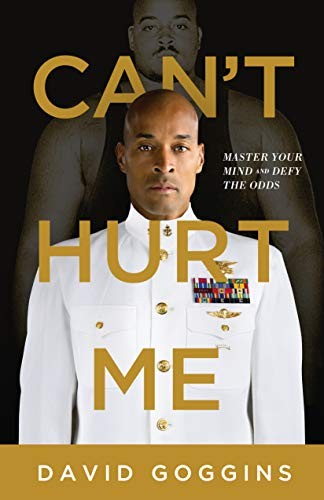
Part memoir, part mental-toughness manual, Goggins recounts an extremely difficult childhood and his transformation into a Navy SEAL and ultra-endurance athlete through relentless self-discipline. The '40% Rule' — that when your mind says you're done, you're actually only at about 40% of your real capacity — anchors the book's central argument.
The memoir underneath the manual
The life story is doing most of the work here, and it is genuinely extraordinary. Goggins describes a childhood of severe abuse in Buffalo, then poverty and open racism in small-town Indiana, an undiagnosed learning disability that left him effectively unable to read or write properly while cheating his way through school, and repeated failures of the military entrance exam. By his mid-twenties he was spraying for cockroaches on a night shift, weighing close to 300 pounds, eating badly and going nowhere.
What follows is the part everyone knows: deciding to become a Navy SEAL, losing something like a hundred pounds in around three months to make the entry standard, then going through Hell Week not once but three times — knocked out by pneumonia, then by broken kneecaps, then finishing it. Afterwards, Army Ranger School and further selections, then ultra-endurance running taken up more or less from a standing start: a hundred miles at his first attempt on essentially no training and with serious damage done to his body in the process, then Badwater and the rest. He set a Guinness pull-up record on his third try, having failed publicly twice.
One piece of context routinely lost in the retelling: the ultrarunning did not begin as a personal quest. Goggins started running hundred-mile races to raise money for the Special Operations Warrior Foundation, which supports the families of fallen special-operations personnel, after friends were killed in a helicopter shoot-down in Afghanistan. He also discovered, well into all of it, that he had been doing this with an undiagnosed hole in his heart. Neither fact is incidental. The first supplies the why that the book's tough-guy surface tends to bury, and the second is a reminder that a good deal of what reads as pure willpower was happening on a body that was, in fact, not fine.
The reason the memoir matters rather than just impresses is that Goggins uses it as evidence for a single claim: the ceiling most people accept on their own capability is invented rather than measured. He isn't arguing that everyone should run ultramarathons. He's arguing that almost nobody has ever actually tested where their limit is, because they stop at the first strong signal that says stop, and then build an identity around that number.
The 40% Rule and callusing the mind
The best-known idea in the book is the 40% Rule: when your mind is telling you that you are completely finished, you are, in Goggins' framing, usually at somewhere around 40% of your real capacity. The remaining 60% is still available but gated — the brain applies a protective governor that pulls you up well short of any actual physical limit, because from an evolutionary point of view stopping early is cheap and being wrong about your limit is fatal.
It's worth being precise about what he does and doesn't claim. The 40% figure is his own framing, not a laboratory result, and he presents it as a working heuristic rather than a measurement. The useful part is the instruction it implies: treat the first loud "I can't" as data about your comfort rather than information about your capability, and check it before accepting it. That's a small, portable habit and it does not require running through injuries to apply.
The mechanism he offers for expanding capacity is callusing the mind. Skin thickens where it's repeatedly rubbed; his argument is that tolerance for difficulty works the same way, and is built the same way — through deliberately chosen discomfort, taken on regularly, rather than avoided and then suddenly demanded of yourself in a crisis. This is why he'd argue that comfort is not neutral. A life arranged entirely around ease quietly removes the very capacity you'll need when something genuinely hard arrives uninvited, and by then it's too late to start building it.
He pairs the rule with two supporting practices. The first is visualisation done pessimistically rather than optimistically: rehearse the event including every part that will hurt, so that when it does hurt it registers as confirmation rather than as a surprise that needs explaining. The second is what he calls the governor — his mental model of the brain's protective limiter, treated as an opponent to be argued with rather than a verdict to be accepted. Both are ways of inserting something between the signal and the decision, which is the same move the Stoics make from an entirely different direction.
The Accountability Mirror and the Cookie Jar
For all the extremity, most of the book's actual method is about honesty rather than exertion, and the two central tools are both mental. The Accountability Mirror is a daily practice of standing in front of your own reflection and stating, out loud and without softening, exactly where you are and exactly what you're avoiding — in his version, written on Post-it notes stuck to the glass. The point is the absence of an audience and therefore the absence of anywhere to hide. Most self-assessment is performed for other people and comes out generous; this is deliberately designed to be the version nobody else hears.
The Cookie Jar is less quoted and arguably more immediately useful. It's a mental store of specific past moments where you overcame something genuinely difficult, assembled deliberately in advance and reached into when a new challenge feels impossible. The point isn't nostalgia or self-congratulation — it's evidence. Under pressure, people reliably forget that they have already proved they can do hard things, and that forgetting is precisely what makes them quit early. Having the list written down before you need it is the whole trick.
There's a third idea, taking souls, which is more combative and more divisive: outworking someone to the point where their belief breaks. It's the most sport-and-military part of the book and translates least well to ordinary life, though the underlying observation — that in most competitive situations the other side is also close to their limit and doesn't know it either — has some truth in it.
What the book is actually for, and who it isn't for
Structurally, Can't Hurt Me is unusual: each chapter ends with an explicit Challenge, a concrete exercise the reader is meant to go and do, and the audiobook interleaves conversations between Goggins and his co-writer Adam Skolnick that reflect on the chapter just read. That format is doing something deliberate — it's a manual with a memoir wrapped round it, not the other way about, and the challenges are where the transferable content sits.
The honest summary is that this is a book about self-deception. Goggins' argument is that most people negotiate with themselves constantly, in small increments, and that the negotiation is invisible because everyone does it — the alarm snoozed, the run cut short, the difficult conversation postponed one more day, each individually defensible. His method is to remove the negotiation entirely by making the standard non-negotiable and the self-assessment brutally literal. Whether that's liberating or exhausting depends almost entirely on temperament, and the book makes no attempt to meet halfway.
The most quoted line in it — who's gonna carry the boats? — comes from SEAL training, where boat crews carry inflatable boats on their heads for hours at a stretch. It functions as the book's shorthand for the moment when everyone is exhausted, everyone is quietly looking around for somebody else to take the weight, and the question of who you actually are gets settled by whether you step forward.
Key lessons
- The '40% Rule': when your mind says you're finished, you typically still have significantly more capacity left than it's telling you.
- Callusing your mind through deliberately chosen difficulty builds genuine resilience over time.
- A 'accountability mirror' — brutally honest self-assessment — is presented as a necessary first step before real change.
- Comfort, pursued as a default, quietly erodes the capacity to handle genuine hardship when it inevitably arrives.
Most people stop well before their actual limit — deliberately seeking out and pushing through difficulty builds a level of resilience that comfort alone never will.
What this means for a UK small business
The register is American and extreme by design, and most UK owners will need to translate rather than adopt. But the Accountability Mirror maps directly onto a Sunday-evening business review done properly: what am I actually avoiding right now? The supplier conversation I keep not having. The customer who owes us four grand. The line that's been losing money for two quarters that I keep calling a growth investment. Said plainly, once a week, that list is worth more than most planning exercises.
The Cookie Jar is the one to build if you're mid-slump. A written list of specific moments this business survived something that felt unsurvivable — the cash-flow month that came right, the client who nearly walked and stayed, the year everything cost more than it should have — read back on a bad week, when the instinct is to assume this time is different. It usually isn't.
The callusing idea has a mundane business version too: deliberately doing the uncomfortable thing while the stakes are low, so you're not learning it in a crisis. Practise putting your prices up on a small customer. Have the awkward conversation early, when it's still small. The capacity is built in advance or it isn't there.
What’s aged well
The intensity of the approach is polarising by design; readers either find it genuinely galvanising or find the extremity off-putting.
What feels outdated
Nothing significant given recent publication; the extreme intensity is a permanent stylistic feature, not a dated one.
Where it falls short
The extremity is the entire appeal and the entire limitation. Several of the feats described — running on stress fractures, going into events with serious untreated damage, the kidney trouble — are presented as inspiring rather than as the medically dangerous decisions they were, and the book offers essentially no acknowledgement that pushing through is ever the wrong call, which for a reader in genuine burnout is not a neutral omission. It's also thin on the practical psychology of how the transformation actually held: the honest answer running under the whole thing is a temperament most people don't have and can't manufacture. There's no middle register in it at all.
The Business Stuff verdict
Intense and not for everyone, but genuinely powerful for readers who respond to its extreme, no-excuses approach to mental toughness.
Three things to actually do after reading it
- Write an honest 'accountability mirror' assessment of where you're currently making excuses in the business.
- Deliberately choose one uncomfortable task this week instead of avoiding it, purely to build the habit of doing hard things.
- Next time you feel like quitting something difficult, test whether you're genuinely at your limit or just at the 40% mark.
If you liked this, read next
Five similar books
- Grit (Angela Duckworth)
- The Obstacle Is the Way (Ryan Holiday)
- Extreme Ownership (Jocko Willink & Leif Babin)
- Ego Is the Enemy (Ryan Holiday)
- The Daily Stoic (Ryan Holiday & Stephen Hanselman)
Common questions
Is the audiobook genuinely better?
Unusually, yes, and it is a different product rather than the same text read aloud. Between chapters, Goggins and his co-writer Adam Skolnick record unscripted conversations reflecting on what you have just heard, and that material does not exist in the print edition at all. Goggins narrating his own story also carries a force the page does not. The counterargument is that each chapter ends with a written Challenge — the actual actionable content — and those are far easier to work with in print. If you only buy one, buy the audio; if the exercises matter, you will want both.
Do I need to be into extreme fitness to get anything from it?
No. The running is the evidence, not the method. The transferable content is almost entirely mental: the Accountability Mirror, a structured way of saying out loud what you are avoiding; the Cookie Jar, a written record of past difficulties you actually got through, assembled before you need it; and the argument that the first strong signal to stop is information about your comfort rather than about your capability. None of that requires a gym or a single mile. What you do need is a tolerance for the register, which is relentless, profane and entirely uninterested in nuance.
Is it a healthy book to read?
For some people, and genuinely not for others, and it is worth being honest about which you are. If you respond to intensity and are currently under-challenging yourself, it works. If you are already running on empty, burnt out, or inclined to treat rest as weakness, it will hand you permission to make that worse — the book glorifies training on stress fractures and offers no acknowledgement anywhere that pushing through is ever the wrong call. Read it alongside something that has an off-switch in it, and treat the medical decisions described as biography rather than as instruction.
How does it compare with Never Finished?
Never Finished, published in 2022, is the follow-up, covering the years after the first book including the pull-up record and the heart surgery. It is more reflective and less linear, built around what Goggins calls the mental lab, and it assumes you have read Can't Hurt Me. Most readers find it the weaker of the two: the shock of the origin story has gone, and the ideas are extensions rather than new ones. Start with Can't Hurt Me, and only go on to the second if the first genuinely landed rather than merely impressed you.