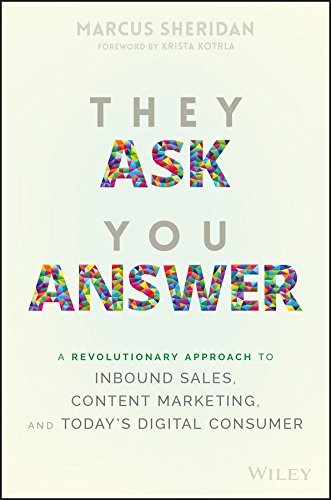
Sheridan built the method from saving his own struggling pool company by answering, in detail and in public, the exact questions customers were too embarrassed or too afraid to ask competitors — including price. The result is a content strategy grounded in genuine helpfulness rather than sales pressure, and a well-documented case study of it working.
A pool company, a crash, and the question nobody would answer
Sheridan's credibility rests on the fact that he wasn't a marketer. He co-owned River Pools & Spas, a fibreglass swimming pool installer in Virginia, and in the winter of 2008 the housing market took the bottom out of a business whose product is the textbook definition of discretionary spending. Customers cancelled and asked for their deposits back — money the company had already spent. He was weeks from losing the business.
What he did instead of cutting his prices was start writing. Not marketing copy: answers. He sat down with the questions customers actually asked on the phone and at the kitchen table, including the ones his industry had a tacit agreement never to publish, and wrote each one up honestly on the company blog. The most important was the question every pool company refused to answer anywhere on the internet: how much does a fibreglass pool actually cost? He wrote it properly — real ranges, what moves the number, what the cheap end genuinely gets you — and it became, by a distance, the most-read article the business ever produced and its single biggest source of sales.
The finding that turns a nice story into a method is what he saw afterwards in the analytics. Sheridan reports that prospects who worked through a substantial amount of the site before a sales appointment closed at a dramatically higher rate than the average visitor — his figure is around 80% for those who had read roughly thirty pages. That is the insight the rest of the book is built on. The content was not generating leads so much as educating people into becoming buyers, and unlike a salesperson's time, the education could be done once and used forever.
The Big 5
The framework is deliberately blunt. Across industries, five categories of content drive a wildly disproportionate share of traffic, trust and actual revenue.
Cost and price: what it costs, why it costs that, and what makes it more or less. Problems: the genuine downsides of your product, service or whole category, including who it is not right for. Comparisons: X versus Y, including your thing against the alternative you don't sell. Best-of lists: the best providers or options in your category, even where you are not on the list. And reviews: honest assessments of what is available.
The reason the Big 5 works is not clever, and Sheridan doesn't pretend it is. It works because these are precisely the five things every business is most reluctant to publish. Pricing feels commercially reckless. Admitting problems feels like handing your competitors ammunition. Comparisons and best-of lists feel like advertising for somebody else. So the search results for the highest-intent questions in most industries are a wasteland of evasion, and whoever answers first and most honestly takes both the traffic and the trust that comes with it.
His argument on pricing is the one readers fight hardest, and his answer is that the objection is nearly always the seller's discomfort dressed up as commercial prudence. Buyers will find a number somewhere; the only question is whether it reaches them from you with the context attached, or from a forum thread without it. He is not demanding a fixed price list. He is asking for the ranges, and for the variables that move a job from the bottom of the range to the top — which is exactly the conversation a good salesperson has anyway, just held earlier and in public.
Assignment selling
The most underrated chapter, and the one that separates this from ordinary content marketing, is about what happens once the content exists. Sheridan's term is assignment selling: you do not merely hope prospects read the material, you require it. Before a sales appointment is confirmed, the prospect is sent specific articles and videos and asked to work through them — and if they haven't, the meeting is moved rather than held.
The logic is capacity. A small sales team's scarcest resource is the hour spent in front of a prospect, and most of that hour is normally consumed answering the same eight questions for the four-hundredth time. Move those answers to content consumed beforehand and two things happen at once. The wrong-fit prospects screen themselves out before they cost you anything, and the meetings that do happen start several steps further along, with someone who already understands the price band and the trade-offs. Sheridan reports the sales conversations got shorter and the close rate went up at the same time, which is the combination every owner claims to want and few pursue.
Worked example, with illustrative figures. A two-partner accountancy firm fields 20 enquiries a month and gives each one an hour of partner time: 20 hours, five new clients, a 25% conversion. It then builds the Big 5 — a pricing page with real ranges, a piece on who the firm is wrong for, a comparison of fixed fees against hourly billing — and starts sending three links and a six-minute video before it will agree a meeting. Eight enquirers never book, having read the prices and quietly ruled themselves out. Twelve meetings happen, and because those twelve arrive with the money conversation already had, six convert. Six clients from twelve hours instead of five from twenty: eight partner hours a month released, and at an average £250 a month per client the extra conversion is £3,000 of annual recurring fee. Building the content took one afternoon a week for a quarter.
This is also the point at which the book stops being a marketing book. Assignment selling only functions if sales and marketing are the same conversation — if the content answers the objections the sales team actually hears, and if the sales team trusts it enough to send it out under their own name.
Insourcing, video and the culture fight
The second half is about organisational change, and Sheridan's central claim is that the bottleneck is never 'we don't know what to write'. The subject-matter expertise is already in the building, sitting in the heads of the people who answer these questions on the phone every day. The bottleneck is fear — of the price question, of the competitor reading it, of putting a claim permanently in writing — plus the lazy assumption that content is something you buy from an agency.
His prescription is to insource: hire a content manager whose job is to interview your own experts and publish, rather than paying an outsider to invent plausible-sounding material about an industry they don't know. In the revised edition he extends the same logic to video with what he calls the Selling 7 — including an '80% video' answering the questions asked by four-fifths of prospects, honest cost and pricing videos, bio videos of the people who will actually turn up at the door, and 'claims we make' videos that stand behind the promises on the website.
The mechanism that keeps it running is deliberately unglamorous: a standing log of every question a prospect actually asks, kept by whoever is on the phone, reviewed regularly, and worked through as a queue. Sheridan's title is not a metaphor. The strategy is literally that they ask and you answer, in the order and the language they used, rather than in the order a marketing calendar would choose. Most content programmes fail because somebody has to invent topics; this one never runs out and never guesses wrong, because the topics arrive daily from the people holding the money.
He is also firm about the questions businesses most want to duck — the ones where the honest answer is that you are not the right choice. Publishing who your service does not suit, or where a competitor genuinely does it better, feels like commercial self-harm and reads to buyers as the only credible thing on the website. It is the cheapest trust you will ever buy, and it costs you only the customers who were going to be unhappy anyway.
The through-line never changes: the buyer wants to know before they commit, everyone in the market is refusing to tell them, and the business willing to answer wins by default.
Key lessons
- Answer the questions your industry avoids — especially price, problems and comparisons — before your competitors do.
- The 'Big 5' content topics (cost, problems, comparisons, best-of lists, reviews) drive disproportionate traffic and trust.
- Genuine transparency, including publishing pricing information, builds trust faster than most businesses expect.
- Content built to actually help buyers make a decision outperforms content built purely to promote the business.
The businesses winning content marketing aren't the cleverest — they're the ones honestly answering the exact questions their buyers are actually asking, including the uncomfortable ones.
What this means for a UK small business
This is one of the most directly copyable frameworks in the library, and it needs no budget at all. Write down the five questions every prospect asks on the first call and is too polite to ask on your website — almost always led by 'roughly what will this cost?' — and answer them properly on your own site. A UK accountant, agency or trades firm that publishes genuine price ranges, with the variables that move them spelled out, routinely out-ranks and out-converts competitors still hiding behind 'contact us for a quote'.
Pricing is where UK owners baulk, and the fear is usually misplaced. Your competitors already know roughly what you charge; it is only your prospects who don't. Publishing 'bookkeeping from £180 a month, and here is what moves that number' filters out the people who were never going to pay it and pre-sells the ones who were.
Assignment selling solves a specifically small-business problem. A two-person firm cannot give every enquiry an hour of its time, and shouldn't. Sending three articles and a five-minute video before the meeting is the nearest thing available to cloning your best salesperson, and it costs one afternoon to build.
What’s aged well
The core method remains genuinely well-tested and widely adopted since publication, with a strong track record.
What feels outdated
Nothing significant; the method is platform-agnostic and still directly applicable.
Where it falls short
The evidence base is one company in one industry — a considered, high-ticket, once-in-a-lifetime purchase, where an anxious buyer will genuinely read thirty pages before committing. The logic carries well into accountancy, law, construction and most B2B services. It carries far less well into low-ticket, habitual or impulse purchases, and the book's confident tone never acknowledges the difference. Publishing meaningful prices is also considerably harder in regulated or fully bespoke work than Sheridan allows for.
The book is repetitive and evangelical too: the core method would fit comfortably in a long article. And the search landscape has moved since 2017, with AI-generated answer boxes now intercepting many of the very questions the method was built to win.
The Business Stuff verdict
One of the most practically actionable marketing books on this list, backed by a real, well-documented case study.
Three things to actually do after reading it
- Write down the five questions customers ask most often before buying, including the uncomfortable ones about price.
- Publish honest content answering your industry's most-avoided question, even if competitors won't.
- Check whether your pricing is genuinely accessible to a prospective buyer researching you online.
If you liked this, read next
Five similar books
- This Is Marketing (Seth Godin)
- Building a StoryBrand (Donald Miller)
- Contagious (Jonah Berger)
- Purple Cow (Seth Godin)
- Made to Stick (Chip & Dan Heath)
Common questions
Do I really have to publish my prices?
You have to answer the price question — publishing a full price list is one way of doing it, not the only way. Sheridan's argument is that the buyer will find a number somewhere, and a business that refuses to discuss it forfeits the chance to frame what drives it. For genuinely bespoke work the honest version is a page explaining ranges and the factors that move them: what a typical job at the low end looks like, what pushes one to the high end, and why you cost more than the cheapest quote. That does the same job. What does not work is the contact-us-for-a-quote page, which every buyer reads as evasion.
Does this still work now that AI answers the questions directly?
The method still works, but the payoff has shifted from clicks to citations. When the book came out in 2017, answering the awkward questions won you a search result and a visit. Today an AI answer box will often summarise your answer without sending anyone to your site — but it can only do that if your answer exists, is specific, and is clearly attributed to you. The businesses getting quoted are the ones publishing real numbers, real comparisons and real reasons not to buy from them. So write for the machine reading you as well as the human: answer the question in the first sentence, stay concrete, and name yourself in the answer.
Does it work for a low-ticket business like a café?
Not well, and the book never really admits it. The method was built on a swimming pool company, where an anxious buyer will genuinely read thirty pages before committing tens of thousands of pounds, and it transfers to anything with that shape — accountancy, law, construction, dentistry, most considered B2B services. Nobody researches a flat white. For low-ticket or habitual purchases the useful residue is much smaller: be straight about price, answer comparison questions plainly, and stop there. If your average sale is a few pounds and the decision takes a minute, a full content engine will cost you more in time than it ever returns in trade.
How long before it produces anything?
Months rather than weeks, and Sheridan is honest that it took years at his own company. The pattern owners report is that the first useful effect is not traffic at all — it is sales conversations getting shorter, because the prospect has already read the awkward answers and turns up with the objections settled. That shows up early, often within a couple of months, and it is the thing worth measuring first. Search visibility takes considerably longer. The most common failure is stopping at eight articles because nothing moved; the second is handing the writing to someone who has never been in the room when a customer asks the difficult question.