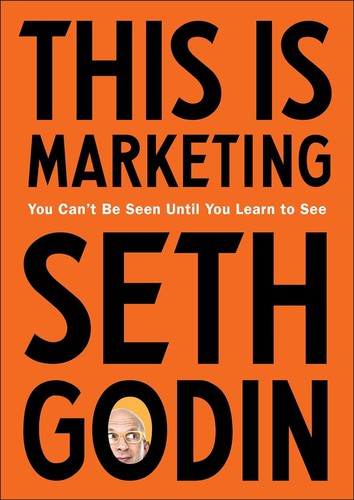
Godin's argument across a long career of marketing writing crystallises here: marketing isn't about interrupting strangers with adverts, it's about finding and serving 'the smallest viable audience' so well that they tell others. The book pushes readers away from mass-market thinking and towards building genuine trust with a specific group of people who have a specific problem you're uniquely positioned to solve.
Marketing is the generous act of making change happen
Godin's reframing runs against decades of default instinct. Marketing, in his account, is not interrupting strangers to persuade them of something they never asked about. It is the practice of finding a specific group of people who want to get somewhere, and helping them get there. The shift sounds soft and is actually structural: it changes the opening question from 'how do I get attention' to 'who is this for, and what change am I trying to make?', and those two questions produce different answers at every stage from what you build to what you put in the subject line.
The empathy argument underneath it is blunt. You are not the market. Your taste, your priorities and your knowledge of your own product are all actively misleading, because the person you're selling to knows a fraction of what you know and cares about something quite different. Godin runs the old line about the quarter-inch drill and the quarter-inch hole further than it usually goes: they don't want the hole either, they want the shelf, and really they want the feeling of a tidy room and of having done it themselves. Work up that chain far enough and you find the thing people are actually buying, which is almost never the thing you think you're selling.
The corollary is that marketing is not a department bolted on after the product exists. If the change you want to make is real, it determines what you build. Godin's phrasing — that you should make products for people rather than finding people for your products — is the whole book compressed into a sentence.
The smallest viable audience
The central strategic idea rejects mass-market thinking outright. Instead of asking how many people you could possibly reach, ask the opposite: what is the smallest number of people you'd need to serve properly for this to be worth doing? Then find that group, serve them so well they can't shut up about it, and let the audience grow outwards from there.
The logic is that mass appeal and delight are in direct tension. To be acceptable to everyone you have to sand off everything that would make anyone love it — 'average stuff for average people', as Godin puts it — and average stuff generates no word of mouth, so you're left buying every customer with advertising forever. Something remarkable, in his older and precise use of the word, is literally worth making a remark about, and remarks are free distribution.
He connects this to the technology adoption curve and Geoffrey Moore's chasm. The early adopters — the people actively looking for something new — are the smallest viable audience, and they are also the only bridge to everyone else, because the mainstream doesn't listen to marketers, it listens to people like itself who went first. Trying to sell to the mainstream directly skips the only mechanism that would have got you there.
For a small business the instruction is uncomfortable but freeing: getting narrower is not the same as getting smaller. It's the only version of the plan you can actually afford to execute.
The other half of the argument is that word of mouth is a design problem, not a hope. Godin's position is that people don't talk about things because you asked them to; they talk about things that make them look good, useful or interesting to the person they're telling. So the question to ask of your own product is what story a customer would get to tell about themselves by recommending it — and if the answer is nothing in particular, no amount of referral scheme will fix it. Building the remark into the work is cheaper than buying attention afterwards.
Status, affiliation, and 'people like us do things like this'
Godin's account of why people buy leans on identity rather than features. The most powerful sentence in the book is 'people like us do things like this' — the quiet, mostly unconscious calculation everyone runs about whether a purchase fits who they understand themselves to be. It explains brand loyalty that no spec-sheet comparison can, and it explains why arguing someone out of a preference almost never works: you are not contesting a fact, you are asking them to leave a tribe.
He puts two drivers underneath it. Affiliation is the desire to belong, to be one of us. Status is the desire to move up relative to others, and Godin is careful to note that status is always relative and that people work harder to protect their current standing than to improve it. Different people and different markets run on different mixes — some buyers want to be seen as sensible, some as first, some as generous — and getting the mix wrong is why plenty of technically excellent marketing lands flat.
Price sits inside this, not outside it. 'Price is a story': what you charge tells people what kind of thing this is and what kind of person buys it, so a low price is a claim about your work as surely as a high one. Godin is consistently in favour of charging more and being worth it, on the grounds that discounting is the one marketing tool that can't be undone. And the tension he wants in the work is not manipulation but the honest question a good offer creates in someone's head: if this is what people like me are doing, where does that leave me?
Positioning, brand versus direct, and the permission asset
The most immediately usable exercise in the book is a grid. Pick two dimensions your customers genuinely care about — speed and price, say, or convenience and craft, or discretion and scale — put them on an X and a Y axis, plot every competitor, and then go and stand in the corner nobody is occupying. It works because it forces you to be extreme on something. Being the fastest and the most expensive is a position; being reasonably good and reasonably priced is where businesses go to be forgotten.
Godin also draws a distinction that saves a lot of wasted money: direct marketing and brand marketing are different jobs and cannot be judged by the same yardstick. Direct marketing is measurable and about action — you spent this, you got that, you can optimise. Brand marketing is not measurable, works slowly, and is about trust and the story that spreads. His test for whether you have a brand at all is the best in the book: if Nike opened a hotel, you could picture it; if Hyatt made trainers, you could picture nothing. A brand is a promise and a shortcut for expectations, not a logo.
Underneath both sits the idea he has been arguing for twenty years: permission. Anticipated, personal and relevant messages sent to people who genuinely want to receive them. The goal of any individual marketing act is not the sale, it's earning the right to keep talking to this person — because a list of people who want to hear from you is an asset that compounds, and interruption never does.
The last thread is consistency, which Godin treats as a form of promise-keeping rather than a scheduling problem. Showing up in the same voice, at the same rhythm, doing the same recognisable thing, is how trust accumulates — and the corollary is that changing the offer, the tone or the audience every few months resets the clock each time. Most small business marketing fails not because it was the wrong idea but because it was abandoned in month four, just before the compounding starts.
Key lessons
- Find the smallest viable audience — the specific group your product or service could serve extraordinarily well — rather than chasing everyone.
- Marketing is the generous act of helping people get where they want to go, not manipulating them into buying something they don't need.
- People like us do things like this — tribal identity and belonging drive purchasing decisions more than feature comparisons.
- Status and affiliation are two of the most powerful (and least discussed) drivers of what people actually buy.
- Consistent, patient trust-building beats any single clever campaign; the goal is to earn permission to keep talking to your audience.
Trying to serve everyone means serving no one especially well — a small, specific, well-served audience is a stronger foundation than a broad, thin one.
What this means for a UK small business
The smallest-viable-audience idea is a direct corrective to the most common answer UK owners give when asked who their customer is: 'homeowners', or 'small businesses'. Too broad to build anything on. Naming a genuinely narrow group — VAT-registered sole traders in their first year, independent cafés turning over under £150k, landlords with three to ten properties in one town — makes every subsequent decision easier rather than harder, because it becomes obvious what that person needs to hear and where they already are.
The positioning grid is worth an actual hour with a pen. Most UK trades and professional firms cluster in the middle of every axis and then compete on price by default, which is the one position that has no defence.
And the trust-over-interruption argument maps neatly onto British scepticism of hard sell. A local business that consistently gives away genuinely useful material — a plumber's honest winter maintenance guide, an accountant's plain-English reminder of what's due in January — builds a reputation and an email list that outperform paid ads within the same town or trade, and neither can be bid away by a competitor with a bigger budget.
What’s aged well
The shift away from interruption-based advertising towards trust and specificity has, if anything, become more true since 2018 as ad-blindness has increased.
What feels outdated
A few specific platform references have moved on, but the underlying philosophy doesn't depend on any specific channel.
Where it falls short
Godin writes in short aphoristic bursts, which makes the book quick and quotable and leaves it light on execution. There is almost nothing here on channels, budgets, measurement or what to do on Monday morning, so an owner will need other reading to turn the philosophy into a campaign. Several ideas are repackaged from his own back catalogue — Purple Cow, Permission Marketing, Tribes — with fresh framing rather than fresh substance, and readers who know those books will find the overlap considerable. The smallest-viable-audience strategy is also sound and slow, which is a hard sell to someone who needs revenue this quarter and cannot wait two years for word of mouth to compound.
The Business Stuff verdict
A genuinely useful mindset reset for small business owners still thinking about marketing as adverts — pair with more tactical reading for execution.
Three things to actually do after reading it
- Write down the smallest viable audience for your business — specific enough that you could describe one real person in it.
- Audit your last three marketing pieces for whether they interrupt strangers or serve people who've already opted in.
- Identify one way your product signals status or belonging to the people who already love it, and lean into it.
If you liked this, read next
Five similar books
- Purple Cow (Seth Godin)
- Start with Why (Simon Sinek)
- Building a StoryBrand (Donald Miller)
- Influence (Robert Cialdini)
- Contagious (Jonah Berger)
Common questions
Is it worth reading if I have already read Purple Cow or Permission Marketing?
Parts of it, and you should know the overlap is substantial. This Is Marketing is Godin consolidating thirty years of his own arguments, so remarkability, permission and tribes all reappear in compressed form. What is genuinely newer is the framing around the smallest viable audience and the weight he puts on status and affiliation as the real engines of buying decisions. If you read the earlier books recently, treat this as the summary volume rather than a fresh instalment. If you have read none of them, start here — it is the most complete statement of the worldview, and the earlier titles then become optional deep dives on single chapters of it.
How small should the smallest viable audience actually be?
Small enough that you could describe one real member in detail without inventing them. For a UK small business that usually means a specific trade or situation rather than a demographic: veterinary practices across the north-west, not 'SMEs'; couples who booked a dry-hire barn and have realised nobody is coordinating the day, not 'weddings'. The test Godin sets is whether you could serve this group so well that they would genuinely miss you if you disappeared — and, crucially, whether they talk to each other, because word of mouth is the only distribution the strategy actually relies on. A group with no way of talking among itself will never fire the mechanism.
Can I use this if I need sales this quarter?
Not on its own, and that is the book's real limitation. The strategy is slow by design: earn attention from a small group, serve them properly, let the trust compound. That is the right long game and a poor answer to a cash-flow problem in October. If you need revenue now, the honest sequence is to run whatever direct response you can actually measure — outreach, referrals, paid search — while using Godin to decide who you are aiming at and what you are promising them. It is a positioning book wearing a marketing book's cover. Pair it with something tactical, and do not let the philosophy become a reason to postpone selling.
What does 'people like us do things like this' mean in practice?
It means people buy to confirm who they are, not to win a feature comparison. Every purchase carries a small statement — this is the sort of accountant a serious founder uses, this is where people round here get their coffee — and that statement usually settles the decision before price gets a look in. Practically it changes what goes on your website: which customers you show, the language you use, the work you visibly refuse. Godin's harder point is that you can reinforce an identity but not create one, so the work is finding a group whose existing self-image your business already fits, then reflecting it back to them accurately.