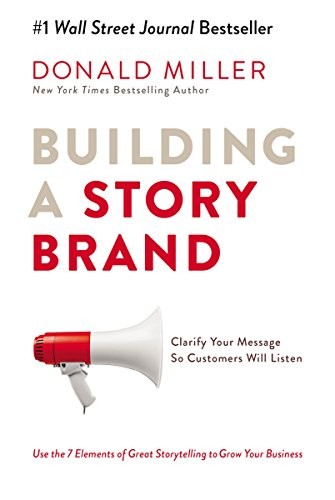
Miller applies classic storytelling structure to business messaging: the customer is the hero of the story, not your brand — your brand is the guide who helps them succeed. The StoryBrand 7-part framework gives a concrete template for building clearer, more customer-centred marketing messages.
The customer is the hero, and you are not
Miller's foundational move borrows classic story structure — the hero's journey, filtered through decades of screenwriting craft — and applies it without mercy to business messaging. Most marketing casts the brand as the hero of its own story: we, our team, founded in 2011, award-winning, passionate about excellence. Customers, entirely reasonably, are the heroes of their own stories and have no interest in auditioning for a supporting role in yours. The fix isn't modesty for its own sake. It's a structural correction: position the business as the guide who has been where the customer is and knows the way through, and you get attention that a self-promoting brand never earns, because it matches the story the customer is already telling themselves.
The supporting argument is about cognitive load. Miller's claim is that the brain is fundamentally economical — it filters aggressively for information that helps it survive and thrive, and discards everything that takes effort to decode. Story is the format the brain processes most cheaply, because it supplies a familiar structure to hang information on. Marketing that doesn't fit that structure has to be actively decoded, and most people won't bother. That is the theoretical backing for the book's most quoted line: if you confuse, you lose.
Clarity beats cleverness, and the grunt test
The book is a sustained attack on marketing's instinct toward clever, ambiguous, brand-voice-first messaging — the abstract headline, the aspirational stock photograph, the tagline that requires a beat of interpretation. Miller's position is that a confused customer doesn't do the decoding work, they simply move on, so a boringly clear message that lands instantly beats a witty one every time.
His test for this is deliberately crude and genuinely useful: the grunt test. Look at your homepage for five seconds and ask whether a caveman could grunt back three things — what you offer, how it will make their life better, and what they have to do to buy it. If any of the three is missing or requires scrolling to find, the page fails. Most small-business homepages fail on at least two. Run it on your own site before reading any further into the book and the value of the whole thing becomes obvious in about ten seconds.
The seven-part framework, in full
Miller turns the theory into a template he calls SB7, and its usefulness lies in how mechanical it is. A character wants something. They encounter a problem. They meet a guide, who shows them empathy and demonstrates authority, gives them a plan, and calls them to action — which either results in success or helps them avoid failure. Seven parts, in that order, and you can fill it in for any business in an afternoon.
Two elements do more work than the rest. The first is the three-layer treatment of the problem. Every purchase involves an external problem (the practical issue — a leaking roof, an overdue return, a website nobody can find), an internal problem (how that makes the customer feel — anxious, embarrassed, out of control, stupid for having let it slide), and a philosophical problem (why it is simply wrong that anyone should have to put up with this). Miller's argument is that almost all business messaging addresses only the external layer, and that the internal layer is what actually drives the decision to act now rather than next month. People buy the resolution of a feeling and justify it with the practical problem afterwards.
The second is the call to action, which he splits into two kinds. The direct call to action is the one that asks for the sale — book a call, buy now, request a quote — and Miller's complaint is that most small businesses ask far too timidly and far too rarely, out of a fear of being pushy that reads to a customer as a lack of confidence. The transitional call to action is for the majority who aren't ready: something free and genuinely useful that keeps the relationship open — a guide, a checklist, a short assessment. A site with only one of the two either loses everyone who isn't buying today, or never asks anyone to buy at all.
The plan is worth separating into its two forms, because businesses usually need both. The process plan lays out the steps between here and the outcome — survey, written quote, install, sign-off — and its job is to remove the fear of the unknown that stops people committing to an unfamiliar purchase. The agreement plan is a short list of the things you promise not to do, which exists purely to defuse the specific worries a customer has but will never say out loud: no work starts without a written price, no subcontractors we haven't used before, nobody in your house without shoe covers. Miller's point is that the agreement plan does more conversion work than the process plan in exactly the industries where trust is the actual barrier, which in the UK covers most of the trades and a good deal of professional services.
The stakes need a lighter touch than the framework suggests. Failure has to be present — a story with nothing at risk generates no urgency at all — but Miller warns against laying it on, on the basis that customers tune out a message that leans too heavily on fear. His rule of thumb is to sprinkle it: name what continuing as they are will cost, once, plainly, and move on to the success side. Alongside it he adds the idea of aspirational identity — defining not just the outcome the customer gets but who they become as a result. The roof gets fixed; the customer becomes the sort of person who deals with things before they turn into a crisis. That layer is what turns a transaction into a reason to stay with you.
The guide section is where most owners over-correct. Empathy is one sentence proving you understand the problem, not a paragraph of feelings. Authority is evidence you can solve it — a handful of results, a relevant credential, a logo or two — and Miller is firm that a small amount is enough and more starts to look like the brand making itself the hero again. Three testimonials and a relevant qualification do the job; a full page of them undoes it.
Using it as an editing tool
The framework's real value is diagnostic rather than creative. Because it's a checklist, you can run an existing homepage or sales page through the seven parts and the gaps become visible immediately — usually a missing plan, a vague call to action buried in a footer, no internal problem addressed anywhere, and a wall of brand-hero language across the top. Miller pairs it with two practical outputs: the one-liner (a single sentence naming the problem, the solution and the result, for use when someone asks what you do) and a homepage wireframe with a specific running order — header, stakes, value proposition, guide, plan, explanatory paragraph, price options, and a 'junk drawer' at the bottom for everything that matters to you and not to the customer.
That last idea is worth the price on its own for anyone who has fought over what to cut from a homepage. Nothing has to be deleted. It just has to go below the fold, in the order the customer cares about rather than the order the business cares about. It turns an argument about ego into a question of sequencing, which is a considerably easier argument to win.
Key lessons
- The customer is the hero of your marketing story; your business plays the guide, not the hero.
- A clear message, even a simple one, beats a clever message that confuses — clarity converts.
- Every good story needs a clear external problem, internal problem and philosophical problem your product addresses.
- Give the hero (your customer) a clear plan and a clear call to action, not a vague invitation to 'learn more'.
Most business messaging accidentally makes the brand the hero of the story — repositioning the customer as the hero, with your business as the guide, produces clearer, more persuasive marketing.
What this means for a UK small business
This is close to a fill-in-the-blanks fix for the classic British small-business homepage: 'Established in 2009, we are a family-run firm committed to quality and customer service.' Rewritten to the framework it becomes 'Your roof is leaking and nobody will call you back. We survey within 48 hours, quote in writing, and fix it. Book a survey.' That rewrite is a mechanical exercise most owners can do themselves in an afternoon, and it does not require a new website — just new words on the existing one.
The internal-problem layer deserves particular attention in UK trades and professional services, where the external problem is obvious and the internal one is what's actually driving the call. The overdue tax return is the external problem; the low-level dread every time a brown envelope arrives is the internal one, and it never appears on the accountant's website. Naming it is uncomfortable and it converts.
The transitional call to action matters more here than the book implies, because British buyers are noticeably slower to commit to a sales conversation. Something genuinely useful and free — a checklist, a five-minute assessment, a straight guide to what a job like theirs costs — keeps the relationship alive with the visitors who were never going to book on the first visit, and costs a few hours to make. For example, say 400 people a month reach your site and 2% enquire. That's 8 enquiries and 392 people gone for good. Add a transitional offer that 10% take, and the same traffic also produces 40 email addresses a month you can follow up — at an average job value of £600 and a 5% eventual conversion, that's roughly £1,200 a month of work the original page was throwing away.
What’s aged well
The core storytelling framework is grounded in narrative structure that doesn't really date.
What feels outdated
Nothing significant; the framework remains widely used.
Where it falls short
Applied literally the framework produces formulaic, interchangeable copy, and enough small-business websites now follow it that the pattern is visible to anyone who has seen it twice — which quietly erodes the clarity advantage it was bought for. The philosophical-problem layer in particular tends to generate pompous copy about how it simply isn't right that anyone should struggle with bookkeeping. It's also narrower than it presents itself: genuinely strong on homepage and sales-page structure, weak on brand voice, pricing, product and everything in marketing that isn't a single page of words. And the evidence is consulting experience asserted confidently rather than anything published.
The Business Stuff verdict
A genuinely useful, concrete template for tightening messaging that's gone vague or self-focused.
Three things to actually do after reading it
- Rewrite your homepage headline so the customer, not your business, is clearly the hero of the sentence.
- Add one clear, specific call to action to your main sales page if it currently only says 'learn more'.
- Map your offer against the StoryBrand 7-part framework and find the weakest part.
If you liked this, read next
Five similar books
- This Is Marketing (Seth Godin)
- Made to Stick (Chip & Dan Heath)
- They Ask, You Answer (Marcus Sheridan)
- Positioning (Al Ries & Jack Trout)
- Contagious (Jonah Berger)
Common questions
Does the StoryBrand framework still work now that everyone's using it?
The underlying principles do; the literal template is showing wear. Positioning the customer as the hero, naming their internal problem and asking clearly for the sale are structural insights that don't stop working because they're widely known. What has worn thin is the surface pattern — the identical headline construction and the same three-step plan graphic appear on so many sites that customers in some sectors now recognise it. The practical answer is to use SB7 to structure the page and then write the actual sentences in your own voice, with your own specifics. Use it as scaffolding, take the scaffolding down before the customer arrives.
What is the grunt test?
It's Miller's five-second check on a homepage: could someone glancing at it grunt back what you offer, how it will make their life better, and what they need to do to buy? All three have to be answerable above the fold, without scrolling and without interpretation. It's crude by design, because it replicates roughly how much attention a real visitor gives an unfamiliar site. Most small-business homepages fail at least two of the three, usually because the top of the page is occupied by the company's history or an abstract slogan. It takes about ten seconds to run on your own site and it's the fastest useful thing in the book.
Do I need the paid tools and courses to use it?
No. The book contains the complete framework, the homepage running order and the one-liner formula, and everything you need to rewrite your own site is in it. There's a substantial paid ecosystem around StoryBrand — online tools, certified guides, courses, a follow-up book on marketing execution — and the book does point toward it fairly persistently, which is worth knowing going in. Paying a certified guide can be worth it if you want the work done rather than done yourself, but nothing in the method is withheld from the book. Read it, run the grunt test, fill in the seven parts on paper, rewrite the page.
How long does it take to read?
Three to four hours, and it's structured so you can act as you go. It's around 240 pages of short chapters and plain prose, with the seven framework elements taking up the middle third and a practical implementation section at the end. Many readers get more out of reading the first half and then immediately doing the exercise on their own website than they do from finishing it in one sitting. If you're short of time, the chapters on the three problem layers and on calls to action carry most of the practical value; the opening argument about story structure is interesting but not necessary to apply the method.