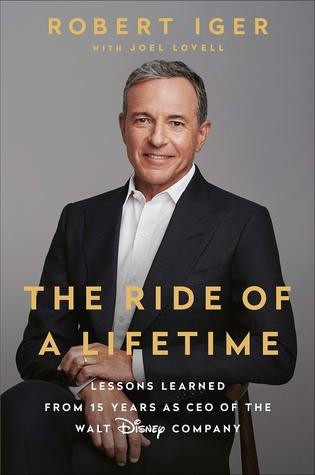
Former Disney CEO Iger's memoir covers his rise through the company and the major acquisitions (Pixar, Marvel, Lucasfilm, 21st Century Fox) that reshaped it, alongside genuinely reflective leadership principles about optimism, courage, and treating people with fairness even during difficult decisions.
Forty-five years of apprenticeship before the top job
The half of the book people skim is the half that explains the rest. Iger joined ABC in 1974 as a studio supervisor on the bottom rung, spent years in television production, and got his real education under Roone Arledge at ABC Sports — a boss he describes as brilliant, relentless and frequently impossible, who would tear up a plan hours before broadcast if he decided it wasn't good enough, and who taught Iger that the relentless pursuit of perfection is a working discipline rather than a slogan.
He then survived two takeovers of his own employer: Capital Cities buying ABC in 1985, and Disney buying Capital Cities/ABC a decade after that. Being on the acquired side twice, and watching closely how each new owner treated the people it had just bought, is the direct source of nearly everything he later did as an acquirer. He knew from the inside what it feels like when the new parent arrives with its own systems and its own certainty.
By 2005 he was Michael Eisner's number two in a company in visible trouble. Animation — the actual heart of the business — had gone cold. The relationship with Pixar, which was producing the hits Disney's own studio wasn't, had broken down almost entirely between Eisner and Steve Jobs. Roy Disney had resigned from the board and was running a public campaign against management. And Iger was the internal candidate in a CEO search that had been designed largely to produce an external one, which meant he had to make an argument rather than wait his turn.
The argument became three strategic priorities, and their clarity is the most transferable thing in the book. First, put the company's resources behind high-quality branded content, on the reasoning that in a world of infinite choice, brand is the shortcut people use to decide. Second, embrace technology rather than fight it, including where it disrupts existing revenue. Third, become genuinely global rather than an American company that exports. Almost every major decision of the next fifteen years traces back to one of those three sentences — which is what a strategy is supposed to do.
Deals where respect was the mechanism, not the manners
The Pixar acquisition is the best-told sequence in the book, and its lesson has nothing to do with valuation. Iger's opening move as CEO was to telephone Steve Jobs — a man who at that point had little but contempt for Disney's management — not about Pixar, but with a proposal to put ABC shows on the video iPod Apple was about to launch. It was a genuine concession, offered quickly, that gave away control of something Disney had been carefully protecting. It re-established a relationship. Only afterwards did a Pixar conversation become possible at all.
What made the $7.4bn deal work once signed was structural. Iger's pitch was never 'we will run Pixar better'; it was a written commitment to protect what made Pixar Pixar. Ed Catmull and John Lasseter kept real creative authority, the Emeryville culture was explicitly ring-fenced, and the pair were put in charge of Disney's own animation studio as well. The asset being bought was a culture, and culture is the one thing integration reliably destroys.
The same pattern repeats. With Marvel in 2009, Iger backed Kevin Feige and the argument that the characters were a coherent universe rather than a licensing library. With Lucasfilm in 2012, the negotiation with George Lucas was as much about legacy — how his life's work would be handled after he let go of it — as about the roughly $4bn price.
Iger is also honest about the limits of this, which is what stops the whole argument reading as public relations. Lucas was genuinely upset when Disney chose not to use his story treatments for the sequel trilogy, and Iger doesn't pretend the respect was unconditional or the relationship painless afterwards. Protecting what you bought and running what you own eventually collide.
Optimism and fairness as operating disciplines
Iger opens with ten leadership principles — optimism, courage, focus, decisiveness, curiosity, fairness, thoughtfulness, authenticity, the relentless pursuit of perfection, and integrity — and the risk with a list like that is that it reads like an airport-lounge poster. What rescues it is that he keeps returning to two of them with real specificity.
Optimism, in his framing, is neither cheerfulness nor denial. It is the discipline of always presenting a path forward alongside the bad news, on the argument that a leader's pessimism travels through an organisation faster and further than they ever realise, and that people cannot do good work in an atmosphere where the person at the top has visibly given up. The book shows him delivering genuinely awful news — he was running ABC on 11 September 2001, and that chapter is the least self-congratulatory in the book — and the pattern each time is identical: state the reality plainly, then say what happens next.
Fairness gets the same treatment, and his version is more precise than the word suggests. His argument is that how a hard decision is delivered is a separate discipline from whether it was the right decision, and that people forgive the decision far more readily than they forgive being handled, spun, or left to find out sideways. Applied to the executives he passed over, the leaders he replaced after acquisitions and the people he let go, this is the part of the book most directly usable by someone who runs eight people rather than 200,000.
Disrupting yourself before somebody does it for you
The Disney+ decision is the most instructive strategic call in the book, and it is instructive precisely because it was deliberately, calculably value-destroying in the short term. Disney was earning large, reliable, high-margin licensing revenue by selling its content to Netflix. Building a direct-to-consumer service meant pulling that content, forfeiting the revenue, spending enormous sums on technology and originals, and telling Wall Street to expect losses for years — in order to compete with an incumbent that had a decade's head start and no legacy business to protect.
Iger's framing is that a legacy organisation's natural gravity pulls towards protecting the existing margin, and that the job of the person at the top is to override that gravity while there is still time to choose the timing. The Fox acquisition, at roughly $71bn and against a live Comcast counter-bid, was the same bet placed larger: buying the content library and the Hulu stake that made the streaming play viable at scale.
The principle that does the most quiet work across all of it is the one that sounds most like a platitude: the relentless pursuit of perfection. Iger's version, learned from Arledge, is not perfectionism and it is not micromanagement. It is refusing to accept good enough on the things that define the product, and being explicit with a team about which things those are — because a leader who demands perfection on everything simply exhausts people, while one who demands it nowhere ends up running a company that makes acceptable films.
The book is also more willing than most CEO memoirs to sit with calls that had no clean answer — firing Roseanne Barr within hours of her tweet, handling the misconduct allegations against John Lasseter, the same executive whose creative independence he had spent a decade protecting, and repeatedly extending his own retirement date in a way he concedes made succession harder rather than easier. None of these resolve neatly, and the book is better for leaving them open.
Key lessons
- Genuine respect for a company's creative culture, demonstrated during acquisition negotiations, made major deals (Pixar, Marvel) work where a purely financial approach might have failed.
- Optimism, deliberately practised as a leadership discipline, spreads through an organisation the way pessimism does — leaders should choose carefully.
- Fairness and integrity in how difficult decisions are handled protects trust even when the decision itself is unwelcome.
- Innovation and risk-taking, even at a large legacy organisation, requires deliberate protection from an otherwise risk-averse corporate culture.
Major transformative deals and decisions succeed more often when built on genuine respect and fairness toward the people involved, not just financial logic — a lesson that scales down from Disney-sized acquisitions to any leadership decision.
What this means for a UK small business
Nobody reading this is buying Pixar, but the acquisition lesson scales down almost exactly. UK small firms buy each other constantly — an accountancy practice absorbing a retiring sole practitioner's client list, an agency merging with a specialist, a trades business taking on a competitor's vans and staff. The most common way those deals lose money is by immediately imposing the buyer's systems, software and pricing on the acquired side, and in doing so destroying the client relationships that were the actual thing being paid for. Iger's discipline costs nothing: decide explicitly what you are protecting before you decide what you are changing, and put it in writing where the other side can hold you to it.
The optimism principle is more useful in a ten-person business than in a global one, because in a small team the owner's face is the weather. A bad quarter, a lost major client, a VAT bill that lands worse than expected — the team reads the owner's demeanour long before they see any figures. The habit of pairing honest bad news with a specific next step is worth building deliberately, well before the day you actually need it.
What’s aged well
Recent and grounded in real, well-documented corporate history; likely to remain a widely cited leadership memoir.
What feels outdated
Nothing significant given recent publication.
Where it falls short
It is a memoir written by a sitting CEO at the peak of his reputation, and it reads like one. The account of Iger's own judgement is consistently favourable, and the parts of the Disney story that don't flatter him are either absent or handled lightly: the executive pay that drew public criticism from within the Disney family, the debt and the job losses that followed the Fox deal, and the labour conditions underpinning an empire of parks and productions.
It also stops in 2019 — before Disney+ met financial reality, before the succession he designed collapsed, and before his own messy return to the job in 2022. Read today, the confident closing chapters are the least reliable part of the book, and the strategic verdict they invite you to draw is one the author himself had to revisit.
The Business Stuff verdict
A genuinely thoughtful leadership memoir from someone who ran one of the most significant corporate transformations of the era.
Three things to actually do after reading it
- Before your next negotiation or acquisition-style deal, consider what genuine respect for the other side's culture would look like in practice.
- Practise deliberately choosing optimism in your next team communication about a difficult situation.
- Review a recent difficult decision for whether it was handled with genuine fairness, regardless of the outcome.
If you liked this, read next
Five similar books
- Steve Jobs (Walter Isaacson)
- Pour Your Heart Into It (Howard Schultz)
- Principles (Ray Dalio)
- Leaders Eat Last (Simon Sinek)
- The Culture Code (Daniel Coyle)
Common questions
Is it still worth reading now that Iger's succession plan collapsed and he came back?
Yes, but with the ending rewritten in your head. The book closes in 2019 on a note of confident completion — the deals done, Disney+ launched, the handover arranged — and very little of that held. Bob Chapek's tenure was short and unhappy, Iger returned in 2022, and the streaming business met a far harder financial reality than the closing chapters imply. None of that spoils the first four-fifths, which is about how he got there and how the acquisitions were actually done. It does mean the strategic verdict the book invites you to draw is one the author himself had to revisit, and the succession material now reads as evidence of how hard that problem is.
Is there anything here for a small business owner, or is it all billion-dollar deals?
More than you would expect, though it needs translating. The acquisition chapters are mostly about persuading founders that what they built will be respected rather than absorbed — the same problem anyone faces buying a small firm from the person who started it, and Iger is unusually specific about the promises he made and then kept. The leadership material scales down cleanly too: that a leader's pessimism spreads faster through a team than their optimism, and that how you handle an unwelcome decision matters more than the decision, both apply to a team of six. What does not transfer is the resource base. He could buy his way out of problems you cannot.
Is it a memoir or a leadership book?
A memoir, with leadership principles bolted on at either end. The principles chapter is the weakest part — optimism, courage, decisiveness, fairness, a list most readers could have guessed — and the real value sits in the narrative, where you watch those things cash out in specific decisions with specific costs. Read it as a case study in judgement rather than as instruction. It is also, unavoidably, a memoir written by a sitting chief executive at the height of his reputation: his own calls come out well, and the uncomfortable material, from executive pay to the debt and job losses that followed the Fox deal, is handled thinly or not at all.
What is the single most useful idea in it?
That you have to disrupt your own business before someone else does it for you, and be honest about what that costs. Pulling Disney's films from Netflix to build a streaming service meant deliberately destroying a large, reliable, high-margin licensing income and telling shareholders profits would fall for years while it happened. That is the version worth stealing: not the slogan, but the willingness to name which existing revenue line you are prepared to damage and for how long. Most owners who say they want to reinvent the business have never answered that second half, which is exactly why the reinvention stays permanently in the planning stage.