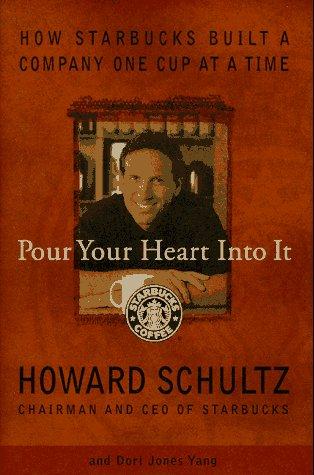
Starbucks founder Schultz's account of building the company around a genuine belief that employees, treated well (including offering equity and healthcare to part-time staff, unusual at the time), would deliver a genuinely better customer experience — and that scaling doesn't have to mean abandoning that founding value.
The founding story is really a healthcare argument
Schultz opens not with coffee but with his father: a delivery driver in Brooklyn who broke his ankle at work in the early 1960s, lost the job, lost the income, and had no health cover or compensation to fall back on. The family went from getting by to not getting by more or less overnight. Schultz returns to that scene throughout the book, and it is the load-bearing wall of everything else in it — the reason Starbucks extended health insurance to part-time employees working 20 hours a week or more from 1988, years before that was normal in American retail and at a point when the company was small and not yet consistently profitable.
What makes the chapter more than sentiment is that Schultz argues the case in the language of cost, not conscience. Retail businesses with high staff churn pay for that churn constantly: recruitment, induction, training, the productivity gap while someone learns the job, and — the expensive one for a business selling an experience — a customer-facing standard that wobbles every time a new face appears behind the counter. His claim is that the insurance bill came in below the turnover bill it displaced, and that the sceptics who saw it purely as a cost line were reading only half the ledger. You do not have to take his numbers on faith to find the framing useful; it is the rare business memoir that treats staff cost as an investment decision with a return to be argued rather than an expense to be minimised.
It is worth being clear about what Schultz did and did not found, because the book is often mis-remembered. Starbucks had existed since 1971 as a Seattle roaster selling beans, tea and equipment — no drinks. Schultz joined in 1982 to run retail operations and marketing. Everything the company is now famous for came after, and much of it over the founders' objections.
Milan, 1983, and the idea the owners did not want
The pivot point is a buying trip to a housewares fair in Milan in 1983. Schultz describes walking into espresso bars where the barista knew the regulars by name, worked the machine with visible theatre, and ran a room that was neither home nor office but somewhere people plainly wanted to be. He came back convinced that Starbucks was in the wrong business: it was selling beans to people who then made coffee alone at home, when the actual opportunity was the room.
The founders — purists about roasting, wary of becoming a beverage chain — said no, repeatedly. Schultz's response is the part worth studying: rather than keep lobbying, he left in 1985 and raised money to build the idea himself as Il Giornale, then bought Starbucks in 1987 for around $3.8 million when the original owners sold up to concentrate on Peet's, and put his stores under the Starbucks name. The lesson embedded there is uncomfortable and rarely stated so plainly in business memoirs: the company that later defined the category rejected the defining idea, and the idea only survived because someone was willing to carry the risk personally instead of waiting for permission.
He is also candid about how badly the first version worked. Il Giornale imported Milan wholesale — opera through the speakers, Italian-only menu boards, baristas in bow ties, standing room and no chairs — and customers quietly rejected almost all of it. Out went the opera and the bow ties; in came seats, English menus and takeaway lids. The durable insight was the third place; the Italian styling was costume, and Schultz's willingness to strip it out is a better demonstration of customer listening than any of the book's explicit passages about it.
The room is the product, which is what makes the price work
The commercial spine of the book is a pricing argument. A cup of filter coffee is close to a commodity, and no consumer pays a premium for a commodity for long. What Schultz was actually selling — and what the book borrows the sociologist Ray Oldenburg's phrase 'third place' to describe — was a reliably pleasant place to sit that was neither home nor work: predictable, unhurried, no obligation to buy again, your name on the cup, the same standard in a strange city as at home. Once that is the product, the premium is not a mark-up on beans; it is the price of the room and the ritual.
That reframing drives the operational choices that make up the middle of the book. Starbucks grew mostly through company-owned stores rather than franchising, which is slower and vastly more capital-hungry — every store is your own build cost and your own lease — and Schultz defends it squarely on control of the experience, licensing only in places the company could not own outright, such as airports and campuses. Store design, music, training, and the refusal to sell artificially flavoured beans all get argued the same way: does this protect the thing customers are actually paying for?
There is a useful discipline in that for any owner. Schultz's test is not 'will this make money' but 'does this protect or dilute the reason people choose us', applied to decisions that looked financially attractive in isolation. He is honest that this cost real opportunities and slowed real growth, and treats that as the price of admission rather than a regrettable side-effect.
Bean Stock, and the problem of scaling a value
The book's most-cited contribution is Bean Stock — company-wide equity granted from 1991 to employees working 20 hours a week or more, which is why Starbucks calls its staff partners rather than employees, a piece of language the book takes seriously enough to justify at length. It was granted before the 1992 flotation, meaning ordinary store staff held options in the company they served coffee in, and Schultz argues the effect showed up in stock losses, retention and the everyday small discretionary effort that no incentive scheme can specify in advance.
The deeper argument, and the one that outlives the specific scheme, is about what happens to a founding value at scale. Schultz's position is that a value does not survive growth by inertia — it survives because leadership keeps choosing it, out loud, at moments when a cheaper option is sitting right there and nobody would much notice the difference. Once the company passed a few hundred stores, he could no longer be in the room for those decisions, which turned culture into an operational problem: hiring, training, store-manager selection and the language the company uses about itself had to carry the value instead of the founder's presence. Much of the back half of the book is about that transfer, and it is the part most relevant to a reader running twenty people rather than twenty thousand.
He is also frank about the anxieties of that period — cannibalising his own stores by opening new ones nearby, the backlash from independents, the strain of expanding into markets he did not know, and the difficulty of hiring managers fast enough without lowering the bar. That candour is what stops the book reading purely as a victory lap, though it never entirely escapes being one.
Key lessons
- Investing genuinely in employee wellbeing (equity, healthcare, even for part-time staff) was framed as a business strategy, not just generosity.
- A clear, consistently defended core value can survive rapid scaling if leadership actively protects it rather than assuming it'll persist on its own.
- Creating a genuine 'third place' experience — distinct from home and work — became the actual product, beyond the coffee itself.
- Growth decisions were repeatedly weighed against whether they'd damage the core customer experience, not just against financial upside.
A founding value like genuine employee investment doesn't survive scaling by accident — it survives because leadership actively, repeatedly chooses to defend it even when a cheaper option is available.
What this means for a UK small business
The third-place argument translates almost directly to any UK café, salon, gym, barber or independent shop that cannot win on price against a chain. The defensible edge is the specific experience of being in your place — how you greet people, whether the regulars are known by name, how the room feels at 3pm on a wet Tuesday — and Schultz's point is that this should be designed on purpose and defended in decisions, not left as an accident of the décor you inherited with the lease.
The staff-investment argument deserves a serious reading in the current UK hospitality and retail market, where recruitment is hard, rotas are fragile and turnover quietly eats margin. You cannot copy Bean Stock, and you would not want to try — but the underlying question is scale-free: what does replacing a good frontline person actually cost you in advertising, training time, manager hours and wobbly service, and would a slice of that money spent on keeping them (better rotas, real training, a share of results, hours they can plan a life around) come in cheaper? Most owners have never put a number on the churn side of that ledger, which is exactly Schultz's complaint about the executives who resisted him.
One caution: he grew on other people's capital and could absorb years of thin returns to protect the experience. A UK owner with a bank overdraft and a personal guarantee has less room, so treat the principle as a decision test rather than a licence to spend.
What’s aged well
The employee-investment argument remains widely cited and increasingly relevant as businesses debate the value of investing in frontline staff.
What feels outdated
Some of the specific 1990s retail and coffee-culture context is dated, though the core values argument holds up.
Where it falls short
Published in 1997 near the top of the growth story, this is a founder's own account written while the verdict was still flattering, and it reads like one — generous to Schultz's judgement, light on the decisions that did not work, and structurally unable to engage with what came later. The Starbucks of the last two decades has faced sustained criticism over unionisation efforts, store closures, and the tension between third-place branding and a drive-thru, app-order business built for speed rather than lingering. None of that is here, and some of it sits awkwardly against the book's central claims.
It is also a values memoir rather than an operating manual: strong on why decisions were made, thin on the mechanics of how a growing retail business actually runs its numbers. Read it for the founding logic, not as a current or complete picture of the company.
The Business Stuff verdict
A genuinely values-driven business memoir, useful for anyone scaling a customer-experience business without wanting to lose its soul.
Three things to actually do after reading it
- Identify one founding value at risk of quietly slipping as your business grows, and decide deliberately whether to defend it.
- Consider one investment in employee wellbeing that would genuinely change the customer experience, not just morale.
- Weigh your next growth decision against whether it protects or dilutes your core customer experience.
If you liked this, read next
Five similar books
- Delivering Happiness (Tony Hsieh)
- The Culture Code (Daniel Coyle)
- Losing My Virginity (Richard Branson)
- The Ride of a Lifetime (Robert Iger)
- Grinding It Out (Ray Kroc)
Common questions
Did Howard Schultz actually found Starbucks?
No, and the book is clear about it even though most retellings are not. Starbucks was founded in Seattle in 1971 by three partners selling roasted beans, tea and equipment — there were no drinks to buy. Schultz joined in 1982 to run retail operations and marketing, came back from a 1983 buying trip to Milan convinced the shops should be Italian-style espresso bars, and left in 1985 when the owners refused. He built that idea himself as Il Giornale, then bought Starbucks in 1987 for around $3.8 million when the founders sold up. So he created the Starbucks you recognise, but not the company — and the interesting part of the story is that the business initially rejected the idea that made it famous.
What is the 'third place' and does it work for a small independent?
The phrase comes from the sociologist Ray Oldenburg and means somewhere that is neither home nor work but that people choose to spend time in. Schultz's argument is that this, not the coffee, was the actual product, and it is the reason a premium price held. For an independent it works, but only if you decide deliberately which business you are in. A café built for lingering needs seating, sockets, unhurried staff and regulars known by name. One built for the 8am rush needs speed, a queue that moves and a lid that does not leak. Both are viable. Being accidentally neither — slow service and nowhere comfortable to sit — is the version that fails, and it is the most common one.
Can a UK business copy the staff-investment argument without offering equity?
The mechanism does not transfer, but the arithmetic behind it does. Take an illustrative £26,000 frontline role that turns over twice a year: perhaps £300 in advertising, roughly 20 hours of a manager's time on recruiting and induction, and six weeks before the new person is genuinely up to speed. That is comfortably £2,000 to £3,000 each time, before counting the customers who noticed the service dip. Schultz's point is that this cost is real but invisible, while the wage line is visible, so businesses keep optimising the wrong one. Set against that number, better rotas, real training, predictable hours or a share of results stop looking like generosity and start looking like the cheaper option.
Is a book from 1997 still worth your time?
Yes, for the founding logic, and no as a picture of the company. It was written near the top of the growth story by the man running it, so it is generous to his own judgement and light on what did not work. Everything that has since complicated the Starbucks story — unionisation efforts, store closures, and a drive-thru and app-order business designed for speed rather than lingering — sits outside it, and some of that sits awkwardly against its central claims. Read it as the clearest available account of why a customer-experience business chooses to spend money on staff and rooms, then read something more recent if you want the company's later chapters.