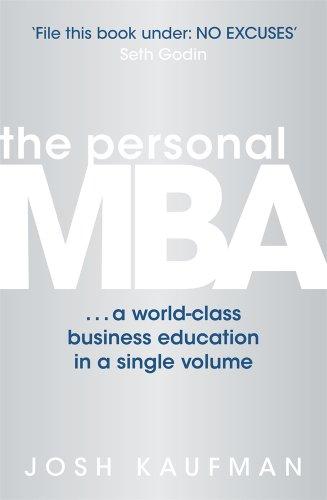
Kaufman's premise is that the core, genuinely useful ideas taught in an MBA can be learned far more cheaply and practically from the right books and explanations. The result is a wide-ranging reference covering value creation, marketing, sales, finance and systems, explained in plain language with minimal jargon.
Every business is five things
Kaufman's organising claim is that every business, at any size and in any industry, is doing five things and only five: creating something of value, marketing it so people know it exists and want it, selling it, delivering it, and managing the money that results well enough to keep going. Everything taught across a two-year MBA, he argues, is commentary on one of those five. The value of the frame isn't its originality — it's that it turns a vague feeling of 'the business isn't working' into a specific question about which of five functions is broken.
That diagnostic use is what makes it more than a list. A business with a queue of customers and no profit has a finance problem, not a marketing one, and pouring more into ads will make it worse faster. A business with an excellent product nobody has heard of doesn't need product work. A business that sells well and delivers badly is generating its own future collapse through refunds and reputation. Most owners instinctively work on the function they enjoy most, which is usually the one that isn't broken.
The framing behind the whole book is that the genuinely useful content of a business education is a few hundred well-explained concepts, learnable from books, and that the fees charged for it are only defensible if you're buying the network or the credential rather than the knowledge. He is not subtle about this. It's a marketing position as much as an argument, but it's a defensible one.
Value creation: the iron law, twelve forms, and testing before building
The bluntest idea in the book is the iron law of the market: a strong market — enough people, who want the thing badly, and have money — will carry mediocre execution, while brilliant execution aimed at a market that doesn't exist or can't pay will fail regardless of how good the work is. It reframes the first question about any new idea from 'can we build this well' to 'is there a group of people already trying and failing to solve this, with a budget'.
Kaufman gives that a usable structure with a market scorecard: score a prospective market out of ten on urgency, size, pricing potential, cost of acquiring a customer, cost of delivering the value, uniqueness of what you'd offer, speed to market, up-front investment, upsell potential and how evergreen it is. It isn't precise and doesn't pretend to be. Its function is to force the uncomfortable variables — cost of acquisition and up-front investment especially — into the conversation before enthusiasm has committed the money.
The most immediately profitable idea for an existing business is his list of twelve standard forms of value: product, service, shared resource, subscription, resale, lease, agency, audience aggregation, loan, option, insurance and capital. Most owners think about value in whichever single form their industry has always used, and the list is a fast way to spot an unclaimed model sitting right next to the current one — the one-off job that could be a maintenance subscription, the kit that could be leased rather than sold, the expertise given away free that could be an agency arrangement, the customer list that is itself an asset.
Behind all of it sits his account of why anyone buys anything, borrowed from research into fundamental human drives: the drive to acquire, to bond, to learn, to defend what you have, and to feel something. Every offer that works is hitting at least one of these, and usually the one the seller isn't talking about. A security system is sold on defend. A course is sold on learn and often on acquire. A restaurant is sold on bond and feel, not on the food. Working out which drive your product actually serves — as opposed to which one appears in your marketing copy — is one of the more clarifying half-hours available to an owner.
On building things, his position is sell before you build. Shadow testing — offering the thing, taking the order, and only then producing it — and minimum viable offers exist to get real money from real customers into the loop as early as possible, because stated interest is close to worthless as evidence. He pairs this with iteration velocity: the rate at which you can complete a cycle of build, test and learn matters more than the quality of any single guess.
Marketing, sales and the four ways to make more money
The marketing section is built around attention and permission. You need people to notice, then you need standing permission to keep talking to them, because the second is what turns a one-off spike of attention into an asset. The concept he leans on hardest is remarkability in its literal sense: something people remark on. Being merely good produces no conversation, and no conversation means paying for every customer forever.
The sales material is grounded in what he calls the three universal currencies — resources, time and flexibility — and the observation that every negotiation trades between them, so a customer who won't move on price will often move on timescale or on how bespoke the work is. He's practical on risk reversal: much of the friction in a sale isn't about whether the customer wants the outcome but about the possibility of looking foolish for buying, and guarantees, trials and staged commitments exist to move that risk off the buyer.
In finance, the single most useful item is his statement of the only four ways to increase revenue: more customers, larger average transaction, more frequent purchases, or higher prices. That's it. It sounds trivially obvious until you notice that almost every business instinctively reaches for the first, which is the most expensive of the four, while the third and fourth are usually available immediately from the existing customer base at effectively no acquisition cost. The material on cash-flow cycles, allowable acquisition cost and lifetime value gives you enough to work out what a customer is actually worth and therefore what you can afford to spend to win one — a calculation a surprising number of profitable-looking businesses have never done.
The back half: minds, teams and systems
The rest of the book widens out, and this is where it becomes a reference shelf rather than a narrative. There's a substantial section on how minds work, covering performance load, the cognitive switching penalty, akrasia — doing the thing you know is worse for you — and the resistance that reliably appears at the start of important work. The practical yield is small but real: batch similar work, cap what's in progress, and treat the reluctance to start as expected rather than as evidence the project is wrong.
The section on working with others covers communication overhead rising with headcount, the value of commander's intent over detailed instruction, the planning fallacy, and why safety determines whether people tell you things. The systems section is the most useful of the three: Gall's law, that complex systems which work invariably evolved from simple systems that worked, is worth taping to a wall before any software project. Alongside it sit the theory of constraints, feedback loops, standard operating procedures, checklists and stress testing, all explained in plain English in a page or two each.
None of the models is original to Kaufman and he never claims otherwise. The value is in having them assembled in one place, in plain language, indexed against the five functions, so that a specific problem — pricing feels wrong, hiring keeps failing, growth has stalled — routes you towards established thinking rather than requiring you to have separately stumbled across it across a dozen other books.
Key lessons
- A business fundamentally does five things: creates value, markets it, sells it, delivers it, and manages finances — everything else supports those five.
- The 12 forms of value describe the different ways a business can genuinely be useful to a customer, beyond just a physical product.
- Understanding core economic concepts (like the 'iron law of the market') helps you evaluate any new idea quickly and honestly.
- You can learn most of what a formal MBA teaches for a fraction of the cost, if you're disciplined about self-study.
You don't need a formal MBA to understand how businesses actually work — the core concepts are learnable, and this book is a genuinely useful map of what to learn.
What this means for a UK small business
The five-part frame is a genuinely fast diagnostic for a UK owner who is busy but stuck. Work through value creation, marketing, sales, delivery and finance in order, and the weak link usually names itself. In practice it's most often marketing — nobody beyond existing customers and referrals knows the business exists — or finance, where real profit per job is unknown because pricing was set years ago from a competitor's website and never revisited against actual costs.
The twelve forms of value are worth ten minutes against any UK service business quietly selling only the one-off version of something that could be a retainer. A trade doing reactive callouts could be selling annual servicing plans. A consultant billing days could be selling a subscription to availability. Recurring revenue changes what the business is worth as well as what it earns, which matters if you ever plan to sell it.
And the four ways to increase revenue is the cheapest exercise in the book: for most small firms, a considered price rise and a second thing to sell to existing customers are both available this quarter without a penny of new marketing spend. Against UK MBA fees running well into five figures, the book's central pitch lands fairly for anyone who wants the content rather than the network.
What’s aged well
The core business fundamentals covered are timeless by nature and haven't dated.
What feels outdated
None significantly; it's designed as an evergreen reference.
Where it falls short
Breadth is the selling point and the ceiling. Nothing here goes deep enough to replace a specialist, and anyone wanting real command of pricing, cash flow or hiring will need a dedicated book straight afterwards — the entries are typically a page or two, enough to know a concept exists but not to apply it under pressure. The reference structure also reads poorly cover to cover; it works far better dipped into. And a few of the digital and marketing examples now feel distinctly of 2010, in a part of the business world that has moved a very long way since.
The Business Stuff verdict
One of the best single-book primers on business fundamentals — a genuinely useful shelf reference, not just a one-time read.
Three things to actually do after reading it
- Identify which of the 12 forms of value your business actually delivers, explicitly, not just implicitly.
- Run a new idea through the core value-creation-to-finance chain before committing resources to it.
- Pick one weak area (finance, marketing, sales) and read the relevant chapters as a focused mini-course.
If you liked this, read next
Five similar books
- The E-Myth Revisited (Michael Gerber)
- Rework (Jason Fried & David Heinemeier Hansson)
- Company of One (Paul Jarvis)
- Zero to One (Peter Thiel)
- Good to Great (Jim Collins)
Common questions
Can this genuinely replace an MBA?
It can replace the content, and Kaufman is upfront that this is the claim. What it cannot replace is the network, the credential and the structured two years of being made to do the work, which for many people are the actual reasons to enrol. If you want an MBA because you intend to move into corporate finance or consulting where the letters open doors, read this anyway but do not cancel anything. If you want one because you run a business and feel you are missing the fundamentals, this book plus a few specialist titles covers the useful ground for the price of a takeaway.
What are the five parts of every business?
Creating something of value, marketing it so people know it exists and want it, selling it, delivering it, and managing the money that results well enough to keep going. Kaufman's argument is that everything taught across a two-year MBA is commentary on one of those five. Its real use is diagnostic. A business with plenty of customers and no profit has a finance problem, not a marketing one, and spending more on ads makes it worse faster. A business that sells well and delivers badly is manufacturing its own collapse. Most owners instinctively work on the function they enjoy, which is usually the one that is not broken.
What is the most immediately profitable idea in it?
His statement that there are only four ways to increase revenue: more customers, larger average transaction, more frequent purchases, or higher prices. Almost every business reaches for the first, which is the most expensive, while the other three are usually available from existing customers at no acquisition cost. For example, a firm with 200 clients paying an average of £600 a year turns over £120,000. Winning 10 new clients at a cost of £250 each adds £6,000 of revenue for £2,500 of spend. A considered 5% price rise across the existing 200 adds the same £6,000 for nothing, and it lands this quarter rather than next year.
Is it worth reading cover to cover?
Probably not, and that is not really a criticism. The first half, on the five functions and on value creation, reads as a proper argument and repays a straight read. The back half is closer to a reference shelf — several hundred concepts explained in a page or two each, covering how minds work, how teams communicate and how systems fail. Read the front, skim the back to learn what is in it, then come back to specific entries when a specific problem shows up. Treated that way it stays useful for years. Treated as a single sitting it becomes a blur of models by about page 200.