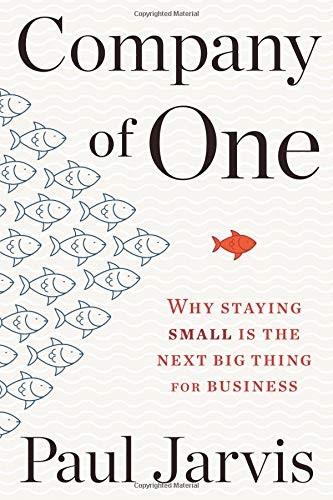
Jarvis makes the case for building a 'company of one' — a business deliberately kept small, resisting growth for growth's sake, optimising instead for autonomy, sustainability and staying genuinely good at a narrow craft, rather than the default startup assumption that bigger is always better.
Growth is a choice, not a default setting
Jarvis's opening provocation is aimed at an assumption baked so deeply into business writing that most readers have never noticed it's an assumption: that growth — more revenue, more staff, more locations, more of everything — is the automatic measure of success, and a business that stops growing has therefore failed. He argues this is borrowed venture-capital logic. It makes complete sense for a company that has taken investors' money and owes them a return several times over. It makes very little sense for the overwhelming majority of businesses, which have no investors, no exit timetable, and every reason to ask instead what size actually serves the owner's life and the quality of the work.
The definition is broader than the title suggests, and this is the bit most summaries get wrong. A company of one isn't necessarily one person. Jarvis defines it as any business that questions growth — which can be a two-person partnership, a fifteen-person firm that has decided fifteen is the right number, or even a team inside a larger organisation that resists the pressure to expand its headcount to justify its budget. The unit of analysis is the decision, not the payroll.
His own career is the running case study. He built a solo web design practice serving clients far larger than himself, and at the point where the obvious next move was to hire, rent an office and become an agency, he deliberately didn't — capping client numbers, raising prices, and later shifting into courses and writing. The counterfactual he keeps returning to is the agency he'd have built instead: more revenue, more staff, more overhead, and a job managing people rather than doing the work he was actually good at.
Resilience, autonomy, speed, simplicity
Jarvis identifies four traits that make a deliberately small business work, and they double as the argument for why small isn't merely acceptable but often genuinely superior.
Resilience is the ability to absorb a shock and keep going — a lost client, a market shift, a bad year. A business with low fixed costs and no debt can survive a 40% revenue drop by tightening the owner's own belt. A scaled competitor with premises, staff and finance covenants faces the same drop as an existential event requiring redundancies, negotiations and months of management attention. Autonomy is control over what you work on and who you work with, which Jarvis is refreshingly honest about: it isn't a right, it's earned by being genuinely good at something people will pay a premium for. Speed is the ability to change direction in a week rather than a quarter, because there's nobody to consult and nothing to unwind. Simplicity is the one owners most consistently underrate — every additional person, product line, tool and location adds coordination cost that shows up as meetings, admin and management time, none of which the customer pays for.
The corollary he presses hardest is that growth frequently doesn't improve profit. Revenue rises, but so do salaries, software seats, space, management overhead and the owner's own time spent supervising rather than producing. Plenty of businesses grow into a larger, busier, more fragile version of themselves earning the owner less per hour than before.
Better, not bigger — and 'enough' as a real number
The alternative metric is straightforward: instead of asking how do we grow this, ask how do we get better at this. Deeper expertise, tighter service, stronger relationships with the same customers or fewer of them, at higher prices — rather than a bigger book of business served worse. It is a genuinely different strategic question and it produces genuinely different decisions.
The most practically useful chapter asks the reader to calculate 'enough' as an actual figure. Two numbers: the personal one — what income does the life you want actually cost, honestly assessed — and the business one — what revenue and profit does that require. Without them, Jarvis argues, 'more' becomes the default target by omission, and it recedes forever because it was never defined. With them, everything downstream becomes a decision rather than a reflex: whether to take the client, whether to hire, what to do with the surplus.
He's also good on customer retention as the growth engine small businesses ignore. Winning a new customer costs a multiple of keeping an existing one, and a small firm's structural advantage is that it can deliver service a large one cannot economically match — the owner answering the phone, remembering the account, noticing a problem before the client does. Marketing spend chasing strangers is often the least efficient money a small business spends.
Start small, stay fundable by your own revenue
The final movement is about how these businesses begin. Jarvis argues for launching the smallest viable version, funded from revenue rather than investment, because outside money doesn't just add cash — it adds an obligation to grow at someone else's pace, which forecloses the entire strategy the book is arguing for. Constraints, in his framing, are a feature: a business that has to be profitable from month one is forced to find out quickly whether anyone will actually pay.
He also takes a swing at the follow-your-passion orthodoxy, siding with the view that passion tends to follow mastery rather than precede it. The practical advice is to get good at something people value, then let interest deepen — rather than waiting for a calling and discovering it doesn't pay. And he makes the case that having a recognisable personality is a small business's cheapest marketing asset: a one-person firm that sounds like a person will out-market a one-person firm that sounds like a corporation, and being polarising to some is the price of being memorable to anyone.
Customers you already have, and the tools that let you keep them
The chapter most likely to change what a reader does on Monday is the one on retention. Winning a new customer costs a multiple of keeping an existing one, and Jarvis's argument is that a small business's structural advantage — the owner knowing the account, answering the phone, spotting a problem before the client raises it — is precisely the thing a scaled competitor cannot match economically. A large firm can beat you on price, reach and hours. It cannot beat you on remembering.
So he treats service as the marketing budget. Not a service department, not a ticketing system, but the small, unscalable gestures that scaled businesses have to strip out: the follow-up call nobody asked for, the problem fixed without an invoice, the honest recommendation to spend less. His claim is that these produce referrals more reliably than advertising does, and cost less — which is convenient for a business that has decided not to have a marketing department.
Underneath this sits what he calls the un-scaling of business. The reason a company of one is more viable now than it was twenty years ago is that the infrastructure a small firm used to need a department for — accounting, payments, hosting, fulfilment, customer support, distribution — is available as software for a few pounds a month. One person with a laptop can genuinely operate at a level that once required premises and staff. Jarvis's warning is the corollary: because tools are cheap, it's easy to accumulate them until you're maintaining a stack rather than serving customers, and complexity creeps in through software just as readily as through headcount.
The last practical thread is capacity. A company of one has one hard constraint — the owner — and Jarvis is direct that the failure mode isn't going bust, it's burning out. Which makes saying no a core operating skill rather than a luxury, and makes price the main lever available: if you're full, the answer is usually to raise prices and serve fewer people better, not to work more hours or hire to absorb the overflow. That's the whole book in one decision, and it's the one most owners find hardest to actually make.
Putting real numbers on “enough”
The argument only becomes concrete when you do the arithmetic Jarvis keeps gesturing at, so here is an illustrative one. Take a solo consultant billing £95,000 a year with £11,000 of overheads — software, accountant, insurance, a desk somewhere. That is £84,000 of profit for one person's time, and it is the number the growth advice quietly assumes is not enough.
Now grow. Two hires at £34,000 each is £68,000 of salary. Employer National Insurance runs at 15% on earnings above the £5,000 secondary threshold in 2026/27, which adds £4,350 a head, or £8,700. Auto-enrolment pension contributions add roughly £1,800 between them. Call the extra overhead — desks, software seats, recruitment, the insurance uplift — £12,000. The team costs about £90,500 a year before anyone has billed an hour.
That means turnover has to reach roughly £185,500 just to stand still on profit. Say it goes well and the practice bills £215,000: profit lands near £113,500. The owner has grown turnover by 126% and profit by about 35% — an extra £29,500 — and in exchange has acquired two people's mortgages, a recruitment problem, a management job they were not previously doing, and a payroll that runs every month whether the work arrives or not.
Jarvis's point is not that £29,500 is worthless. It is that almost nobody runs this calculation before growing, so the trade never gets priced. Run it on your own numbers and the decision stops being about ambition and becomes arithmetic — and often the honest answer is that the smaller version already clears the bar.
Key lessons
- Growth is a choice, not an obligation — a deliberately small business can be a completely legitimate, sustainable goal, not a failure to scale.
- Staying small preserves autonomy and control that's often quietly sacrificed the moment a business starts adding headcount and complexity.
- Resilience — the ability to adapt and survive — is presented as more valuable than growth as the primary business metric to optimise for.
- A narrow, well-served niche audience can sustain a genuinely profitable business without needing broad market scale.
Growth isn't the only legitimate measure of business success — deliberately staying small, resilient and autonomous is a genuine, sustainable strategy, not a failure to be more ambitious.
What this means for a UK small business
This is the permission-slip book for the very large population of UK sole traders and small partnerships who never wanted twenty staff and an office, and who've absorbed a low-grade guilt about that from a decade of scale-up content aimed at a different kind of business entirely. Doing the 'enough' exercise properly — an actual number for personal income and an actual number for business turnover, written down — is worth an evening for any owner who's been growing on autopilot without checking whether the extra headcount and stress buy anything they want.
The resilience argument has been tested hard in the UK recently. Energy costs, borrowing costs and wage inflation have hit businesses with premises, stock and staff far harder than lean operators with low fixed overhead — a pattern anyone who watched their local high street between 2022 and 2025 will recognise.
The retention point has a specific UK edge too: for a trades business or a small practice, the cheapest growth available is usually raising prices with existing clients and improving the service enough that they don't flinch — not another round of leads. Jarvis would say do that first, and only then ask whether you need to be bigger at all.
What’s aged well
The argument has gained relevance as more founders openly question growth-at-all-costs assumptions since publication.
What feels outdated
Nothing significant given recent publication.
Where it falls short
Jarvis writes from a genuinely advantaged position — an established reputation, a high-value knowledge skill, and work that can be done from anywhere with a laptop. The book is thin on how staying small on purpose works for a business with premises, stock, or staff whose own careers depend on the firm growing. A café or a garage cannot simply cap client numbers and raise prices.
It's also a persuasive essay rather than an operating manual: strong on why, noticeably light on the mechanics of running a deliberately small business well — pricing, capacity planning, what to do when demand exceeds the cap. And the examples skew heavily towards US tech and creative work, which limits how directly the specifics transfer.
The Business Stuff verdict
A genuinely well-argued permission slip for founders who don't want the growth-at-all-costs path, worth reading even if you ultimately choose to grow.
Three things to actually do after reading it
- Write down honestly whether you're pursuing growth because you want it, or because it's assumed as the default.
- Identify one part of the business you could deliberately keep small rather than scaling by default.
- Consider resilience, not just growth, as a metric worth optimising for this year.
If you liked this, read next
Five similar books
- The 4-Hour Workweek (Tim Ferriss)
- Essentialism (Greg McKeown)
- Rework (Jason Fried & David Heinemeier Hansson)
- The Toilet Paper Entrepreneur (Mike Michalowicz)
- Buy Back Your Time (Dan Martell)
Common questions
Is Company of One just an excuse not to grow?
It is an argument that growth should be a decision rather than a default, which is not the same thing. Jarvis is not against growth; he is against growth adopted unexamined because business culture treats it as the only measure of success. His test is whether more revenue, more staff and more locations actually improve what you care about — profit per hour, resilience, quality of the work, the shape of your week — and his observation is that plenty of businesses grow into a busier, more fragile version of themselves earning the owner less than before. If growth passes that test in your case, grow. The book asks you to run the test.
Does any of this work if I have staff, premises or stock?
Less well, and this is the book's real weakness. Jarvis writes from a laptop-based knowledge business with an established reputation, where capping client numbers and raising prices is genuinely available. A café cannot cap covers and charge double, and a garage with four bays and four mechanics has fixed costs that make the low-overhead resilience argument much harder to reach. What still transfers is the thinking: calculating what enough actually costs, treating retention as cheaper than acquisition, and questioning whether the next hire adds profit or just adds activity. The specific tactics are for service businesses; the questions are for everyone.
How is it different from Rework or The E-Myth?
Rework is the closest relative and shares the scepticism about growth, but it is written from inside a software company scaling on its own terms, and it is a collection of short provocations rather than a sustained argument. The E-Myth is almost the opposite book: it wants you to systematise the business so it can run without you and, ultimately, get bigger. Company of One sits between them, arguing for a business deliberately kept at a size the owner chose, funded by its own revenue. If you only read one, pick by intent — E-Myth to build something that outgrows you, Company of One to build something that fits you.
How long does it take to read?
Around four to five hours across roughly 250 pages, and it reads quickly because it is essentially a long essay with examples rather than a framework to work through. The most useful chapters are the one on defining enough as an actual number and the one on customer retention, and both can be read in isolation. Do not expect an implementation manual: there are no templates, spreadsheets or step-by-step processes, and the one exercise genuinely worth doing — writing down the personal income figure and the business turnover figure that would count as enough — takes an evening on its own and matters more than the reading.