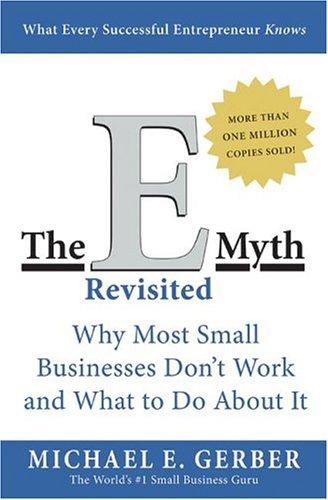
Gerber's central diagnosis is the 'fatal assumption': that someone who understands the technical work of a business understands how to run a business that does that work. Most small businesses, he argues, are started by technicians having an 'entrepreneurial seizure' — and then collapse under the weight of that assumption. The fix is to work on your business, not just in it: build systems and processes so the business doesn't depend entirely on your personal skill and presence.
The fatal assumption
Gerber's foundational observation is that most small businesses aren't started by entrepreneurs at all. They're started by technicians — the brilliant baker, the gifted plumber, the talented designer — who suffer what he calls an entrepreneurial seizure and act on a fatal assumption: that because they understand the technical work of a business, they understand how to run a business that does that work. Those are two entirely different jobs, and confusing them is why so many owners end up doing everything, exhausted, in what is really a badly paid job with unlimited liability and no holiday cover.
The seizure phase feels wonderful, which is part of the trap. Doing the work you love without a boss is genuinely better than working for someone else — right up until the point where the work you love becomes maybe a fifth of your week and the rest is quoting, chasing, hiring, VAT, complaints and the bank. Gerber's framing is that this isn't a failure of effort or character. It's the entirely predictable outcome of building a business around one person's hands.
Entrepreneur, manager, technician
Everyone running a business is three people sharing one body. The Entrepreneur lives in the future, sees opportunity and change, and is a nuisance to work for. The Manager craves order, plans, and clings to the past. The Technician just wants to do the work, now, and regards both of the others as obstacles. Gerber's contention is that in the typical small business owner the balance is wildly skewed towards the Technician — his own rough split is something like ten percent Entrepreneur, twenty percent Manager, seventy percent Technician — and the Technician wins every internal argument because the work is comfortable, the feedback is immediate, and it looks like productivity.
The consequence is structural rather than moral. A business run by its Technician stops growing at the edge of one person's capacity, because every improvement has to pass through the pair of hands that are already full. Gerber isn't arguing that you should stop doing the work you're good at; he's arguing that the Entrepreneur and the Manager need scheduled time, in the diary, in the week, because unlike the Technician they never shout loudest and will otherwise be permanently postponed to a quieter month that never arrives.
The three phases, and why adolescence is where firms break
Gerber's model of business growth has three phases and the middle one is where most owners are living when they pick up the book. Infancy is the owner as Technician doing everything, and it ends the day the work exceeds one person's capacity — usually announced by a dropped ball, a missed deadline or a customer who was let down. Adolescence begins when you get help, and Gerber's account of what typically happens next is uncomfortably accurate: the owner hires someone, hands over the parts they dislike most with no instruction beyond 'you know what to do', and then rediscovers the work themselves the first time it isn't done to their standard. He calls this management by abdication rather than delegation.
From there the business either shrinks back to the size one person can control, goes for broke and collapses under complexity it has no systems to handle, or survives in what Gerber calls adolescent hell — permanently just beyond the owner's grasp, permanently rescued by the owner working weekends. Maturity, in his account, isn't a stage you eventually reach by surviving long enough; it's a perspective the best businesses start with, in which the founder is building a business that works rather than a job that pays.
The franchise prototype and the turn-key revolution
Gerber's engine for getting out of adolescence is the franchise prototype, and the argument behind it is the strongest idea in the book. Ray Kroc's genius, he contends, wasn't the hamburger; it was recognising that the business itself was the product, and the customer for it was the franchisee. Build the business so that it produces a predictable result regardless of who is on shift, and you have something that can be sold, replicated, or simply run without you standing in it.
So: build your business as if you intended to franchise five thousand of it, whether or not you ever will. That thought experiment imposes a set of rules with real teeth. The model must deliver consistent value beyond what customers, staff and suppliers expect. It must be operable by people with the lowest possible level of skill — not because people are stupid, but because a business that requires exceptional people to produce ordinary results is a business built on a dependency you can't buy reliably. It must be documented in an operations manual. And its results must be uniform and predictable, because a customer's trust is built on knowing what will happen next.
The section on skill level is the one that provokes most argument and is most often misread. Gerber isn't advocating a workforce of automatons; he's pointing out that great businesses get consistently good results from ordinary people because the system carries the quality — the checklist, the script, the standard, the photograph of what a finished job should look like — which is precisely what frees the genuinely talented people to spend their judgement on the parts that need it.
Innovation, quantification, orchestration — and starting with your own life
The operating loop Gerber gives you is three words. Innovation is finding a better way to do a specific thing — the greeting, the follow-up call, the quote format. Quantification is measuring what changed, because without numbers an innovation is just an opinion. Orchestration is eliminating discretion once you know what works, so the better way becomes the only way rather than something the keen ones do on good days. It's a simple cycle and it's the practical core of everything else in the book.
His marketing strategy chapter deserves a mention because it cuts against what most owners believe about their own customers. Gerber's contention is that you don't sell what you think you sell — the pie shop isn't selling pies, it's selling whatever feeling makes someone choose that shop — and that the two things you must actually know are your customer's demographics (who they are) and psychographics (why they buy). His example of the colour of a shopfront or the shade of a suit changing conversion rates is characteristically unevidenced, but the instruction behind it is sound and cheap to act on: stop guessing and go and ask a dozen of your best customers why they picked you, then build the offer around the answer rather than around what you enjoy making.
The step most readers skip is the one Gerber puts first: the primary aim. Before the strategic objective, before the organisation chart, he insists you write down what you actually want your life to look like — how you want to spend your days, how much money you need, when you intend to stop. The business is then designed as a means to that, and gets measured against it. His organisational strategy follows the same logic and is startlingly practical for a business of three: draw the organisation chart your business will need at maturity, with every role named and a written position contract describing what each is accountable for; put your own name in every box; then replace yourself one box at a time, starting from the bottom, handing over a documented job rather than a vague hope. That single exercise is worth the cover price.
Key lessons
- The 'fatal assumption' is believing that technical skill at the work equals skill at running a business that does the work.
- Work on your business, not just in it — spend deliberate time on the systems that let the business run without you.
- Build the business as if you were going to franchise it, even if you never actually do — document processes so anyone competent can follow them.
- You need three roles inside every business: the Entrepreneur (vision), the Manager (systems and order), and the Technician (the actual work) — and most owners over-index on Technician.
- A business's systems should produce a consistent outcome regardless of which specific person is doing the work on a given day.
A business that only works because you personally show up every day isn't a business — it's a job you've trapped yourself in, and it's fixable.
What this means for a UK small business
This is arguably the most directly applicable book in the whole library for the UK's five-million-plus small business population, the overwhelming majority of whom are technicians with a Companies House registration. The diagnostic is the holiday test: if the money stops when you're in Tenerife for a fortnight, you own a job rather than a business, and everything Gerber says applies to you.
Start smaller than the book implies. One system, written down this week — the enquiry-to-quote process, the onboarding email sequence, the end-of-job checklist with a photo of what good looks like. Then the next one. UK owners have an additional reason to document as they go: employment law here makes it genuinely hard to manage out someone who was never told in writing what the standard was, so a position contract that says what a role is accountable for is both a Gerber system and your evidence if it ever goes wrong.
It's also the book that explains why so many capable tradespeople stay stuck at one van forever. It's almost never a shortage of demand. It's that nothing is written down clearly enough to hand to a second pair of hands, so every attempt at a second van costs the owner more time than it saves and gets quietly abandoned.
What’s aged well
The core diagnosis of technician-founders drowning in their own businesses is timeless and shows up constantly in trades, hospitality and creative small businesses today.
What feels outdated
The franchise-prototype metaphor and some of the 1980s small-business examples (the book was originally written in 1986, revised in 1995) feel a little dated, though the underlying logic still holds.
Where it falls short
The framing device — a long, slightly saccharine dialogue with a pie-shop owner called Sarah, who exists mainly to have realisations at convenient moments — pads a genuinely good 100-page idea out to 270, and the tone drifts towards infomercial in places, which is not entirely a coincidence given Gerber built a large consulting business selling exactly this medicine. The franchise-prototype lens also fits repeatable service businesses far better than creative, advisory or relationship-led ones, where over-systemising risks stripping out precisely what the customer is paying for. And the evidence throughout is assertion and anecdote rather than data.
The Business Stuff verdict
One of the most practically useful books for a genuinely small business owner, still, decades later — required reading before your third hire.
Three things to actually do after reading it
- Pick one task only you currently do, and write down the exact steps well enough for someone else to follow it this week.
- Block one hour weekly, permanently, for working ON the business — systems, hiring, direction — not IN it.
- List your business's three or four core processes and rate, honestly, how consistent the outcome is regardless of who does the work.
If you liked this, read next
Five similar books
- Traction (Gino Wickman)
- Built to Sell (John Warrillow)
- Scaling Up (Verne Harnish)
- Work the System (Sam Carpenter)
- Company of One (Paul Jarvis)
Common questions
Is The E-Myth Revisited worth reading if I have read summaries of it?
The core diagnosis — that technicians start businesses and then get trapped doing the technical work — is fully conveyed by any decent summary, so if that is all you want, you have it. What summaries consistently drop is the practical scaffolding in the last third: the primary aim, the organisation chart drawn for the business at maturity with your own name in every box, the position contracts, and the innovation-quantification-orchestration loop. That material is the actionable half of the book and it is the reason the book still sells. Read the first 60 pages quickly, then slow down for the business development programmes, which is where the work actually is.
What does 'work on the business, not in it' mean in practice?
It means blocking time to build the thing that does the work, rather than doing the work. Concretely: this week, pick one repeated process — the enquiry-to-quote sequence, say — and write down exactly how it happens, step by step, to the standard you would accept. Next week, the onboarding email. The week after, the end-of-job checklist with a photograph of what a finished job should look like. Say you are billing at £60 an hour and you spend two hours a week on this: that is £6,000 of foregone billing a year, and it buys you a business that can add a second pair of hands without your standards collapsing.
Does the systems approach kill the personality of a small business?
This is the most common objection and Gerber's answer is better than his critics allow. He is not arguing for scripted robots; he is arguing that a business which needs exceptional people to produce ordinary results is built on a dependency you cannot reliably buy. When the system carries the routine quality — the checklist, the standard, the photograph of the finished job — the genuinely talented people are freed to spend their judgement on the parts that need it. That said, the objection has real force in creative, advisory and relationship-led businesses, where over-documenting risks stripping out precisely what the customer is paying for. Systemise the repeatable; leave the judgement alone.
Who should not read this book?
Founders of venture-backed, fast-growth technology businesses will find the franchise-prototype lens a poor fit — that world is about finding a repeatable model at all, not documenting one you already have. Anyone allergic to a folksy tone should also be warned: the book is framed as a long dialogue with a pie-shop owner called Sarah who exists mainly to have realisations at convenient moments, and it pads a genuinely good 100-page idea to 270. And if your business is already systemised and you are looking for advice on scaling a management team, this is aimed at an earlier stage than the one you are in.