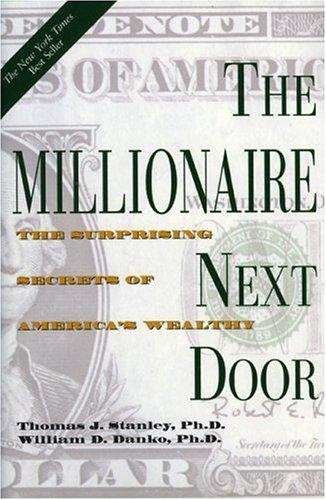
Based on extensive research into actual US millionaires, Stanley and Danko found that most don't look like the popular image at all — they live well below their means, drive ordinary cars, and prioritise building assets over visible status spending. The book remains one of the most cited studies on how wealth is actually accumulated.
The research that broke the picture of wealth
Stanley and Danko started from a mismatch. Financial firms kept aiming products at expensive postcodes and visible spending, and kept finding surprisingly little actual money behind the big houses and the leased cars — while ordinary-looking households in unremarkable streets turned out to be sitting on genuine wealth. The book is the write-up of two decades of surveys, interviews and focus groups with American households worth a million dollars or more, and its finding is that the outward signals people use to guess who is rich are frequently signals of the opposite, because that lifestyle is normally funded by spending rather than owning.
There is a famous scene early on that does more work than any table. The researchers assembled a focus group of genuinely wealthy men and, assuming they were catering for the rich, laid on pâté and expensive Bordeaux. The first participant explained he had never in his life drunk anything more expensive than free beer and Budweiser. Nobody touched the pâté. The people they were studying had no interest whatsoever in the props of wealth, which was precisely why they had any.
The analytical tool that comes out of the research is the distinction between Prodigious Accumulators of Wealth and Under Accumulators of Wealth — PAWs and UAWs. Two households can earn identical incomes for identical numbers of years and end up with wildly different net worths, and the difference is almost entirely behavioural rather than a matter of luck, inheritance or pay grade.
The formula: work out where you actually stand
The book's single most useful page is an arithmetic test for which of those two you are. Take your age, multiply it by your total pre-tax annual household income, and divide by ten. That is roughly what your net worth ought to be, given what you've earned and how long you've been earning it. Double that figure and you are a prodigious accumulator; half of it or less and you are an under-accumulator, however impressive the income.
It is worth doing on paper because the answer is usually startling. A forty-five-year-old household on £85,000 a year has an expected net worth of about £382,500. To count as a PAW they'd need around £765,000; at £191,000 or below they are an under-accumulator regardless of how comfortable life feels. The formula's power is that it puts income and net worth in the same sentence, which almost nobody does, and it makes the uncomfortable point that a rising income raises the bar rather than clearing it.
That is the book's central claim in numerical form: income is not wealth. High earners who spend to match their income stay permanently fragile, while comparatively modest earners who hold their spending well below what they bring in accumulate seriously over time. Stanley and Danko frame it as offence and defence. Most people play decent offence — they earn respectably — and almost no defence at all, and defence is the half that compounds.
A related finding is easy to miss and worth the price of the book on its own: the wealthy households in the study deliberately kept their realised, taxable income low relative to their net worth. Their money grew in things they weren't obliged to sell — a business, property, long-held investments — so it compounded without being taxed along the way, while the high-earning under-accumulators were converting everything into salary and paying for the privilege annually. Two households can be doing the same thing economically and one of them is handing over a slice of it every April because of how the income is structured.
Seven factors, and the very boring businesses behind them
The authors distil the research into seven shared characteristics, and the list is deliberately unglamorous. They live well below their means. They allocate time, energy and money efficiently towards building wealth. They value financial independence over displaying social status. They did not receive ongoing financial help from their parents. Their adult children are economically self-sufficient. They are proficient at spotting market opportunities. And they chose the right occupation.
The second one is more concrete than it sounds: the research found that prodigious accumulators spend substantially more hours each month planning their financial lives — reviewing, budgeting, deciding — than under-accumulators do. It is not that they are cleverer about investments. It is that they spend time on it at all, and the under-accumulators are busy managing the consequences of not having. The behavioural marker the authors keep returning to is unglamorous to the point of comedy: the accumulators could tell them roughly what their household spent each year on food, clothing and housing. The under-accumulators, on far higher incomes, generally could not. Budgeting is not presented as a virtue here so much as a piece of instrumentation — you cannot hold spending below income if you don't know what either number is.
They also found a widespread habit worth borrowing: a reserve large enough to live on for years without working, which several of their interviewees called a 'go to hell fund'. The name captures the point better than any financial-planning language does. Its purpose is not investment return; it is the ability to walk away from a customer, a contract or an employer without the decision being made for you by the mortgage.
The occupation finding is the one most relevant to anyone reading a business site. Self-employed people and business owners are heavily over-represented among the genuinely wealthy relative to their share of the population, and the businesses in question are almost aggressively dull — welding contractors, pest control, mobile home parks, dry cleaning, scrap metal, rebuilt engines. Very few glamorous industries. The authors' explanation is partly control over how income is deployed and partly the discipline forced on people whose income was never guaranteed. The consumption findings run the same way: a large proportion of the millionaires surveyed bought used cars, haggled hard, and had never spent anything close to what their income would have permitted on a vehicle.
Economic outpatient care
The chapter that has aged best, and stings most, is on what the authors call economic outpatient care: regular cash gifts and subsidies from wealthy parents to adult children. The finding is counterintuitive and consistent — recipients of ongoing help tend to consume more and accumulate less than comparable people who received none, and the effect strengthens the longer it goes on. The subsidised deposit supports a house whose running costs require the next subsidy. The gift becomes an expected part of the household's standing budget rather than a foundation to build from.
Stanley and Danko are careful to distinguish this from paying for education or a genuine one-off leg-up, which they find has the opposite effect. What corrodes is the recurring transfer, particularly when it is used to sustain a lifestyle the recipient's own income cannot support — because it removes exactly the constraint that produces accumulating behaviour in the first place, while quietly signalling that the recipient is not expected to manage without it.
It connects back to the fifth of the seven factors — their adult children are economically self-sufficient — and it is the part of the book most likely to change what a successful owner does with their money, as opposed to how they feel about it.
Key lessons
- Most actual millionaires live well below their means and don't display visible signs of wealth — the popular image is largely wrong.
- Income and net worth are not the same thing; high earners who spend it all are frequently less wealthy than modest earners who save.
- Business owners are disproportionately represented among the genuinely wealthy compared with high-earning employees.
- Deliberate, unglamorous budgeting and consistent investing beats occasional windfalls for building lasting wealth.
Genuine wealth is built through consistent saving and investing well below your means, not through visible spending that looks like wealth — the two are frequently opposites.
What this means for a UK small business
Run the formula. Age times household income divided by ten, then compare it with what you'd actually be left with if you sold everything and cleared the debts. For owners drawing a comfortable mix of salary and dividends, the gap between feeling well off and being well off is usually the whole point of the exercise, and the answer is not improved by a good year unless some of that year was retained.
The finding that business owners over-index among the genuinely wealthy is encouraging for this readership, but the warning attached matters just as much: that advantage only shows up for owners who behave like accumulators, living below what the company could afford them, rather than treating the business as a machine for funding a lifestyle. The van, the watch and the extension are all paid for out of the same pot as the pension and the reserve.
One UK caveat worth holding: a large share of British household net worth sits in a main residence you still have to live in, so a flattering balance sheet can be almost entirely illiquid. Count it, but don't count on it.
What’s aged well
The core research findings about wealth-building behaviour remain widely cited and broadly still hold.
What feels outdated
Some of the original data is dated (mid-1990s figures), though the behavioural patterns described remain relevant.
Where it falls short
The research is thirty years old, entirely American, and conducted across an exceptional bull market — a point Nassim Taleb made pointedly in Fooled by Randomness, along with the more damaging charge of survivorship bias: the authors studied people who got rich, not a control group of equally frugal people who didn't. The net worth formula also breaks at the edges, mechanically labelling almost anyone under thirty an under-accumulator and flattering anyone whose income only recently rose. The car brands, house prices and geography don't map onto Britain at all, and the moralising about spending reads differently in an era where UK housing costs consume a far larger share of income than the book's original context assumed.
The Business Stuff verdict
A genuinely eye-opening, research-backed corrective to popular assumptions about what wealth actually looks like.
Three things to actually do after reading it
- Compare your own visible spending against your actual net worth honestly, without judgement.
- Identify one status-driven expense that isn't actually building any lasting asset.
- Set a savings/investing rate as a genuine fixed habit, not an occasional intention.
If you liked this, read next
Five similar books
- The Psychology of Money (Morgan Housel)
- Rich Dad Poor Dad (Robert Kiyosaki)
- The Intelligent Investor (Benjamin Graham)
- Your Money or Your Life (Vicki Robin)
- I Will Teach You to Be Rich (Ramit Sethi)
Common questions
Is The Millionaire Next Door still worth reading in 2026?
Yes, but read it as a book about behaviour rather than a set of findings to rely on. The fieldwork is 1990s American and the specific detail — the car brands, the house prices, the neighbourhoods — has aged badly. What survives is the distinction the book made famous: income is what you earn, wealth is what you keep, and the two run together far less often than people assume. That lands just as hard on a UK owner drawing a good salary out of a limited company and wondering why nothing has actually accumulated. Treat the chapters as a mirror rather than a map, and skim the American consumer detail without guilt.
Has the research behind it been discredited?
Not discredited, but it has taken serious and fair criticism. The most damaging charge is survivorship bias: Stanley and Danko interviewed people who had already become wealthy and worked backwards to their habits, with no control group of equally frugal people who never got there. Nassim Taleb made the point bluntly in Fooled by Randomness — the study ran across an exceptional American bull market, so the investment returns doing much of the work were partly a feature of when these people happened to be buying. The frugality findings themselves are not really in dispute. The causal claim, that living below your means reliably produces millionaires, is doing more work than the data supports.
Does the net worth formula work for a British reader?
Roughly, though it needs translating. The formula multiplies your age by your annual pre-tax income and divides by ten to give an expected net worth; twice that and you are a prodigious accumulator, half of it and you are an under-accumulator. Two things distort it here. It treats all net worth as interchangeable, so a pension you cannot touch for decades scores identically to cash you could put into the business tomorrow, which is a real distinction for an owner. And it punishes the young by construction, because someone at twenty-six has had almost no years for the multiplication to work. Use it once as a direction-of-travel check, not as an annual scorecard.
What does it say business owners actually do differently?
Nothing glamorous, which is rather the point. The self-employed were heavily over-represented among the wealthy in the sample, and the businesses were unremarkable ones — contractors, services, ordinary trades with steady demand and no status attached. The behaviours were equally dull: knowing to the pound what the household spends, budgeting deliberately rather than by feel, putting real hours each month into planning finances, and refusing to let one good year in the business become a permanent step up in lifestyle. The pattern the authors kept finding was owners who ran a plain business well and stayed quiet about it, rather than owners who found an exciting sector.