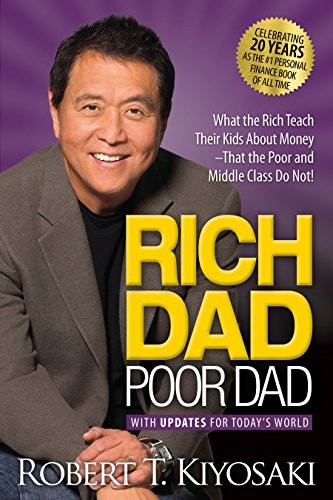
Framed as a comparison between the financial philosophies of Kiyosaki's own father (educated, but financially cautious and employee-minded) and his best friend's father (an entrepreneur, financially bold), the book's core argument is simple: the rich buy assets, the poor and middle class buy liabilities they mistakenly call assets, like an owner-occupied home. Whatever you make of the disputed authenticity of the two 'dads', the underlying reframe of assets versus liabilities has genuinely changed how a generation of readers think about money.
Two dads, one argument
The book's structure — Kiyosaki's own highly educated, cautious, salaried father set against his best friend's entrepreneurial, financially bold one — is a teaching device more than a documented biography, and the existence of the second man has been credibly disputed since publication. Taken as parable rather than memoir, the contrast does its job. One path optimises for qualifications, a secure job, a pension and a paid-off house; the other for financial literacy, ownership and assets that pay you whether or not you turn up. Kiyosaki is entirely unambiguous about which he thinks wins over a lifetime, and the force of the book comes from how directly it attacks the first path, which is the one most readers were raised to want.
The framing device that carries the argument is the rat race: earn more, pay more tax, acquire more expense, need to earn more. Kiyosaki's claim is that a pay rise, in the absence of financial literacy, mostly buys a larger set of obligations, which is why higher earners so often feel no more secure than they did before. The escape isn't a bigger salary. It's changing what you do with the money in between.
The asset-liability reframe
This is the book's one genuinely durable idea, and it is repeated relentlessly because it is worth repeating: an asset puts money in your pocket, a liability takes money out. By that strict cash-flow test, plenty of things people proudly list as assets — the house you live in, the car on finance, most of what appears on a personal net-worth spreadsheet — are liabilities. It is a deliberately narrower definition than an accountant would use, and the narrowness is the point. It forces the only question that matters for building wealth: is this thing generating income, or quietly draining it?
Kiyosaki supports it with the crude cash-flow diagrams that are the most-copied pages in the book: money coming into the poor household and leaving straight out as expenses; the middle-class household routing income through liabilities dressed up as assets; the wealthy household building an asset column that throws off enough income to cover the expenses. Whatever you make of the author, the diagrams communicate something a great deal of personal-finance writing never quite manages — that the shape of the flow matters more than the size of the income, and that the middle-class pattern is a treadmill rather than a slower version of the wealthy one.
He follows it with the instruction to mind your own business, meaning the distinction between your profession — what you get paid for — and your business, the asset column you are building on the side. His argument is that most people spend an entire career diligently building someone else's asset column and reach retirement having built nothing of their own, and that the fix isn't quitting your job, it's refusing to let the job be the whole plan.
He is also specific, for once, about what counts. Kiyosaki's asset column is businesses that don't require your personal presence, shares, bonds, income-producing property, royalties from intellectual property, and anything else with value that generates income or reliably appreciates. The common thread is that none of them require you to be in the building, which is the actual definition of the freedom the book is selling — and it is also the test that quietly disqualifies most owner-operated small businesses, where the owner leaving for a month would stop the income entirely.
The origin story does more work than its length suggests. Kiyosaki describes himself at nine, working for the rich dad for ten cents an hour and then for nothing at all, and being made to sit with the resentment until he stopped waiting for a raise and started noticing the opportunities in front of him — the comic books being thrown away, and the lending library he built out of them. Whatever its literal truth, the lesson is the one the book keeps returning to: a wage negotiates the price of your time, while the alternative is to stop selling time altogether.
Financial literacy, and inventing money
Kiyosaki's second argument is that how much you earn matters far less than what you understand, and he defines financial IQ concretely: accounting, investing, understanding markets, and law. Income alone doesn't compound; income that is understood, structured and reinvested does. He's persuasive on why schools don't teach any of it, and on the consequence — that people making the largest financial decisions of their lives do so with no framework at all beyond what an estate agent or a salesperson tells them.
The most-quoted chapter argues that the rich invent money — that opportunities are created by financial knowledge rather than found by luck, and that the person who understands how a deal is structured sees possibilities invisible to someone who doesn't. He illustrates it with property stories, and this is where the book asks for its largest leap of faith: the returns described are extraordinary, the details thin, and no independent verification has ever been offered.
The tax and corporations chapter is the most consequential and the most dangerous. Kiyosaki's argument is that employees earn, are taxed, then spend what's left, while a business owner earns, spends legitimately through the company, and is taxed on what remains — and that this ordering, compounded over decades, accounts for a large share of the gap. The structural insight is real and does apply, in modified form, in the UK. The book's presentation of it as an almost unlimited advantage is not, and the specifics are entirely American.
Fear, and working to learn
The closing argument is psychological. Kiyosaki's position is that the barrier to building an asset column is almost never a lack of capital or opportunity — it is fear of loss, and the desire for the certainty of a monthly payslip, which together keep people in the pattern they can see isn't working. He's honest that everybody feels the fear; his claim is only that the financially successful act anyway, having done the work to know what they're looking at.
He names five specific obstacles that stop financially literate people acting on what they know, and this is the most useful list in the book: fear of losing money, cynicism (the endless what-ifs that talk you out of everything), laziness disguised as busyness, bad habits — chiefly paying everyone else before yourself — and arrogance, which he defines as ego plus ignorance, the state of not knowing something and behaving as though the gap doesn't matter. His counter to the bad-habits one is the pay-yourself-first rule: move money into the asset column before the bills, and let the resulting pressure force you to find the rest, an approach that is either bracing or reckless depending entirely on your circumstances.
The last lesson is the one most worth keeping: work to learn, not to earn. Take the job, the role or the side project that teaches you a skill you're missing — selling, negotiating, reading accounts, managing people — over the one that pays slightly more for what you can already do. For a young reader with time to compound, that is genuinely good advice, and it sits oddly well alongside the rest of a book otherwise fixated on the shortest route to passive income.
Key lessons
- An asset puts money in your pocket; a liability takes money out — many things people call assets (like a personal home) are, by this strict definition, liabilities.
- Financial literacy — understanding accounting, investing, markets and law — matters more than how much you earn.
- 'The rich don't work for money, they make money work for them' — building or acquiring income-generating assets beats trading time for a salary alone.
- Fear and self-doubt stop most people from taking the financial risks that actually build wealth — not lack of opportunity.
- Your own financial education is your responsibility; most school systems don't teach it, so you have to seek it out deliberately.
Reframing the basic question from 'how much do I earn' to 'what assets am I actually building' changes long-term financial decisions more than any single tactic.
What this means for a UK small business
The asset-liability test is worth applying literally to your own balance sheet. The van on finance, the office lease, the second car, the home you live in — none of them put money in your pocket unless deliberately structured to. Listing what genuinely generates income against what merely feels like wealth is a clarifying hour, whatever you make of Kiyosaki himself, and for a business owner it usually exposes how much of the "asset column" is actually the business, and how dangerously concentrated that is.
The financial-literacy argument lands hard in the UK, where structure genuinely changes outcomes: salary versus dividends, corporation tax on retained profits, pension contributions made from the company, the VAT threshold, capital allowances on equipment. These are mechanics, not secrets, and understanding them measurably changes what an owner keeps. An hour with a decent accountant usually pays for itself several times over precisely because so few owners have done the reading Kiyosaki is arguing for.
One firm warning: do not import the tax chapter. UK rules on what a company can legitimately deduct, on benefits in kind, and on drawing money out are strict and specifically policed by HMRC. Take the reframe. Take the specifics from a qualified UK adviser.
Run the test literally. For example, a van on finance at £340 a month, a personal car at £280, and a home with a £1,150 mortgage take roughly £1,770 out of your pocket each month and put nothing back. Against that, a let property clearing £300 after costs and a business that runs for a fortnight without you are the only lines on the page doing what Kiyosaki calls asset work. Most owners have never seen those two columns side by side, and the gap is the point of the exercise.
What’s aged well
The core asset-versus-liability reframe remains a genuinely useful mental model regardless of how you feel about the author's later career.
What feels outdated
Several of the book's specific factual claims and the authenticity of the 'rich dad' character have been credibly challenged over the years, and some later advice from the same author has been widely criticised — read the original book on its own merits rather than as investment advice.
Where it falls short
This is the shakiest book on the list on factual grounds. The authenticity of the rich dad has been credibly challenged, the property returns are described with no verifiable detail, and the tax argument is American in a way that could get a UK reader into genuine trouble if followed literally. Kiyosaki's subsequent career — a long tail of seminars sold under the brand, and one of his companies filing for bankruptcy in 2012 after losing a multi-million-dollar court judgement — has not helped the book's standing either.
Read it for the asset-versus-liability reframe and the work-to-learn advice. Verify anything specific — tax, structures, leverage, investment vehicles — against a properly qualified UK adviser, not these pages.
The Business Stuff verdict
Useful as a mindset primer despite the disputed backstory; pair it with more rigorous personal finance reading before acting on anything specific.
Three things to actually do after reading it
- List your current assets and liabilities using the book's strict definition, not the conventional accounting one.
- Identify one liability you've been calling an asset, and reconsider it honestly.
- Commit to one hour a week of genuine financial education — books, courses, or a proper conversation with an adviser.
If you liked this, read next
Five similar books
- The Psychology of Money (Morgan Housel)
- The Millionaire Next Door (Thomas Stanley)
- Your Money or Your Life (Vicki Robin)
- I Will Teach You to Be Rich (Ramit Sethi)
- The Barefoot Investor (Scott Pape)
Common questions
Did the rich dad actually exist?
There is no evidence that he did, and Kiyosaki's answers on the question have shifted over the years — at various points describing the character as real, as a composite, and as effectively a teaching device. Journalists and the writer John T. Reed have looked for the man and found nothing verifiable. Treat the book as a parable rather than a memoir. That does not invalidate the asset-versus-liability idea, which stands or falls on its own logic, but it should shape how much weight you put on the property returns and the deal stories, which are described with no verifiable detail and cannot be checked by anyone.
Does the tax advice in the book work in the UK?
No, and applying it literally could get you into genuine trouble. The famous argument — that a company earns, spends, and is taxed on what is left, while an employee is taxed before they can spend anything — describes a real structural difference that does exist in the UK. What does not carry across is the book's sense of how far it stretches. UK rules on allowable business expenses, benefits in kind, and how directors extract money are specific and actively policed by HMRC, and "my American finance book said so" is not a defence. Take the reframe from Kiyosaki. Take the specifics from a qualified UK accountant.
Is your own home really not an asset?
Under Kiyosaki's deliberately narrow definition, no — it takes money out of your pocket every month in mortgage interest, insurance, council tax and repairs, and produces no income while you live in it. Under standard accounting, it plainly is an asset, and if it appreciates you may realise a gain on sale. Both are true; they are answering different questions. Kiyosaki's version is a cash-flow test designed to stop people counting a liability as progress, and as a corrective to "my house is my pension" it does useful work. As a description of your net worth it is simply wrong, and he overstates the case for effect.
Given all the criticism, should I read it at all?
Read it if you have never been taught to distinguish between things that generate income and things that consume it, because it teaches that distinction more memorably than anything else at this price. Read it with the criticism firmly in mind, and read something rigorous alongside it — The Psychology of Money is the natural pairing. Do not treat it as a manual. The specific tactics are unverifiable, American, and in some cases legally inapplicable here, while the mindset reframe is genuinely useful and has changed how a very large number of people think about money. Take the frame, leave the instructions.