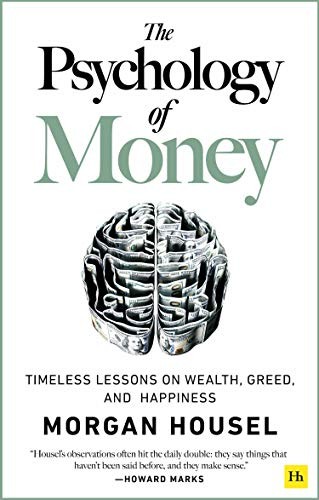
Housel argues that doing well with money has little to do with how smart you are, and a great deal to do with how you behave — and that behaviour is a soft skill, not a technical one. Through a series of short, standalone chapters, he explores why individually rational-seeming financial decisions so often lead to irrational outcomes when you factor in ego, fear, envy and the simple unpredictability of the future.
No one's crazy — and that includes your business partner
The book opens with two men. Ronald Read spent his working life pumping petrol and then sweeping floors as a janitor at JCPenney; when he died in 2014 he left an estate of around $8 million, built by buying decent shares and then doing absolutely nothing with them for fifty years. Richard Fuscone had a Harvard MBA and a senior career at Merrill Lynch, borrowed heavily against a lifestyle to match, and lost his homes to foreclosure after 2008. Housel's point isn't that Read was secretly a genius. It's that finance is close to the only serious field where a janitor can comprehensively beat a Harvard-trained executive, because the game is not primarily technical.
His explanation is that everybody learns money in a different classroom, and the classroom is whatever the world happened to be doing when they were young. Come of age in the 1970s and you learned in your bones that inflation eats savings. Come of age in the 1990s and you learned that shares only go up. Get made redundant in 2009 and you learned that cash in the bank is the only thing that is actually yours. Housel leans on research showing that an investor's appetite for risk tracks the returns they personally lived through in early adulthood far more closely than it tracks any objective analysis of the numbers in front of them. People are not being stupid. They are being rigorously logical about a world they experienced and you didn't.
For anyone running a business this quietly reframes every money argument you will ever have. The co-director who will not countenance a loan, the spouse who wants the mortgage cleared before the business takes on stock, the good employee who takes the salary over the share options — none of them are being irrational. They are pricing in a version of the world they have personally watched happen. You will get further asking what they saw than telling them what the spreadsheet says.
Luck, risk, and why you should be careful who you admire
Housel's second big move is to take the two things every success story leaves out and put them at the centre. Bill Gates went to Lakeside, one of a handful of secondary schools anywhere in the world with a computer terminal in 1968 — Gates himself has said that without Lakeside there would have been no Microsoft. Housel then does the thing almost nobody does and tells you about Kent Evans, Gates's closest friend and equal collaborator on that same terminal, who died in a mountaineering accident before he finished school. Two one-in-a-million events, in opposite directions, and only one of them gets told as a story about character.
Luck and risk, he argues, are siblings: both are the reality that outcomes are driven by forces well outside individual effort. Because you can't measure either one, his practical instruction is to study broad patterns rather than specific people, and to be sparing with both admiration and contempt. Nothing is ever quite as good or as bad as it looks from outside.
The application for an owner is uncomfortable but useful in both directions. On the one hand, it is a warning about the entire genre of founder podcasts and case studies: you are being shown the survivors, and the same decisions made by the people who didn't survive are invisible. On the other, it is permission. A pandemic, a rate rise, a client's own insolvency — plenty of business outcomes had nothing whatever to do with how well the business was run, and treating every bad year as a personal verdict is both inaccurate and expensive.
Compounding is a duration game, and survival is the whole strategy
Housel's most quoted arithmetic: when he was writing in 2020, Warren Buffett's net worth was around $84.5 billion, of which roughly $84.2 billion arrived after his fiftieth birthday and about $81.5 billion after he turned sixty-five. Buffett has been investing since he was ten. Housel then runs the counterfactual — if Buffett had started at thirty and retired at sixty with an ordinary career shape, and earned exactly the same returns, he would be worth something in the region of $12 million rather than $84 billion. He sets Jim Simons alongside him for contrast: Simons has compounded at roughly 66% a year, three times Buffett's rate, and is worth a fraction as much, because he didn't hit his stride until he was fifty.
The lesson is that everybody optimises for returns and almost nobody optimises for duration, even though duration is doing most of the work. Which leads directly to the book's sharpest distinction: getting wealthy and staying wealthy are different skills, and they point in opposite directions. Getting money takes risk-taking, optimism and putting yourself out there. Keeping it takes humility, frugality relative to income, and an active fear that what made you the money could take it away. Survival, Housel says, is the strategy. Everything else is a footnote.
That is why he spends a whole chapter on room for error, and why he defines a margin of safety not as pessimism but as the thing that makes the forecast unnecessary. The point of a cash buffer isn't that you predicted the bad quarter; it's that you no longer have to. And it connects to his chapter on tails: Walt Disney made hundreds of cartoons through the 1930s, most of which lost money, and one of them — Snow White, released in 1938 and earning around $8 million within six months — paid for all of it and rebuilt the company. A tiny number of events drive most of any outcome, so the job is to still be standing when one of them arrives.
The posture he recommends is a barbell: optimistic about the decade, paranoid about the quarter. Bet on the long run and simultaneously arrange your affairs so that no single short-run event can remove you from the board.
'Enough', and the wealth nobody can see
The hardest financial skill, Housel writes, is getting the goalposts to stop moving. He illustrates it with Rajat Gupta and Bernie Madoff — men who were already extravagantly, permanently rich and risked everything they had, including their liberty, for money they demonstrably did not need. The failure isn't greed in the abstract; it's the absence of a number at which you stop. Without one, every gain resets the baseline and you are permanently one rung short.
The 'man in the car paradox' is the companion idea and it is devastatingly simple. When you see someone in a beautiful car, you do not think about the driver. You imagine yourself in the car. Nobody is admiring the owner, because nobody ever is — so spending money to be admired doesn't even buy the admiration it was purchased for. Wealth, meanwhile, is what you don't see: it is the cars not bought, the upgrades declined, the money that stayed invested. It is invisible by definition, which is precisely why almost nobody has a visible role model for it, and why 'looking rich' and 'being rich' are not merely different but frequently opposites, since the first is funded by liquidating the second.
What money actually buys, in Housel's account, is control over your time — the highest dividend it pays. Which is also his case for saving with no particular goal attached: earmarked savings buy a thing, unearmarked savings buy options, and options are what let you say no to the wrong client, wait out a bad market, or take the six months to fix the business properly.
Key lessons
- Financial success is a soft skill about behaviour, not a hard skill about knowledge — how you act under uncertainty matters more than what you technically know.
- 'Enough' is a genuinely important, under-discussed number — knowing when you have enough protects you from risks that could cost you everything for gains you didn't need.
- Compounding works best over long, uninterrupted stretches of time — the biggest risk to compounding is often your own behaviour interrupting it.
- Save money for reasons you can't yet predict — flexibility and optionality are themselves valuable, not just a specific goal you're saving towards.
- Everyone's experience of money is shaped by the specific, narrow slice of economic history they happened to live through — which is why financial advice that worked for one generation can mislead the next.
How you behave with money under uncertainty determines your financial outcomes far more than how much you technically know about markets or accounting.
What this means for a UK small business
The 'room for error' chapter is the one to photocopy and pin up. UK small firms run on notoriously thin buffers, and Housel's argument — that a margin of safety isn't drag on the business, it's what keeps you in the game long enough for compounding to do its work — is the philosophical case for every boring thing your accountant nags you about. Keep a month or two of fixed costs in reserve. Move the VAT and Corporation Tax money into a separate account the day it lands, not the day it's due. Don't let one good year permanently raise the cost base.
'Wealth is what you don't see' may be the single most useful sentence for an owner having a strong year. The new van on finance and the corporation tax bill both turn up regardless of how the next twelve months go, and the profit that funded the van is the same profit that would have funded the buffer. The choice is not between spending and being boring; it's between the visible version of doing well and the durable one.
And the 'no one's crazy' framing is worth taking into your next difficult conversation about money — with a co-director, a spouse, or a bank. Their apparently irrational caution is usually a rational response to something they watched happen.
What’s aged well
Written recently enough, and grounded in behaviour rather than specific market conditions, that it should stay relevant for a long time.
What feels outdated
Nothing significant given its recent publication.
Where it falls short
It is a book of essays, so it circles the same handful of ideas from different angles and repeats itself more than it needs to — you'll finish it genuinely wiser about money and no better at, say, choosing a pension or reading a set of accounts. The framing is thoroughly American: the vehicles, the tax context and the social assumptions about home ownership don't translate cleanly, and there is nothing here about VAT, dividends or the specific cash-flow shape of a UK company. It is also, by design, entirely behavioural. Housel tells you why you sabotage yourself and almost nothing about the mechanics of what to do instead.
The Business Stuff verdict
One of the most re-readable books on this list — short chapters, genuinely applicable to both business and personal finance.
Three things to actually do after reading it
- Write down your own definition of 'enough' for the business — a number, or a state, past which you'd stop taking unnecessary risk.
- Identify one financial decision you've made recently driven by ego or comparison rather than genuine need.
- Build one deliberate cash buffer aimed purely at flexibility, not tied to any specific predicted expense.
If you liked this, read next
Five similar books
- Rich Dad Poor Dad (Robert Kiyosaki)
- Thinking, Fast and Slow (Daniel Kahneman)
- The Millionaire Next Door (Thomas Stanley)
- Your Money or Your Life (Vicki Robin)
- Die With Zero (Bill Perkins)
Common questions
Is it worth reading if I already know I should save and invest?
Yes, because the book is not about what to do — it is about why people who know exactly what to do still do not do it. Housel's subject is the behaviour underneath the decision: the pull to keep score against people whose real situation you cannot see, the difference between being rich and being wealthy, and the way a perfectly sensible plan gets abandoned at precisely the wrong moment. If you have ever watched a business have a good year and immediately raised your baseline spending to match, the book is describing you. It will not teach you a single technical thing about products or tax, and that omission is deliberate rather than careless.
How much of it applies in the UK?
The psychology transfers completely; the plumbing does not. Housel writes from American assumptions about vehicles, tax treatment and the social weight given to home ownership, and there is nothing here on ISAs, pensions, dividends versus salary, or how cash actually behaves inside a limited company. Read it for the behavioural chapters and take your mechanics from something written for this country. The one place the context genuinely matters is his argument that your whole view of money is set by the narrow slice of economic history you personally lived through. An owner who traded through 2008 and 2020 reads risk very differently from one who started in 2021, and both should notice that about themselves.
Is this a personal finance book or a business book?
Personal finance by subject, but several ideas land hardest on owners. The central one is that survival beats optimisation — compounding rewards long uninterrupted stretches far more than it rewards clever returns, so the real job is arranging things so you are never forced to sell, quit or accept a bad deal at the worst possible moment. Translated into a business, that is the argument for holding more cash than looks efficient, refusing the contract that would make you dependent on one client, and treating a boring balance sheet as a competitive weapon. The chapter on 'enough' is the one most likely to change a decision you are currently weighing up.
How long does it take to read?
Around four to five hours, and it is built to be dipped into rather than consumed whole. The twenty chapters are effectively standalone essays, so you can read one on a train and lose nothing by leaving three weeks before the next. That structure is also the book's weakness — the same handful of ideas recur from different angles, and the repetition becomes obvious in a single sitting. Most readers get more from a second pass a year later, when different chapters suddenly apply, than from reading it straight through. If you only have an hour, take the chapters on 'enough', on getting wealthy versus staying wealthy, and on the seduction of pessimism.