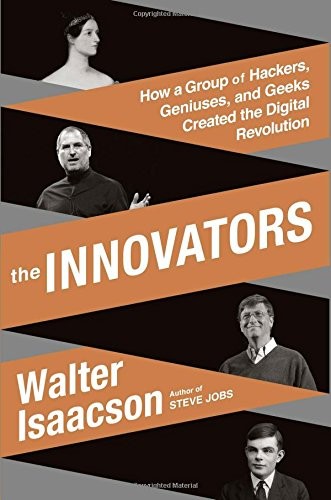
Isaacson traces the history of the computer and the internet through the people who built it — from Ada Lovelace through to the founders of Google — with a consistent argument running underneath: innovation is almost always a team sport, built through collaboration between visionaries and practical engineers, not the work of a single lone genius, however much the popular retelling of tech history likes that story.
The lone genius is a story we tell afterwards
Isaacson states his thesis early and then spends five hundred pages demonstrating it: the solitary genius with a eureka moment is almost always a simplification applied retrospectively, usually by the person who was best at self-presentation. What the record actually shows is teams — and, more specifically, a recurring combination of three types. The visionary who sees what the thing could become, the engineer who can actually build it, and the operator who turns it into an organisation that survives. Remove any of the three and history tends to record a fascinating failure.
The pattern starts with Ada Lovelace and Charles Babbage. Babbage designed the Analytical Engine; Lovelace, in the notes she appended to a translation of someone else's paper, saw what he had not — that a machine manipulating numbers could manipulate anything that could be represented by numbers, including music, and that it could therefore be general rather than merely arithmetical. She also drew the line the whole book returns to: the machine could execute what it was told, but could not originate. It is a remarkable piece of thinking from 1843 and it belonged to neither of them alone.
The pattern repeats with unsettling regularity, and Isaacson is at his best when he restores credit that history mislaid. The six women who programmed ENIAC — working out how to make the machine do anything at all, at a time when programming was considered clerical work and hardware was the prestige job — were largely written out of the story for decades. Xerox PARC invented the graphical interface, the mouse-driven desktop and much of what a modern computer looks like, and was institutionally incapable of selling any of it. The engineers who could build it and the company that could commercialise it were, disastrously, not the same organisation.
From Lovelace to the transistor: the long chain
The first half of the book is a genuinely good history of how a machine became possible, and it is more interesting than the phrase suggests because the necessary ideas arrived from unrelated directions. George Boole worked out an algebra of logic in the 1850s with no machine in mind. Claude Shannon, as a graduate student in the 1930s, noticed that Boolean logic mapped exactly onto electrical switching circuits — arguably the single most consequential connection in the book, and one made by someone standing between two fields rather than deep inside either. Alan Turing supplied the theory of what a universal machine could and could not compute. None of them built a computer.
The building was messy and contested, as Isaacson is careful to show. John Atanasoff had crucial ideas and no team, and his machine never fully worked; Mauchly and Eckert had a team, funding and a war on, and ENIAC ran. John von Neumann wrote up the stored-program architecture in a draft that circulated under his name alone, cementing his credit for an idea developed collectively — a small scandal that illustrates the book's whole argument about how attribution actually happens.
Then Bell Labs, which Isaacson treats as the most important organisational invention in the story. Bardeen, Brattain and Shockley produced the transistor in 1947 in an environment deliberately designed for collision: theorists and experimentalists and metallurgists in the same corridors, in a building laid out to make people bump into each other. Shockley's later inability to run a company he founded, and the departure of the group who went on to found Fairchild and then Intel, gives Isaacson his clearest contrast — brilliance without the third type of person produces a footnote, while Noyce, Moore and Grove together produced an industry.
Networks, and the road not taken
The second half is about connection, and it carries the book's most interesting counter-narrative. J.C.R. Licklider argued around 1960 for man-computer symbiosis — machines as partners that extend human thinking — at a time when the fashionable ambition was artificial intelligence that would replace it. Isaacson's argument is that the symbiosis path is the one that actually delivered, and that almost every product in the story succeeded to the degree it augmented people rather than substituting for them. Douglas Engelbart's 1968 demonstration, with a mouse, hypertext, video conferencing and collaborative editing decades early, is the purest expression of that idea.
The internet's origins are the strongest rebuke to Silicon Valley's garage mythology. ARPANET was a US defence project. Packet switching was invented independently and almost simultaneously by Paul Baran at RAND and Donald Davies at Britain's National Physical Laboratory — Davies supplied the word packet. Cerf and Kahn's TCP/IP made networks of networks possible. Almost none of it was commercial, none of it had a customer, and all of it took years of patient public money. The web itself came from Tim Berners-Lee at CERN, a publicly funded physics laboratory, and was given away rather than licensed.
That simultaneity is the book's quieter lesson. Baran and Davies. Noyce and Kilby on the integrated circuit. Multiple credible claims to the personal computer. Isaacson reads this not as coincidence but as evidence that innovation arrives when the surrounding conditions — available components, accumulated knowledge, a market ready to care — mature together. The genius who saw it first usually saw it about six months before several other people did.
The personal computer chapters add a tension the rest of the book only implies: the collision between a culture that wanted to give everything away and a business model that required charging for it. The Homebrew Computer Club in mid-1970s California ran on open sharing of designs and code as a matter of principle. Steve Wozniak, by temperament, belonged entirely to that world and would happily have handed his circuit boards to anyone who asked. Steve Jobs would not, and the Apple that resulted was the argument between them settled in favour of a product with a price and a case around it. Isaacson is clear that Wozniak's brilliance without Jobs's insistence produces a much-admired schematic and no company.
The same fault line runs through Bill Gates's open letter to hobbyists, which accused people copying his BASIC interpreter of theft and was received, at the time, as close to heresy. It established the principle that software was a product rather than a courtesy that came with hardware — a claim that reads as obvious now only because it won. Isaacson's point is not that one side was right. It is that both instincts were necessary: the sharing culture generated the ideas and the commercial instinct built the organisations that carried them to everyone else, and the digital age is the unresolved argument between the two rather than the victory of either.
What it says about building anything
For all that it is a history rather than a manual, three arguments carry over. The first is the humanities-and-engineering intersection: Isaacson traces a direct line from Lovelace's instinct about music to Jobs's insistence that Apple stand where technology meets the liberal arts, and treats the crossing point as where the non-obvious ideas come from. The second is that ideas are cheap and organisations are not — PARC had the ideas and Apple had the company, and the difference decided who got the credit and the money.
The third is the most useful and the least flattering to founders. Almost every breakthrough here was built on infrastructure somebody else had paid for, usually the public, usually slowly, usually with no commercial case at the time. Wikipedia closes the book as Isaacson's favourite example: not a machine that got clever, but an ordinary piece of software that let large numbers of people be useful together. That is the argument in miniature — the win came from the combination, not the invention.
Key lessons
- Genuine breakthrough innovation is overwhelmingly collaborative, built by teams combining different strengths, rather than the work of a single isolated genius.
- Many of the most important technological ideas emerged from the unglamorous intersection of the humanities and engineering, not engineering alone.
- Government and university-funded research played a far bigger role in foundational technology than the popular startup-garage mythology usually credits.
- Timing matters enormously — several of the innovations profiled were independently arrived at by multiple teams around the same time, because the surrounding conditions had matured together.
- The most durable technology businesses combined a genuine product vision with equally serious commercial and organisational discipline.
The lone-genius startup myth is mostly wrong — real breakthroughs come from collaborative teams working at the right moment, which has direct implications for how you build your own team.
What this means for a UK small business
The lone-genius myth does real damage at small scale. An owner who believes an idea only counts if it was theirs will under-credit, and eventually lose, the person who actually spotted the process fix that saved a fortnight a year. The book's practical prompt is to look at your own business and ask which of the three roles you are missing: for example, plenty of UK firms are run by a strong visionary and a strong technician with nobody doing the operator's job at all, which is exactly the Shockley failure in miniature.
The infrastructure point is the corrective for any UK founder building something tech-adjacent. You do not need to invent from scratch, and trying to is usually why small British software projects stall. Payment rails, cloud hosting, open-source libraries, Companies House and HMRC APIs, and the whole open-banking layer are all publicly available scaffolding built at enormous cost by other people. The innovation available to a small firm is nearly always in the combination.
There is also an uncomfortable national pattern in these pages. Britain has an exceptional record of inventing and a poor one of commercialising — Turing, Donald Davies and packet switching, Berners-Lee and the web, and the world's first business computer built by a tea-shop company, J. Lyons, in 1951. The lesson for a UK owner is Isaacson's own: the idea is not the asset. The organisation that ships it is.
What’s aged well
As history, it only gets more useful with time; the collaborative-innovation argument holds up well against more recent tech developments too.
What feels outdated
Written in 2014, it naturally doesn't cover the most recent wave of technology, though its historical argument doesn't need updating.
Where it falls short
It is long — over five hundred pages — and offers almost no directly actionable business advice, because it is history rather than a how-to. The collaboration thesis is stated well early on and then restated rather than developed, so the argument does not really deepen across the length. The framing is heavily American: British and European contributions get considerably less room than they earned, and readers outside the US may find the story slightly tilted. Isaacson is also generous to his subjects to a fault, and the closing chapter on artificial intelligence, written in 2014, has been comprehensively overtaken by events. Read it because the history is genuinely good, not because you will extract a framework from it.
The Business Stuff verdict
A long read, but a genuinely rewarding one for understanding how technology-driven business actually advances.
Three things to actually do after reading it
- Identify one 'lone genius' assumption in how you talk about your own business's ideas, and credit the actual collaborators properly.
- Consider whether a current stuck project needs a different combination of skills in the room, not just more effort from the same people.
- Note one piece of foundational infrastructure your business relies on that came from outside your own innovation efforts entirely.
If you liked this, read next
Five similar books
- Steve Jobs (Walter Isaacson)
- The Idea Factory (Jon Gertner)
- Dealers of Lightning (Michael Hiltzik)
- The Innovator's Dilemma (Clayton Christensen)
- Elon Musk (Walter Isaacson)
Common questions
Is The Innovators worth 500 pages if I want business lessons?
Honestly, no — not if lessons are the only reason you are reading. There is no framework here, no checklist, and the central argument about collaboration could be stated in a chapter. What you get instead is two centuries of well-told history that quietly changes how you think about where ideas come from and why some organisations turn them into products while others do not. If you enjoy history and read it for its own sake, it is one of the most rewarding books on this list. If you want tools by Friday, read almost anything else and come back to this one on holiday.
What is the book's main argument?
That significant innovation is almost always collaborative, and specifically that it needs three kinds of person: someone who sees what the thing could become, someone who can build it, and someone who can turn it into an organisation that survives. Isaacson demonstrates this from Lovelace and Babbage through Bell Labs to Intel, Apple and Google. The corollary matters as much — many of the ideas here were arrived at independently by several people at once, which suggests conditions matter more than individual brilliance. The eureka story, in his telling, is something written afterwards by whoever was best at telling it.
Does it cover British contributions to computing?
Some, though less than the record justifies. Alan Turing is properly central to the theoretical half, and Donald Davies at the National Physical Laboratory gets due credit for inventing packet switching independently of Paul Baran at RAND — Davies supplied the word we still use. Tim Berners-Lee's invention of the web at CERN is covered well. But the framing is American throughout, and much of the British story, including the Manchester machines and the fact that a tea-shop company built the world's first business computer, sits outside Isaacson's frame. Read it for the sweep, not for a British history.
Should I read this or Isaacson's biography of Steve Jobs?
They do quite different jobs. The Jobs biography is a portrait of one difficult, remarkable person and is the better read if you want narrative drive and insight into how one company was actually run. The Innovators is the wide shot: Jobs appears, but as one node in a two-hundred-year story, and the book is explicitly arguing against the great-man framing the biography inevitably invites. If you have already read the Jobs book, The Innovators is a useful corrective. If you have read neither and want to be gripped, start with the biography.