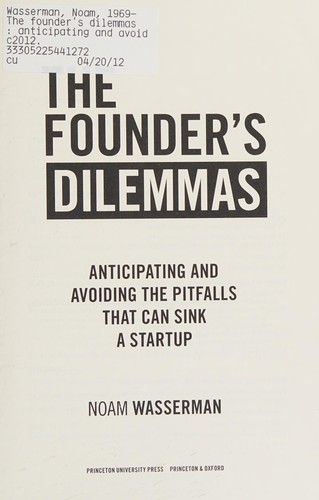
Drawing on a large dataset of startup founders, Wasserman documents the recurring, often irreversible decisions founders face early on — who to found with, how to split equity, whether to hire friends, when to bring in outside money — and the tradeoffs (often between being 'rich' versus being 'king', i.e. wealth versus control) that come with each.
Founder problems are predictable, and most founders meet them unprepared
Wasserman's premise is that the decisions which sink early-stage companies are not exotic. They repeat, they arrive in a broadly predictable order, and they are largely made badly — not through stupidity, but because each one turns up disguised as an administrative detail at the exact moment everybody is too excited to treat it as a decision. He built the book on a dataset of nearly ten thousand founders, tracking who founded with whom, how equity was divided, who was hired, who took money from whom, and crucially who was still running the business years later. The result is one of the very few business books where the claims are grounded in a large sample rather than a handful of flattering case studies.
The framing he uses throughout is the difference between a decision made and a decision defaulted into. Founding teams do not usually decide to split equity equally; they avoid the conversation, and equality is what avoidance produces. They do not decide to hire a friend; they hire the person who is available and trusted. Wasserman's contribution is to put a cost on each default, and to show that the costs are systematic rather than a matter of bad luck.
Rich or king: you can usually maximise one
The book's headline finding is the tension between wealth and control. Every move that grows the value of the company — bringing in an experienced co-founder, taking outside investment, hiring a professional CEO, granting board seats — also dilutes the founder's ownership or authority, and often both. Founders who prioritise staying in charge tend to end up in control of a smaller, less valuable business. Founders who prioritise value tend to end up with a smaller share of something much larger, and frequently without the top job. Wasserman's data indicates that founders who gave up more equity and more control ended up, on average, with more valuable stakes than those who kept both — which is a genuinely uncomfortable finding for anyone whose instinct is to hold on to everything.
The blunt corollary is about tenure. On his numbers, roughly half of founder-CEOs are no longer chief executive by the company's third birthday, and only a minority are still in the seat by the time of an IPO. Most did not choose to leave. They made a sequence of individually sensible wealth-maximising decisions, each of which added a stakeholder with a say, and the accumulated stakeholders eventually concluded that a professional manager was the safer bet for the next stage. The point is not that this is unjust; it is that it is foreseeable, and almost nobody prices it in at the time they are shaking hands on the investment.
Wasserman's practical instruction is therefore to decide which you actually want, early and honestly, and to test each subsequent decision against it. Rich and king are both legitimate goals. Drifting between them is what produces founders who resent the investors they invited in and boards that lose patience with a founder who will not let go.
Choosing who you found with, and the three Rs
Before any of that comes the first and least reversible decision: whether to found alone, and if not, with whom. Solo founders keep control, avoid the arguments, and hit a ceiling of hands, skills and credibility sooner. Teams go further and fight more. Neither is the right answer in general, and Wasserman's contribution is to describe what actually breaks in each configuration.
His most quoted finding concerns founding with people you already know. Teams built on prior social relationships — friends, family, spouses — start with the highest trust and are among the least stable over time. The mechanism is straightforward once stated: the personal relationship makes the blunt commercial conversations harder, not easier. You do not tell your closest friend that their contribution has fallen behind, or that the role they want is not the role the company needs, and so the problem compounds silently until it detonates. Teams built on prior professional relationships fare better, because the working history has already tested the awkward conversations.
He structures the co-founder decision around three Rs: relationships, roles and rewards. Relationships is who, and on what history. Roles is the division of titles, decision rights and territory — including the question most teams postpone, which is who decides when the two of you disagree and neither will move. Rewards is equity and pay. His observation is that founders spend nearly all their attention on the first, some on the third, and almost none on the second, which is why so many disputes that look like arguments about money are really arguments about authority.
Equity, hiring and the clock everybody starts by accident
The chapter on equity splits is the one worth the price of the book. Wasserman finds that most founding teams divide equity very early, quickly, and close to equally, and that this is driven by the wish to avoid an uncomfortable conversation rather than by any analysis of contribution. The split is then usually static — fixed on day one, with no vesting and no mechanism for change — at the precise point when the founders know least about who will actually do what. Within eighteen months one founder is full-time and the other is still employed elsewhere; one has raised the money and one has written the product; one has had a child and stepped back. The equity has not moved, and the resentment has nowhere to go.
His alternative is a slower, more deliberate conversation and a dynamic structure: vesting over time, with a cliff, so that ownership is earned by continued contribution rather than granted for showing up at the beginning. It is a more awkward conversation to have in month one and vastly cheaper than the alternative, which is renegotiating a stake after somebody has stopped pulling their weight and knows it.
There is a related dilemma he handles well: whether to hire for the business you have or the business you intend to have. Hiring for today is cheaper, faster and produces loyal people who may be out of their depth in two years, at which point you either carry them or replace the very people who got you there. Hiring ahead of the curve buys capability you cannot yet fully use and costs more in cash, equity or both. Wasserman's point is that early compensation decisions set precedents — the equity granted to hire number three becomes the benchmark for hires four through ten, long after the risk being compensated for has fallen away.
The same discipline extends to early hiring. Wasserman documents the specific risk in hiring friends and family: the performance conversations that would be routine with a stranger become fraught with someone you see socially, so under-performance persists far longer than it would otherwise, and the eventual separation costs you the relationship as well as the role. He also points out that early hires and early investors both introduce people with a legitimate claim on how the company is run, which is the mechanism that starts the succession clock described earlier.
The through-line is not a warning against ambition. It is an argument for treating a specific set of largely irreversible decisions — co-founder, roles, equity, first hires, first money — as decisions, made deliberately, with the trade-offs written down, rather than as friendly agreements reached quickly by people who are all in a very good mood.
The equity split, priced
Wasserman's most expensive finding deserves actual figures, so here is an illustrative case. Two people start an agency, shake hands on 50/50, and paper nothing beyond the share certificates. Fourteen months in, one of them loses interest, takes a salaried job and stops contributing. Nobody buys anybody out, because there is no mechanism to — and nothing on paper says there should be.
Five years later the remaining founder sells the business for £1.2 million. The person who left after fourteen months owns half of it and receives £600,000. The person who worked the other three years and ten months receives exactly the same.
Now run it with the vesting Wasserman spends the book arguing for: four years, one-year cliff. At fourteen months the leaver has vested 14 of 48 months against their 50%, which is 14.58% of the company — £175,000 at the same valuation. The unvested 35.42%, worth £425,000, returns to the company. The gap between papering it and not papering it is £425,000, and every pound of it is decided in an afternoon at the start, when the two of you like each other and the conversation feels unnecessary.
That is the shape of the whole book. The decision costs nothing to get right at the point you make it and is close to impossible to unwind afterwards, because by the time it matters the other party holds the shares and has no reason at all to hand them back. In a UK company the mechanism is a shareholders' agreement with good leaver and bad leaver provisions rather than US-style vesting paperwork, but the arithmetic above is identical — and so is the cost of skipping it.
Key lessons
- Many founder decisions are effectively irreversible — equity splits and co-founder relationships are very hard to undo once set.
- There's a recurring tradeoff between maximising wealth and maximising control; few founders can fully have both.
- Equal equity splits, chosen for the sake of harmony, often create problems later when contributions turn out to be unequal.
- Hiring friends and family carries real, well-documented risks that are worth planning for explicitly, not hoping around.
The decisions made in the first weeks of a startup — who founds it, how equity is split, who's hired first — quietly shape outcomes for years, and deserve far more deliberate thought than they usually get.
What this means for a UK small business
Most of the underlying research is US venture-backed startups, but the mechanics transfer directly to any UK business taking on a partner — a two-partner accountancy practice, two tradespeople going into business together, an agency bringing in someone for their sales book. The quick 50/50 handshake is exactly as common here and exactly as likely to produce a bitter dispute in year three when one partner is working sixty-hour weeks and the other thirty.
The UK-specific fix is a shareholders' agreement, and it is one of the highest-return few hundred pounds a new business will spend. It should cover what Wasserman calls roles and rewards: who decides what, what happens to shares if someone leaves or stops contributing (good leaver and bad leaver provisions are the vesting equivalent for a UK company), how a deadlock between two equal shareholders gets broken, and what a buyout looks like. Without one, you are relying on the Companies Act 2006 default position and the model articles, which were not written with your specific fallout in mind. Get the share structure and any employee equity checked for tax at the same time, because HMRC's treatment of shares issued to people who work in the business is not something to discover afterwards.
The rich-versus-king trade-off applies whenever outside money arrives with strings — an investor, a private equity buyer of a minority stake, even a lender with covenants. Decide which one you are optimising for before you sign, because the agreement locks in whichever you picked.
What’s aged well
The research-backed patterns around equity splits and co-founder conflict remain frequently cited and relevant.
What feels outdated
Academic in tone compared with most books on this list — worth it for the content, but a slower, denser read.
Where it falls short
This is the most academic book on the list, and it reads like the research programme it grew out of: careful, hedged, statistically scrupulous and considerably longer than the argument requires. Where a punchier writer would give you the rule, Wasserman gives you the distribution around it. Most readers will get more from a targeted raid on the co-founder and equity chapters than from a cover-to-cover read.
The data is also almost entirely US venture-backed technology startups, so the surrounding furniture — stock options, Series A term sheets, board composition, IPO timelines — maps awkwardly onto a UK partnership, a family business or a firm that will never raise a penny. The findings on relationships, roles and equity are broadly universal; the worked examples frequently are not.
The Business Stuff verdict
Dense, but genuinely valuable before locking in a co-founder agreement or equity split you'll be living with for years.
Three things to actually do after reading it
- Before splitting equity with a co-founder, write out each person's expected contribution honestly rather than defaulting to 50/50.
- Put a vesting schedule in place for any co-founder or early equity grant, without exception.
- If you're considering hiring a friend, write down explicitly how you'll handle it if the working relationship doesn't work out.
If you liked this, read next
Five similar books
- Zero to One (Peter Thiel)
- The Hard Thing About Hard Things (Ben Horowitz)
- Venture Deals (Brad Feld)
- High Growth Handbook (Elad Gil)
- The Founder's Mentality (Chris Zook)
Common questions
Is it worth reading if I will never raise venture capital?
Yes, but selectively. The chapters on choosing a co-founder, dividing roles and splitting equity apply to any business with more than one owner — a two-partner practice, a trades partnership, an agency taking someone on for their client list. Those decisions have the same structure and the same failure modes whether or not an investor is ever involved. The chapters on investors, boards and founder succession are much more specific to venture-backed companies and will feel remote if you are self-funded. Buy it for the first half, treat the second half as reference material for the day an outside investor actually turns up.
Should my co-founder and I just split the equity 50/50?
Probably not on day one, and almost certainly not without vesting. Wasserman's central finding on equity is that fast, equal, permanent splits are chosen to avoid an awkward conversation rather than because contributions are genuinely equal, and that they correlate strongly with later disputes once the contributions diverge — which they nearly always do. If 50/50 is genuinely right, it survives a proper conversation about who is going full-time, who is putting in cash, and who carries the client relationships. What matters more than the starting percentage is that shares are earned over time and that the shareholders' agreement says what happens when someone leaves.
Is it actually readable, or is it a textbook?
It is closer to a textbook than to a normal business book, and you should know that before buying. It runs past 450 pages, the prose is careful rather than lively, and the arguments come wrapped in the caveats you would expect from a Harvard Business School professor reporting regression results. There is no narrative pull and very little of the storytelling that carries most books in this genre. The compensation is that the claims are backed by a large dataset rather than a few flattering anecdotes, which is rarer than it should be. Read it with a specific decision in front of you and it is excellent; read it for pleasure and you will stall.
Which chapters should I read if I only have an evening?
Read the co-founder chapters and the equity-split chapter, in that order. The co-founder material covers solo versus team founding and why teams built on friendships and family carry the highest later conflict, which is the decision most people make fastest and regret longest. The equity chapter covers the quick handshake split, static versus dynamic allocations, and vesting, and it is the one most likely to change what you do this month. If you have an extra half hour, add the section on hiring friends and family. Everything about boards, investors and founder succession can wait until it is actually relevant.