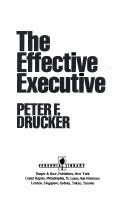
Drucker argues that effectiveness — getting the right things done — is a discipline that can be learned, distinct from raw intelligence or hard work. The book covers time management, contribution-focused thinking, strengths-based delegation, and disciplined decision-making, decades before most of these ideas became mainstream.
Effectiveness is a discipline, not a gift
Drucker's opening move — radical in 1966, still under-absorbed sixty years on — is to separate effectiveness from intelligence, effort and even competence. He had spent decades inside large organisations watching brilliant, hardworking, imaginative people produce very little of consequence, and unremarkable plodders produce a great deal, and he concluded that the difference wasn't talent. It was a learnable set of habits that almost nobody is taught. That reframing is the book's real gift: effectiveness stops being a trait you either have or don't, and becomes a practice you can deliberately build.
Underneath it sits Drucker's larger observation, and the reason the book still matters. The manual worker's problem was efficiency — doing the job right, at a pace someone else could measure. The knowledge worker's problem is effectiveness — doing the right job at all — and nobody else can measure it, because nobody else can see it. A knowledge worker who spends a month producing an immaculate report on a question that didn't need answering has been perfectly efficient and completely ineffective, and the organisation has no mechanism for noticing. Drucker's five practices are his answer to that supervision gap: since nobody can manage this from outside, you have to do it yourself.
Know where your time actually goes
The first practice is measurement before management, and Drucker is unusually blunt about it: track your time honestly, in real time, for a stretch of weeks, because your memory of how you spent it is not merely imprecise, it is systematically wrong. Everyone overestimates time spent on the important work and underestimates what evaporates into interruption, courtesy meetings and fragmentation. The executives he asked to guess, then log, were routinely startled — and he insists the log has to be kept as you go, because a reconstruction at the end of the week just reproduces the same flattering fiction.
What follows the audit is pruning in three passes. What am I doing that needn't be done at all? What can be done by someone else at least as well? And — the one that stings — what am I doing that wastes other people's time? Drucker's suggestion to simply ask subordinates that last question is still one of the most useful and least followed pieces of advice in management writing.
Then comes consolidation, and this is the part most productivity writing since has failed to improve on. Discretionary time — the time genuinely under your control — arrives in scraps unless you deliberately gather it into blocks. Anything that requires real thought needs a large, uninterrupted chunk; the same total hours diced into fifteen-minute intervals produce nothing at all. Drucker notes coldly that the more senior you get, the smaller the proportion of your day you control, which means the fight for those blocks gets harder exactly as the work that needs them gets more important.
Drucker is also unusually hard-headed about meetings. His view is that a meeting is a tool with a specific purpose, not a default state of organisational life, and the volume of them is a diagnostic: an organisation that meets constantly is one whose structure has failed to put the necessary knowledge where the work happens. His practical rules are simple and still routinely ignored — decide what the meeting is for before it starts and say so out loud, and either chair it or contribute to it, because doing both badly is the reason most meetings produce nothing. The same test applies to reports and memos: they are instruments for a purpose, and anything that has outlived its purpose should stop, not be reformatted.
Contribution, and building on strengths
The second practice is to ask what results this role is uniquely positioned to produce that would justify its existence — a question Drucker found most senior people had never explicitly answered. Ask a manager what they do and you get a description of authority and activity: I run the department, I have forty people. The contribution question demands an answer in terms of what changes on the outside because the role exists. It reframes an enormous amount of daily activity as either serving that contribution or merely feeling productive while serving nothing.
The third practice is to make strengths productive. Drucker's argument is that organisations exist precisely to make individual strength effective and individual weakness irrelevant, so staffing to minimise flaws is a category error. He is scathing about the search for the well-rounded candidate with no serious weaknesses, on the grounds that such a person almost always has no serious strengths either. The right question about a hire is not "can this person get along with everybody?" but "what can they do exceptionally well, and does that matter here?" He extends the same test upward — an effective subordinate asks what the boss does well and feeds it, rather than complaining about what the boss can't do — and to yourself: build the job around what you actually do well, and staff around the rest.
He is also good on the job that has broken two capable people in a row. Drucker's rule is that such a role is not waiting for a better candidate; it is badly designed and needs restructuring, because a job that only a genius could do is a job no organisation should have.
Concentration and the anatomy of a decision
First things first, and no second things at all. Drucker's fourth practice is concentration on the few areas where superior performance produces outstanding results, and its enforcement mechanism is systematic abandonment: for everything currently being done, ask whether you would start it today knowing what you now know. If not, stop — not scale it back, stop. He observed that nothing is harder for an organisation than killing yesterday's success, and that failing to do so is the main reason executives have no time for tomorrow's opportunity. Priorities, he adds, are easy; posteriorities — deciding what will not get done, and holding to it — are what actually take courage.
The last practice is decision-making, and Drucker's account is contrarian even now. Effective executives make few decisions, not many, because they concentrate on the important and generic ones rather than solving the same recurring problem repeatedly as though each instance were new. His process starts by classifying the problem — is this a generic situation needing a rule, or a genuine exception? — then specifying the boundary conditions the answer must satisfy before considering any answer, so you can tell later whether the decision failed or merely the execution. He insists on deciding what is right before compromising, because you cannot negotiate sensibly from a position you haven't defined. And the decision isn't a decision until someone's name and a deadline are attached to the action it implies.
Then there is dissent. Drucker recounts Alfred Sloan telling a GM committee that since everyone appeared to be in complete agreement, discussion would be postponed until they had developed some disagreement and gained an understanding of what the decision was actually about. The point isn't procedural politeness — it's that without genuine alternatives you have no basis for judgement, only an opinion you happen to hold, and that disagreement is the only reliable protection against being the prisoner of your own preconceptions.
Key lessons
- Effectiveness is a learnable discipline, not an innate trait — anyone can develop it with deliberate practice.
- Know where your time actually goes, through honest tracking, before trying to manage it better.
- Focus on your contribution — what you're uniquely positioned to deliver — rather than just staying busy.
- Build on strengths, both your own and your team's, rather than spending disproportionate effort shoring up weaknesses.
Effectiveness — doing the right things, not just doing things efficiently — is a learnable discipline, and most executives never deliberately develop it.
What this means for a UK small business
The time log is worth an honest fortnight for any owner who feels permanently busy but couldn't tell you what the business actually gained last week. Drucker's bet is that the record will be uncomfortable: quoting, chasing, answering, firefighting, and almost nothing on the handful of decisions that actually moved anything. Then run his three questions over it, including the one owners never ask — what am I doing that wastes my team's time? In a ten-person firm, the owner is usually the single biggest source of interruption, and nobody is going to volunteer that.
Systematic abandonment is the sharper tool for a small UK business, because most carry work they'd never take on today: the awkward legacy client on 2019 prices, the service line that survives out of loyalty to the person who built it, the monthly report nobody reads. Would you start it now, knowing what you know? If not, stop it — and accept that stopping is a decision with a name and a date on it, not a vague intention.
The strengths argument also cuts against a habit small firms fall into: spending an owner's scarce management attention dragging a weak performer to adequate, while the genuinely strong person is left alone because they're fine. Drucker would put the attention where the return is.
Put real numbers on it and the argument sharpens. Say you log a fortnight and find 31 hours went on quoting and chasing, 9 on genuinely urgent client problems, 6 on a monthly report two people read, and 4 on the pricing review you have postponed since March. Drucker's three questions then write themselves: the report goes, the quoting gets a template or a junior, and the pricing review — the only item on the list that changes what every future job earns — gets a defended two-hour block.
What’s aged well
Remarkably well for a 1967 book — many of its ideas (strengths-based management, contribution focus) are now mainstream but were genuinely ahead of their time.
What feels outdated
The prose style and some references are of their era, and it's a denser read than most modern equivalents.
Where it falls short
It was written for executives inside large mid-century corporations, and it shows. The prose is formal and unrelentingly abstract, the examples are dated, and a fair slice of the organisational context — standing committees, deep management hierarchies, the machinery of a General Motors — maps onto a ten-person firm not at all. Drucker's world is one where you have subordinates to delegate to; plenty of readers don't.
It is also dense in a way modern productivity writing isn't, one idea per paragraph with no signposting, no summaries and no examples to rest on. It rewards patience, but it asks considerably more of the reader than anything else on this list.
The Business Stuff verdict
A foundational text that rewards patience — many later, more famous management books draw directly from its ideas.
Three things to actually do after reading it
- Track your actual time honestly for one week before assuming you know where it goes.
- Write down your specific, unique contribution to the business, distinct from being generally busy.
- Identify one team member's strength you could deploy more, instead of managing around a weakness.
If you liked this, read next
Five similar books
- High Output Management (Andy Grove)
- The 7 Habits of Highly Effective People (Stephen Covey)
- Multipliers (Liz Wiseman)
- Measure What Matters (John Doerr)
- Principles (Ray Dalio)
Common questions
Is The Effective Executive still relevant if you don't run a big company?
Mostly yes, with one caveat. The five practices — audit your time, define your contribution, build on strengths, concentrate on the few things that matter, and decide properly — apply at any size, and small-business owners arguably need them more, since nobody is managing their priorities for them. The caveat is that Drucker assumes an organisation around you: subordinates to delegate to, committees to sit on, a hierarchy to navigate. A sole trader will find perhaps a third of the book describing a world they do not live in. Read it for the practices; skip the chapters on organisational structure without guilt.
Which Drucker book should I read first?
This one, if you want something you can act on. The Effective Executive is his most personal and most practical book — it is about managing yourself, and it is short. Management and The Practice of Management are the more complete statements of his thinking, but they are reference works: comprehensive, several hundred pages, and aimed at people running organisations rather than themselves. Innovation and Entrepreneurship is the one to read next if you are building something new. Start here, and if the density suits you the rest of the shelf opens up.
How long does the time log actually need to run?
Drucker wants several weeks, logged as you go rather than reconstructed afterwards, and he is right that reconstruction defeats the point — a Friday recollection of the week reproduces the same flattering fiction the exercise exists to break. In practice, two weeks recorded honestly in fifteen-minute blocks will show you the pattern. Then run it again a few months later, because time discipline decays quietly and most people drift back within a quarter. The value is not in the logging, which is tedious. It is in the three questions you ask afterwards: what needn't be done, what could be done by someone else, and what am I doing that wastes other people's time?
Is it a hard read?
Harder than almost anything else on this list, yes. Drucker writes in dense, formal, mid-century prose with one idea per paragraph, no summaries, no bullet points and few concrete examples to rest on. There is no chapter recap to catch you if your attention drifts. It is around 180 pages that read like 300. The compensation is that almost every paragraph is carrying an idea rather than restating one, which is the opposite problem to most modern business books. Read it slowly, a chapter at a time, and expect to reread sections. It rewards that; skimming it produces nothing.