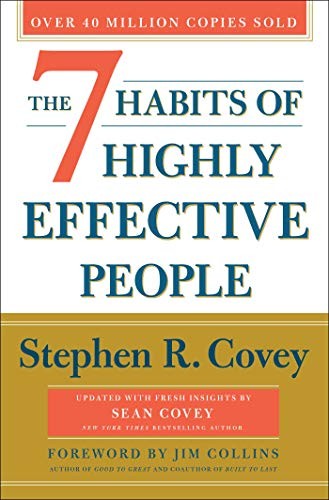
Covey's classic argues that lasting effectiveness is built on character, not just technique — a set of habits moving from dependence to independence (private victory) and then to interdependence (public victory). It remains one of the most widely read personal-effectiveness books ever published, and much of the vocabulary it introduced has entered everyday business language.
Character before technique
Covey's starting move is a historical claim about the self-help genre itself. Reviewing roughly two centuries of American success literature, he says he found a break somewhere around the First World War: everything written before it concerned character — integrity, humility, fidelity, courage, justice, patience — and most of what came after concerned personality, meaning technique, image, attitude and influence skills. He calls these the character ethic and the personality ethic, and his argument is that the second is not wrong so much as parasitic. Technique works, but only on top of something. Applied without it, people can feel the gap, and what you get is a person with excellent listening skills whom nobody trusts.
Underneath that sits the book's other foundational idea: paradigms. Covey uses the map analogy — if you're given a map of the wrong city, no amount of positive attitude or harder effort helps; you need a different map. He argues that most attempts at personal change fail because they operate on behaviour while leaving the underlying paradigm untouched, and that real change is therefore an inside-out job. His illustration is the story of a man on a subway train whose children are running riot while he sits vacantly, until he explains they've just come from the hospital where their mother died an hour ago. Nothing about the situation changed. Everything about the appropriate response did.
The third foundation is P/PC balance — production versus production capability, illustrated through Aesop's goose and the golden eggs. Effectiveness, in Covey's definition, is not maximum output; it is the sustainable ratio between what you produce and the health of the thing producing it. Kill the goose and the eggs stop. This is the idea most readers skim and most owners need: it's the difference between a good quarter and a business that can still do it next year, and it applies just as directly to a person, a relationship and a team as to an asset.
The maturity continuum
The seven habits are not a list, they're a sequence, and Covey's insistence on that is the book's most repeated and most ignored warning. Habits 1 to 3 constitute what he calls the private victory: the move from dependence to independence, from being acted upon to being genuinely self-governing. Habits 4 to 6 constitute the public victory: the move from independence to interdependence, where real collaboration becomes possible. Habit 7 renews the whole thing.
The claim is that you cannot skip the first stage. Someone who has not established their own priorities, who reacts rather than chooses, and who has no clear sense of what they're aiming at, will find win-win thinking and empathic listening ring hollow — because those habits require something to negotiate from and something to be secure in. Independence is also, importantly, not the destination. Covey is direct that our culture treats independence as the highest achievement, and that most real value in life and work is produced interdependently, by people secure enough not to need to win every exchange.
Habits 1 to 3: the private victory
Habit 1, Be Proactive, is built on the space between stimulus and response — the claim that between what happens to you and what you do about it there is a gap, and that freedom lives in the gap. Covey's practical device is the circle of concern and the circle of influence: a large ring of everything you worry about, and a smaller ring inside it of everything you can actually affect. Proactive people spend their energy in the inner circle, which tends to grow. Reactive people spend it on the outer one, which leaves them with less power and more grievance. He extends this to language, and it's a sharper test than it sounds — listen for "I have to", "if only", "they won't let me" versus "I choose to", "I will", "let's look at the alternatives".
Habit 2, Begin With the End in Mind, rests on the proposition that all things are created twice — once mentally, once physically — and that if you don't do the first creation deliberately, someone or something else will do it for you. His exercise is to imagine your own funeral and what you would want said by a family member, a friend, a colleague, then work backwards from that into a personal mission statement. He pairs this with the distinction between management and leadership: management is efficiency in climbing the ladder, leadership is determining that the ladder is against the right wall — and no amount of the first fixes an error in the second. He also catalogues alternative life centres people organise around by default — spouse, family, money, work, possessions, pleasure, self — and argues each produces a predictable distortion, against a principle-centred alternative that doesn't move when circumstances do.
Habit 3, Put First Things First, contains the time-management matrix that has since escaped into general business vocabulary: urgent versus important, four quadrants. Covey's real point is not the grid but the specific trap of Quadrant II — important, not urgent: planning, prevention, relationship-building, capability development. It never shouts, so it never gets done by people who are technically extremely busy, and it is precisely where effectiveness comes from. His answer is to organise weekly rather than daily, around roles and goals rather than tasks, so that Quadrant II gets scheduled before the urgent fills the space. He also distinguishes gofer delegation, where you tell someone every step and remain the bottleneck, from stewardship delegation, where you agree the desired result, the guidelines, the resources and the accountability, and then get out of the way.
Habits 4 to 6: the public victory, and habit 7
Habit 4, Think Win-Win, is more rigorous than the phrase suggests. Covey lays out six paradigms of human interaction — win-win, win-lose, lose-win, lose-lose, win, and win-win or no deal — and argues that most people default to win-lose because school, sport and league tables trained them to. The habit rests on an abundance mentality, the assumption that there is enough to go round, as against a scarcity mentality that treats someone else's success as a subtraction from your own. And crucially he includes win-win or no deal: if a genuinely mutual arrangement isn't available, agreeing to disagree and walking away is better than a bad compromise that quietly poisons the relationship. Supporting all of it is the emotional bank account — the running balance of trust, built by small courtesies, kept promises and clarified expectations, drawn down by their opposites.
Habit 5, Seek First to Understand, Then to Be Understood, is the one Covey considers the key to interpersonal effectiveness, and he makes it uncomfortably specific. Most listening, he argues, is autobiographical: we evaluate, probe, advise or interpret, all from inside our own frame, while waiting to speak. Empathic listening means listening to understand rather than to reply, reflecting content and feeling until the other person feels genuinely heard — at which point, he argues, they become dramatically more open to hearing you. His analogy is medical: no competent doctor prescribes before diagnosing, yet almost everyone does exactly that in conversation.
Habit 6, Synergize, follows from 4 and 5: when trust is high and both parties genuinely understand each other, the outcome can be a third alternative neither arrived with — not compromise, which is 1+1=1.5, but something better than either original position. This requires valuing differences rather than tolerating them, and Covey's line is that if two people always agree, one of them is unnecessary. Habit 7, Sharpen the Saw, then protects everything else by insisting on renewal across four dimensions — physical, mental, social/emotional and spiritual — on the grounds that all six preceding habits degrade without it. It is P/PC balance applied to yourself, and it closes the loop the book opened.
Key lessons
- Be proactive: focus energy on what you can actually influence, not what you can only react to.
- Begin with the end in mind — define what success genuinely looks like before working towards it.
- Put first things first — organise around what's important, not just what's urgent.
- Think win-win, and seek first to understand, then to be understood, in every meaningful negotiation or relationship.
Sustainable effectiveness is built from the inside out — character and principles first, tactics and technique second.
What this means for a UK small business
The circle of influence is a daily filter worth actually using. An owner's attention gets dragged towards Budget announcements, interest rates, National Insurance changes and what a competitor posted on Instagram — none of which they can move — instead of pricing, service standards, hiring and cash, all of which they can. The test is simple: is this thing on my list something I can affect this week?
Quadrant II is the most directly useful idea in the book for a small firm. The VAT return and the angry customer are Quadrant I and will always get done, because they shout. The pricing review, the succession conversation, the systemising of the thing only you know how to do, the second supplier so you're not exposed to one — all Quadrant II, all invisible until they become emergencies. If they aren't in the diary they don't happen, and Covey's weekly planning method is a workable way to put them there.
P/PC balance is the other one worth taking literally: an owner working every hour and taking nothing out is eating the goose. So is a business running entirely on one exhausted key person, which is a description of a great many UK small firms and the single most common reason they're hard to sell.
What’s aged well
The core habits remain widely referenced and applied across business and leadership contexts decades later.
What feels outdated
The tone and some examples are dated, and it's a genuinely dense read compared with more modern, concise business books.
Where it falls short
This is the slowest, densest read on the list by a distance. Covey's prose is earnest and repetitive, with diagrams and coined terminology in a register modern readers have been trained out of tolerating, and it takes a hundred pages to get properly moving. There is a persistent quasi-religious undertone that not everyone will connect with, and several extended examples — family scenes, workplace scenarios — are dated in ways that now distract. Some of the framing is also more assertion than evidence: the historical claim about the character and personality ethics is his own reading, presented rather more firmly than a review of the literature warrants. The ideas underneath have aged into standard business vocabulary for good reason; the packaging has aged considerably less well.
The Business Stuff verdict
Slower going than most books on this list, but foundational enough that it's still worth the time.
Three things to actually do after reading it
- Write your own short personal mission statement and check your last month of decisions against it.
- Identify one relationship where you've been seeking to be understood before genuinely understanding the other side.
- Sort your task list this week by important-vs-urgent, and protect time for important-but-not-urgent work.
If you liked this, read next
Five similar books
- The Effective Executive (Peter Drucker)
- Essentialism (Greg McKeown)
- Principles (Ray Dalio)
- Man's Search for Meaning (Viktor Frankl)
- Mindset (Carol Dweck)
Common questions
Is it worth reading when the ideas are already everywhere?
This is the fair question, because you already know the vocabulary — begin with the end in mind, circle of influence, win-win, sharpen the saw are all in general business speech now. What does not survive summarisation is the sequencing argument, which is Covey's actual thesis: that the interpersonal habits simply do not work until the personal ones are in place. Nor does P/PC balance, the least quoted and most useful idea in the whole book. If you have absorbed the phrases without the structure, you have the labels and not the argument, and the argument is the part that changes anything.
Which edition should I buy?
The 30th anniversary edition, published in 2020, is the one to get. Covey's text is original and unaltered; what has been added is commentary from his son Sean Covey, situating the habits against a working world Covey did not live to see. Older paperbacks are everywhere and perfectly usable if you find one cheaply, and nothing essential is missing from them. There is also an official companion workbook and a well-known version aimed at teenagers, both of which are supplements rather than substitutes. For the argument itself, the main book is the main book.
Can I skip to the habit that sounds most relevant to me?
Covey says no, and the maturity continuum is his reason: habits 4 to 6 assume you have done 1 to 3. Someone with no clear sense of what they are aiming at, who reacts rather than chooses, will find win-win thinking hollow, because they have nothing secure to negotiate from. That said, the practical compromise most readers land on is to read 1 to 3 properly and slowly, then move through 4 to 6 more quickly and return to them when a specific relationship or negotiation makes them live. Habit 7 is short and can be read at any point.
Are Covey's other books worth reading?
First Things First, from 1994, is the useful one: it expands habit 3 into a full method built around weekly planning by roles rather than daily to-do lists, and it is more practical than the corresponding chapter here. The 8th Habit, from 2004, adds finding your voice and helping others find theirs, and is generally reckoned the weaker book — thinner argument, more corporate framing. The Speed of Trust, written by his son Stephen M. R. Covey, develops the emotional bank account idea into a subject of its own and stands up better than most extensions of a parent's work.