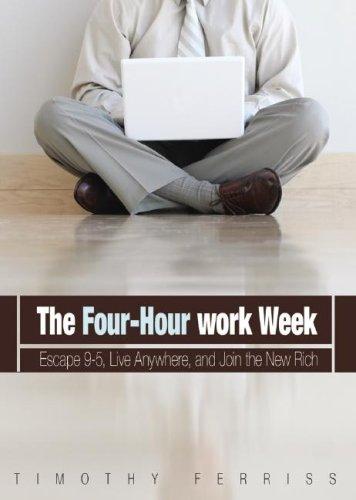
Ferriss's central pitch — design a business and lifestyle around freedom rather than around a traditional career — was genuinely ahead of its time in 2007. The book's most durable contribution is the DEAL framework: Definition (redefine what you actually want), Elimination (apply the 80/20 rule ruthlessly), Automation (systems and outsourcing), Liberation (location independence). The literal '4-hour' framing is more provocation than promise, but the underlying questions about what deserves your time are genuinely useful.
The New Rich and lifestyle design
Ferriss's founding distinction is between the Deferred-Life Plan — work hard for forty years, retire, then finally live — and what he calls the New Rich, who design a business around freedom and mobility from the start. The redefinition at the heart of it is that wealth isn't a number in a pension pot but a combination of three things: what you do, when you do it, and where you do it. Two people earning the same money can have completely different lives depending on how much of their calendar and location they control, and Ferriss's point is that most people optimise obsessively for the number and never notice the other two variables were negotiable all along.
Whatever you make of the branding — and there is a lot of branding — the underlying question is genuinely disruptive to the standard small-business script. Most owners treat the lifestyle as the reward that arrives once the business has succeeded. Ferriss inverts it: write the specification for the life first, cost it, then build a business that pays for that specification and stop there. He calls the costing exercise 'dreamlining' — take the vague wish ('travel more'), turn it into specific items with prices against them, total it, and divide by twelve. The answer is usually far smaller than people assume, and that's the whole point. The fantasy that felt like it needed a lottery win turns out to need an extra £1,200 a month and a diary you actually control.
He goes after the retirement premise directly too. Deferring everything assumes you'll reach 65 with the health, the appetite and the relationships intact to enjoy what you postponed, and that the intervening decades were tolerable enough to be worth trading. It's an argument rather than a proof, but for an owner who has spent five years telling themselves 'after this next push', it lands hard.
Definition and Elimination: the 80/20 knife
DEAL — Definition, Elimination, Automation, Liberation — is the book's spine, and the first two letters do most of the real work.
Definition is about getting specific: not 'more money' but a number, a date and a concrete picture, because vague goals produce vague effort and give you no way of knowing when you're finished. The strongest tool in this section is fear-setting: writing down, in detail, the actual worst case of the change you're avoiding, how you'd repair it if it happened, and — the column everyone skips — what it costs you to do nothing for another year. It's genuinely useful for an owner circling a decision they've been avoiding for months, because the undefined fear is always larger than the written-down one. Dropping the client who eats a day a week and pays for two hours looks terrifying until you cost the alternative.
Elimination applies the 80/20 rule with more ruthlessness than most readers are ready for. The instruction is not to work faster through everything — it's to identify the small number of customers, products and activities producing most of the results and actively cut the rest. Ferriss's twin questions are worth the cover price on their own: which 20% of sources are causing 80% of my problems, and which 20% are producing 80% of my results? Applied honestly to a client list that usually means sacking people, and he's unusually blunt that this is the correct move rather than a last resort.
The other genuinely original idea in this section is relative income. Everybody measures income in absolute terms — £80,000 a year — which tells you nothing about the life attached to it. Relative income divides by the hours and the constraints: £80,000 for a 70-hour week tied to one city is a worse deal than £55,000 for 25 hours from anywhere, and the person on the bigger number will tell you they're doing better. Once you start pricing work per hour of your life rather than per year, a lot of decisions that looked obvious stop being obvious — including the big contract that consumes the quarter and the client who pays well and rings at weekends.
Paired with it is Parkinson's Law — work expands to fill the time available — which he weaponises as a scheduling tool. Give a task a deadline that's slightly too tight and it shrinks to fit. Combine that with the 80/20 knife and you have the book's real thesis about time: do fewer things, and give the things you do less room to sprawl. The 'low-information diet' is the same logic pointed at attention rather than tasks — cut the news, cut the browsing, batch email into set windows instead of reacting all day. Written in 2007, before smartphones were universal, it reads now as either prescient or quaint depending on how much of your day currently disappears into a screen.
Automation: the muse and the outsourced week
The book's most durable practical contribution is the argument that delegation stopped being a big-company privilege. Ferriss walks through hiring virtual assistants, briefing remote contractors, and building what he calls a 'muse' — a product or service with a repeatable, largely automated fulfilment chain, so that revenue stops being a direct function of the owner's hours.
The muse chapters are the most dated in their specifics and the most useful in their structure. The exact businesses he describes — drop-shipped niche products, information courses, mail-order supplements — were a particular moment in e-commerce that has long since been competed away. The tests he applies to an idea have aged far better: can it be explained in a single sentence, can fulfilment be handed to somebody else, can it be tested cheaply before you commit real money, and does the margin still work once you're paying other people to run it? That last one kills most side-business ideas at the napkin stage, which is exactly what it's for.
The delegation advice comes with a caveat Ferriss states once and then largely ignores: you cannot outsource a mess. Handing a broken process to a virtual assistant gets you a broken process running remotely plus a monthly invoice. The genuinely transferable bits are his rules for the handover — write the instruction as though for someone who has never seen your business, and set decision limits in advance so nobody comes back to you for every £50 judgement call. Owners who delegate badly almost always fail on that second rule and then conclude that delegation doesn't work for them.
Liberation, and what the book is really arguing
Liberation is the digital-nomad section: negotiating remote work, running the business from somewhere cheaper, and taking 'mini-retirements' spread through your working life rather than banking them all for the end. It's the most time-bound and least universally applicable part of the framework, and the part responsible for a decade of laptop-on-a-beach photography.
Stripped of the packaging, though, the principle is one other books on this list reach from different directions: the business shouldn't need your physical presence to function. Gerber calls it working on the business rather than in it; Ferriss calls it liberation and adds a plane ticket. The mini-retirement is the genuinely original piece — instead of one long retirement at the end, take extended breaks periodically, which has the useful side effect of forcing the business to prove it can survive without you while the stakes are still small enough to recover from. Two weeks fully unreachable is a better systems audit than any consultant will sell you.
Read generously, the whole book is one argument made four ways: your time is the genuinely scarce asset, almost none of what currently fills it was ever consciously chosen, and the examination is the work.
Key lessons
- The 80/20 rule applied ruthlessly: a small fraction of your activities produce most of your results — find them and cut the rest.
- A 'low-information diet' — deliberately limiting inputs — protects the focus needed for meaningful work.
- Outsourcing and delegation aren't just for large companies; virtual assistants and contractors can absorb far more of a small business's admin than most owners assume.
- Batch similar tasks together and check email/messages at set times rather than reactively throughout the day.
- Design the lifestyle first, then build a business that funds it — rather than assuming the lifestyle is a reward that comes after building the business.
Most of what fills a business owner's day doesn't actually move the business forward — ruthlessly questioning that is worth doing long before you're burnt out.
What this means for a UK small business
The literal '4-hour' promise doesn't survive contact with a UK trade or professional-services business — clients expect responsiveness, staff need managing, and HMRC deadlines are indifferent to lifestyle design. But the Elimination step is directly usable this week: pull last month's actual hours against actual invoices and find the 20% of clients, jobs or products producing 80% of the profit. Most owners have never done that sum and are genuinely shocked by the answer, particularly by how much time the smallest-paying clients consume.
Automation has aged into cheap reality here. Bookkeeping, payroll, diary management, first-line customer email and social scheduling can all be moved to a bureau, a VA or software for a fraction of what the equivalent cost in 2007 — and for a UK owner, moving the bookkeeping out is usually the single highest-return delegation available, because it's the task most likely to be done late, badly and resentfully at 10pm.
The bit to handle carefully is staff. Ferriss writes for a solo operator with contractors; the moment you have UK employees, 'eliminate and automate' becomes a redundancy conversation with legal process attached. Apply the thinking to your own diary first, and to the org chart only with proper advice.
What’s aged well
The 80/20 focus and the case for outsourcing routine work remain genuinely useful, and are arguably easier to act on now than in 2007 given how much cheaper outsourcing has become.
What feels outdated
The tone hasn't aged gracefully, and the '4-hour' framing oversells what's realistically achievable for most small business owners — read it for the underlying principles, not the literal promise.
Where it falls short
The tone hasn't aged well — brash, self-promotional, and pitched at a reader chasing a specific mid-2000s fantasy that doesn't map onto most real businesses, especially anything with premises, staff or regulated client relationships. The '4-hour' framing wildly oversells what's achievable and has fairly been criticised for encouraging owners to outsource judgement calls that genuinely needed them. Several of the specific tactics — the tools, the outsourcing firms, the arbitrage plays — are simply out of date. Read it for the discipline underneath DEAL, and discount the marketing heavily.
The Business Stuff verdict
Worth reading for the DEAL framework and the permission to question your own busywork, with a healthy filter on the more hype-driven claims.
Three things to actually do after reading it
- List your last week's tasks and identify the 20% that produced 80% of the actual results.
- Find one recurring task you could hand to a virtual assistant or contractor this month, and price out what it would cost.
- Set two fixed times a day to check email/messages instead of leaving notifications on throughout the day.
If you liked this, read next
Five similar books
- Deep Work (Cal Newport)
- Company of One (Paul Jarvis)
- Essentialism (Greg McKeown)
- The One Thing (Gary Keller)
- Atomic Habits (James Clear)
Common questions
Can you actually run a business on four hours a week?
Not a normal one, no — and Ferriss half-admits it. The four-hour figure applies to a narrow kind of business: a product with automated fulfilment, no employees, and customers who never need you personally. A cafe, a building firm or an accountancy practice cannot get near it, because the work is the product and the clients are the relationship. What is genuinely achievable is the direction rather than the number. Owners who apply the Elimination and Automation steps properly routinely cut ten to fifteen hours a week of admin and low-value client work out of their diary within a couple of months. Treat four hours as the provocation it is, and the reclaimed afternoon as the actual prize.
How do I work out my own 80/20 split?
Take last month's sales ledger and last month's calendar and put them side by side. For each client, write down what they invoiced and roughly how many hours they consumed, including the unbilled ones — the phone calls, the chasing, the rework. Say you have twenty clients billing £14,000 between them: sort by profit per hour and you will usually find the top four produce more than half the profit, and the bottom five produce almost none while eating a day a week. That day is the thing you are actually buying back. The exercise takes an afternoon, needs no software, and most owners have never once done it.
Is outsourcing to a virtual assistant realistic for a small UK firm?
Yes, and it is far cheaper than it was when the book came out — a UK-based VA typically works on a retainer of a few hours a week, and a bookkeeping bureau will run a small firm's ledgers for a couple of hundred pounds a month. The realistic constraint is not cost, it is documentation. Handing over a task you have never written down produces a fortnight of questions and a conclusion that delegation does not work. Record yourself doing the job once, with commentary, and set the decision limits in advance: what they can approve without asking, and what always comes back to you.
Has the book aged badly enough not to bother?
Parts of it, yes — the specific tactics, the outsourcing firms, the arbitrage plays and a fair amount of the tone belong to 2007 and should be read as period detail. But the framework underneath has held up better than the packaging. The questions it forces — what is this business actually for, which fifth of it produces the results, what am I doing personally that nobody needs me to do — are the same questions every serious book on owner-managed businesses arrives at. Read it quickly, skim the muse chapters, and take the Definition and Elimination sections seriously. Roughly a third of the book is worth your time, and it is a valuable third.