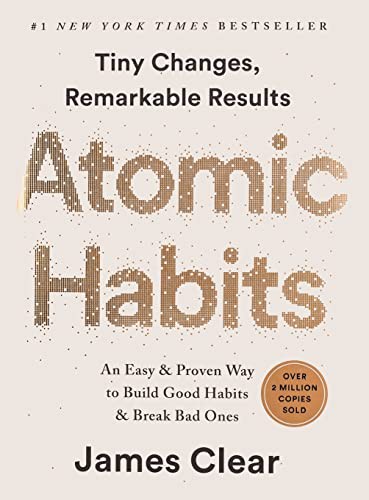
Clear's central argument is that meaningful change comes from small, consistent habits compounding over time, not from dramatic, unsustainable transformations. The book gives a practical four-law framework — make it obvious, make it attractive, make it easy, make it satisfying — for building habits that stick, and the inverse for breaking the ones that don't serve you, all grounded in identity: you don't just do habits, you become the kind of person who does them.
Systems beat goals
Clear's opening argument is the one everybody quotes and almost nobody applies: winners and losers have the same goals, so the goal cannot be what separates them. Every struggling café owner wants a full room. Every failing gym member wanted to get fit. What separates the outcomes is the system — the set of things that happen every day whether or not anyone feels motivated on the day. His line that 'you do not rise to the level of your goals, you fall to the level of your systems' is the whole book compressed into one sentence.
He goes further than the usual motivational version of this and names three specific problems with goal-setting. Goals are momentary: hitting one changes nothing about the process that produced it, which is why the tidy room gets messy again and the business that hits its best-ever quarter drifts back down the next. Goals restrict happiness, because they set up a single acceptable outcome and make everything before it a form of failure. And goals are at odds with long-term progress — the runner who trains for a marathon and then stops running got the medal and lost the habit. The alternative isn't to abandon direction; it's to treat the target as a compass heading and put all the design effort into the daily mechanism.
The four laws of behaviour change
Every habit runs the same loop — cue, craving, response, reward — and Clear turns it into an engineering checklist you can run against any behaviour you want to add or remove.
Make it obvious. Most habits are triggered by context, not decision, so the fix is usually environmental rather than motivational. Two specific tools do the work here: implementation intentions ('I will do X at TIME in PLACE', which is far more effective than 'I'll do it more'), and habit stacking, where you bolt the new behaviour onto an existing reliable one — 'after I lock the shop, I file the day's receipts'. The existing habit becomes the cue, so you're not relying on remembering.
Make it attractive. Behaviour follows anticipated reward, not actual reward, so the trick is to raise the anticipation. Temptation bundling pairs something you need to do with something you want to do — the podcast you only allow yourself while doing the admin. Clear also makes the point that the strongest force here is social: we copy the close, the many and the powerful, so the fastest way to make a habit attractive is to spend time around people for whom it's already normal.
Make it easy. This is where the book is most useful and most counter-intuitive to ambitious people. The two-minute rule says shrink the habit until it's almost embarrassing — two minutes of bookkeeping, not 'do the accounts'; open the spreadsheet, not 'write the forecast'. You're not trying to get the work done, you're trying to make the habit automatic, and you can only scale a habit that already exists. Alongside it, reduce friction on the things you want and add friction to the things you don't: the difference between a habit that sticks and one that doesn't is often three clicks.
Make it satisfying. What gets rewarded gets repeated, but the reward has to be immediate, because the brain heavily discounts anything in the future. That's the fundamental problem with everything worth doing in business — the payoff for good bookkeeping arrives in January, the payoff for content arrives in a year. Clear's answer is habit tracking: give yourself visible, immediate evidence that the thing was done, because the tick is a reward in itself. Inverting all four laws breaks a habit — make it invisible, unattractive, difficult and unsatisfying.
Identity-based habits
The deepest idea in the book, and the one that survives longest after reading it, is that there are three layers of change: outcomes (what you get), processes (what you do), and identity (what you believe about yourself). Most people work from the outside in — 'I want to lose a stone' — and Clear argues durable change works from the inside out: 'I'm the kind of person who doesn't miss training.'
The mechanism he gives makes this practical rather than fluffy. Every action is a vote for the kind of person you believe you are. You don't need a unanimous vote, just a majority — which means a missed day doesn't reset anything, provided you don't miss twice. 'Never miss twice' is arguably the single most useful rule in the book, because it takes the moralising out of a slip and turns recovery into the actual skill.
It works commercially too. A business that decides 'we're the firm that replies same day' and then casts a daily vote for that will, in eighteen boring months, have a reputation that no advertising budget buys. The identity comes first and the evidence accumulates behind it.
The plateau of latent potential
Habits compound like money, which means early returns are effectively invisible and the breakthrough looks sudden to everyone watching from outside. Clear's ice-cube image — the room warming from -4 to -1 degrees with nothing visibly happening, then everything melting at zero — is the best description you'll read of the first year of a content strategy, a referral system or a savings habit. He calls the gap between effort and visible result the valley of disappointment, and it's where nearly everyone quits: not because the work wasn't working, but because it was being stored rather than displayed.
Awareness first, and where the ideas come from
Before any of the four laws can be applied, Clear insists on a step most readers skip: you can't change a behaviour you haven't noticed. His habits scorecard is a plain list of every behaviour in a normal day, each marked as positive, negative or neutral — no judgement, just an inventory. The exercise is mildly humiliating and extremely effective, because most bad habits aren't decisions, they're defaults nobody has ever looked at directly. He borrows pointing-and-calling from Japanese rail operators, where staff physically point at signals and say them aloud, as a way of dragging an automatic behaviour back into conscious attention — the personal version being to say out loud what you're about to do before you do it.
It's also worth being clear about what's original here and what isn't, because it affects how you read the book. The cue-craving-response-reward loop is behavioural science that Charles Duhigg had already popularised; the make-it-easy principle is close to BJ Fogg's tiny habits work; the environment-over-willpower argument runs through decades of behavioural economics. Clear is a synthesiser rather than a researcher, and he's reasonably open about it. What he adds is the packaging — a single coherent checklist you can actually run — and the identity layer, which is the genuinely distinctive contribution. That's not a criticism so much as a reading instruction: this is the best-assembled version of a body of ideas, not a new one.
The plateau, and the honest limits
The final section adds the honest caveat to everything before it. Habits create the floor, not the ceiling. Automaticity is exactly what you want for the repetitive maintenance work — and exactly what you don't want for the skills where you're trying to improve, because a habit performed without attention stops getting better. The answer is habits plus deliberate practice: automate the routine, and deliberately review the parts that matter. Related is the Goldilocks rule — motivation peaks when a task sits just beyond current ability — and Clear's blunt closing observation that the real enemy of long-term success isn't failure, it's boredom. Professionals stick to the schedule; amateurs let life get in the way.
Key lessons
- You do not rise to the level of your goals, you fall to the level of your systems — build the system, not just the target.
- The Four Laws of behaviour change: make it obvious, make it attractive, make it easy, make it satisfying.
- Habits are identity-based: the most durable change comes from deciding who you want to become, then letting habits be the evidence.
- 1% improvements compound dramatically over time — the aggregation of marginal gains matters more than any single big leap.
- Environment design beats willpower — make good habits the path of least resistance rather than relying on motivation.
Consistent small systems beat occasional heroic effort, in habits and in business alike — the compounding is the whole game.
What this means for a UK small business
Swap 'habits' for 'operations' and this becomes a small-business book. The two-minute rule is how you finally fix the receipts problem: not 'catch up on the bookkeeping' (never happens) but 'photograph the receipt before it leaves your hand' (ten seconds, and it survives a January VAT return). Habit stacking is how you make it stick — attach it to something that already happens without fail, like locking up or the end-of-day cash-up.
Environment design explains why the owners who check the bank balance daily stay calm and the ones who check monthly get surprises. Put the banking app on the home screen. Put the Making Tax Digital software where the invoices already are. Every extra click is a chance to not do it.
The identity frame matters commercially as well as personally. 'We're the firm that quotes within 24 hours' is worth more than a marketing campaign if you actually cast the vote every day — and in trades and professional services in particular, being reliably responsive is still, remarkably, a competitive advantage rather than a baseline.
What’s aged well
The core science and framework are well-grounded and hold up; this is likely to stay relevant for a long time.
What feels outdated
Nothing significant — it's recent enough that little has dated.
Where it falls short
Atomic Habits is far stronger on mechanics than on why you can't stick to anything in the first place — stress, workload, health, or a business model that genuinely demands more hours than exist. It has nothing much to say to someone whose problem is capacity rather than design. Clear can also stretch a two-sentence idea across a chapter, and the compounding claim ('1% better every day = 37x a year') is marketing arithmetic rather than maths that maps onto anything real. None of that stops the toolkit working — just skim the padding and keep the rules.
The Business Stuff verdict
One of the most genuinely useful personal-effectiveness books for business owners, precisely because the ideas are so easy to actually apply.
Three things to actually do after reading it
- Pick one business habit you want to build, and redesign your environment to make it the obvious, easy default.
- Identify one habit currently working against the business, and make it one step harder to do.
- Track a single 1% improvement weekly for a month and review the compounding effect honestly.
If you liked this, read next
Five similar books
- Deep Work (Cal Newport)
- The Power of Habit (Charles Duhigg)
- Essentialism (Greg McKeown)
- Mindset (Carol Dweck)
- The Compound Effect (Darren Hardy)
Common questions
What is the single most useful idea for a business owner?
The two-minute rule, applied to the admin you keep putting off. Not because two minutes of work achieves anything, but because the habit has to exist before it can be scaled, and 'do the bookkeeping' is a habit nobody has ever successfully started. For example: a sole trader collects roughly 200 receipts a year. Photographed as they are handed over, that is about 30 seconds each and 100 minutes across the whole year, spread invisibly. Left in a carrier bag until January, the same 200 receipts become a miserable six-hour evening, done badly, with the ones that faded now unclaimable. Same work, different container, completely different outcome.
Does the 1% better every day maths actually hold?
No, and it is worth saying plainly because it is the most-quoted line in the book. Compounding 1.01 to the power of 365 gives roughly 37, which is arithmetically correct and practically meaningless — nothing in a business or a body improves by a consistent one per cent every single day without limit. It is an illustration of direction, not a forecast. The defensible version of the claim is much duller and still true: small consistent actions accumulate results that are invisible early and obvious late, and most people abandon them during the invisible part. Take the shape of the curve seriously and ignore the number attached to it.
What is the difference between this and Charles Duhigg's The Power of Habit?
Duhigg explains why habits work; Clear tells you what to do on Monday. The Power of Habit is the better book on the science and the storytelling — it spends its length on case studies and the underlying research into the cue-routine-reward loop. Atomic Habits takes largely the same loop and converts it into an operating checklist, adding the identity layer, which is genuinely Clear's own contribution and the part most likely to change how you think. If you want to understand habits, read Duhigg. If you want to change three of yours this month, read Clear. Reading both is mostly repetition.
Will habit tracking work if I have already failed at it repeatedly?
Probably, if you fix the two things that usually cause the failure. First, most people track too many habits at once — three is manageable, ten guarantees a broken chain within a fortnight and the abandonment that follows. Second, most people treat a missed day as evidence that they are the sort of person who cannot stick to things, which is exactly the identity conclusion Clear is trying to prevent. His rule is never miss twice: one missed day is noise, two is the start of a new habit going the other way. Make the tracker visible, keep it to three, and treat recovery as the actual skill you are practising.