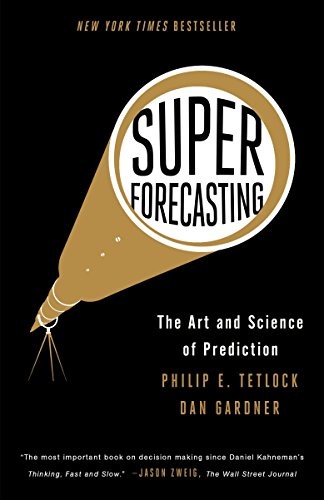
Drawing on a large, multi-year forecasting tournament, Tetlock and Gardner identify what actually distinguishes the small group of consistently accurate forecasters ('superforecasters') from typical experts, whose predictions often perform little better than chance. The answer is more about process and mindset than raw expertise.
The scandal underneath the book: experts who could not forecast
Superforecasting only makes sense against what Tetlock did first. Over roughly two decades he collected tens of thousands of specific, checkable predictions from a few hundred credentialled experts — academics, analysts, commentators — and then waited to see what happened. The result, published as Expert Political Judgment, was quietly devastating: the average expert performed little better than chance on questions inside their own field. The line that followed the book around, about a dart-throwing chimpanzee doing comparably well, was a simplification, but not a wild one.
The finding with the most bite was the correlation with fame. The more in demand an expert was as a commentator, the worse their forecasting record tended to be. Tetlock's explanation borrows Isaiah Berlin's distinction between the hedgehog who knows one big thing and the fox who knows many small ones. Hedgehogs have a single organising theory, push every new fact through it, and produce the confident, clean, quotable narratives that broadcasters want. Foxes gather scraps from incompatible sources, hold views loosely, hedge, and revise — which makes for poor television and better predictions.
The obvious criticism of that first book was that it only proved a negative. If credentialled experts cannot forecast, can anyone? That question became urgent after the intelligence failure over Iraqi weapons of mass destruction, and the US intelligence community's research arm responded by funding an open forecasting tournament to find out. Tetlock and Barbara Mellers entered with the Good Judgment Project, recruiting several thousand ordinary volunteers — a retired computer programmer, a pharmacist, a farmer — against teams from universities and against intelligence analysts with access to classified material.
What the tournament actually measured
The methodology is why this book is worth taking seriously where most forecasting advice is not. Questions were specific and had resolution dates, so there was no hiding in ambiguity: will this leader still hold office on this date, will this currency close above this level by that month. Forecasters gave a number, not a phrase. Accuracy was scored with Brier scores, which reward being right and punish being confidently wrong more than being tentatively wrong, so bluster carries a measurable cost.
The results were not marginal. Tetlock reports that his volunteers beat the control group by roughly 60% in the first year and around 78% in the second, and that the best of them outperformed intelligence analysts who were reading classified traffic they could not access. The top 2% he labelled superforecasters, and — the crucial finding — their advantage persisted year after year, which rules out luck as the explanation. Grouping them into teams improved accuracy further, provided the teams were run to encourage disagreement rather than consensus.
It matters that these were not geniuses with unusual data. They were intelligent, numerate, curious people using public information and a set of habits. That is the book's central claim, and the reason it is useful to anyone rather than only to analysts: forecasting is a skill with identifiable components, not a gift.
What superforecasters actually do differently
The first habit is decomposition, which Tetlock calls Fermi-ising after the physicist who was famous for estimating unknowable quantities by breaking them into knowable ones. A superforecaster refuses to answer a big fuzzy question directly. Will this venture work in three years becomes: how many comparable ventures survive three years, and what is specifically different about this one. The base rate comes first — the outside view, what usually happens to things of this type — and the specifics of the case adjust it. Almost everyone else starts with the specifics, and the compelling story of this particular case, and never anchors to anything.
The second is granularity. Ordinary forecasters think in thirds — probably, maybe, probably not. Superforecasters distinguish 65% from 70% and, tested, that extra resolution turns out to carry real information rather than false precision. The third is the updating discipline, and it is the least glamorous thing in the book. They nudge: 60 to 65, not 60 to 90. Dramatic swings on thin new evidence were a marker of the worse forecasters, as was stubbornly ignoring evidence that should have moved the number. Getting good means learning to make many small revisions rather than a few heroic reversals.
The fourth is the temperament: actively hunting for what would prove them wrong, and treating a belief as a hypothesis with a probability attached rather than a possession. Tetlock's strongest single predictor of accuracy was not intelligence or subject knowledge but what he calls perpetual beta — the degree to which a forecaster treated their own method as permanently unfinished and worth revising. It is a growth-mindset finding, arrived at from an unusual direction, and it is measurable.
Why organisations resist all of this
The last third turns to why institutions that would obviously benefit from accurate forecasting mostly avoid measuring it. The heart of it is language. Vague words protect the person using them: a serious possibility, likely, a distinct risk. Tetlock retells the case of the 1951 US intelligence estimate that judged a Soviet attack on Yugoslavia a serious possibility — the analyst who wrote it later asked colleagues what odds they had understood by the phrase and got answers ranging from about one in five to about four in five. Everyone agreed on the sentence and nobody agreed on the meaning, which is precisely the appeal.
Numbers destroy that protection, and that is why they are resisted. A person who says 70% can be scored; a person who says a distinct possibility can never be shown to have been wrong. Tetlock also names the wrong-side-of-maybe fallacy, in which anyone who forecast 30% and saw the thing happen is treated as having been wrong — which is not how probability works, and which teaches forecasters to retreat into vagueness for self-protection.
His historical parallel is medicine, and it is the most persuasive passage in the book. For most of its history medicine ran on the confident judgement of experienced practitioners, and for most of its history it killed as often as it cured — bloodletting persisted for centuries on the strength of expert consensus alone. What changed it was not better doctors but the willingness to run controlled trials and count. Tetlock uses Archie Cochrane, the Scottish doctor whose insistence on randomised evidence gave the Cochrane reviews their name, as the model: someone who kept asking how anyone actually knew, and who was routinely told by senior colleagues that measuring was unnecessary because they could already tell.
The analogy is pointed. Most business forecasting is at the bloodletting stage — confident, experienced, unmeasured, and defended on the grounds that judgement cannot be reduced to numbers. Tetlock's answer is that nobody knows whether it can until somebody keeps score, and that the professions which started keeping score improved while the ones that did not stayed exactly where they were. Forecasting can be measured cheaply, by anyone, starting this quarter. The reason it usually is not has nothing to do with difficulty.He closes by engaging with the strongest objection to his whole project, Nassim Taleb's argument that tournament questions with clean resolution dates systematically exclude the rare, unforeseeable events that actually shape history. Tetlock's answer is partial and honest: black swans are real, but most consequential decisions still turn on unremarkable questions that are entirely forecastable, and improving those is worth doing even if the truly unpredictable stays unpredictable. He also insists forecasting is not a substitute for decisiveness, using the military tradition of giving subordinates clear intent and letting them act — you can hold a probability loosely and still commit to a course of action.
Key lessons
- Expert credentials and confidence are poor predictors of forecasting accuracy — process and mindset matter more.
- Breaking a big question into smaller, more answerable sub-questions consistently improves forecast accuracy.
- Frequent, granular updating of a forecast as new information arrives beats a single confident prediction held rigidly.
- Actively seeking out disconfirming evidence, rather than just confirming your initial view, is a defining trait of accurate forecasters.
Forecasting accuracy is a learnable skill built from specific habits — breaking questions down, updating frequently, seeking disconfirming evidence — not a talent some experts simply have.
What this means for a UK small business
Every small firm runs on forecasts nobody ever checks: this quarter's revenue, how long a new hire takes to earn their keep, whether a second site will work. Fermi-ising is the cheap fix. Instead of guessing whether a café site will work, break it up. Imagine 300 passing customers a day at a 4% conversion, at £6.50 average spend — that is roughly £78 a day, £2,300 a month, against rent of £1,400 and business rates on top. Each of those numbers can be checked with a clicker and an afternoon on the pavement. The single gut answer cannot be checked at all.
The second habit is even cheaper and almost nobody does it: write predictions down with a number and a date. Six months of that — I am 70% confident we hit £45k in March, 40% confident this hire works out — reviewed honestly, is the only thing that turns a feeling into a track record. It also exposes the owner who is right about everything in hindsight.
And Tetlock's point about vague language belongs in every client conversation. A UK accountant who says HMRC challenging this is a distinct possibility has said nothing anyone can act on. Saying you would put it at roughly one in five is a real answer, and it can be scored later.
What’s aged well
The research findings remain influential and are increasingly applied in business forecasting and risk assessment.
What feels outdated
Nothing significant; the methodology is durable.
Where it falls short
The whole evidence base is geopolitical: treaties, elections, currencies, questions with clean resolution dates and public information. Business questions rarely resolve that cleanly, and the authors leave the translation entirely to you. Taleb's objection also lands harder than the book's response acknowledges — the tournament format necessarily excludes the rare, large events that do most of the damage to a small business. It is a slower, more academic read than its practical payoff justifies, with a fair amount of research narrative around each idea, and it is thin on what happens next: knowing something is 70% likely still leaves the actual decision entirely open.
The Business Stuff verdict
A rigorous, genuinely useful guide for anyone whose job involves making predictions under real uncertainty.
Three things to actually do after reading it
- Break your next big business forecast into smaller, more specific sub-questions rather than one broad guess.
- Set a fixed cadence to revisit and update a current forecast as new information comes in.
- Actively look for one piece of evidence that would prove your current prediction wrong.
If you liked this, read next
Five similar books
- Thinking in Bets (Annie Duke)
- Noise (Kahneman, Sibony & Sunstein)
- Thinking, Fast and Slow (Daniel Kahneman)
- The Art of Thinking Clearly (Rolf Dobelli)
- Predictably Irrational (Dan Ariely)
Common questions
What is a superforecaster, and can anyone become one?
A superforecaster is someone in the top 2% of a large forecasting tournament whose accuracy persisted across years, which rules out luck. They were not specialists — the group included a retired programmer, a pharmacist and a farmer working from public information — and several beat intelligence analysts with classified access. What they shared was habits: breaking questions into checkable parts, starting from base rates, thinking in fine-grained probabilities, and revising in small steps. Tetlock's evidence suggests the habits are learnable, with the caveat that the strongest predictor was temperament — treating your own method as permanently unfinished.
How do I actually apply this to a small business?
Three things, in order. First, force every important guess into a number with a date: 'I am 65% confident we bill £40,000 in March' rather than 'March should be fine'. Second, before you look at the specifics of a decision, find the base rate — how do businesses like this, hires like this, sites like this usually turn out? Third, keep the list and score yourself every quarter. That last step is the one almost nobody does and the only one that actually improves judgement, because without a record you cannot distinguish good instinct from a run of luck you have since rewritten as skill.
What is a Brier score?
It is the scoring system the tournament used, and the reason its results mean something. You state a probability, the event either happens or does not, and you are penalised by the square of the gap between your number and the outcome. Squaring is the clever part: being confidently wrong costs far more than being tentatively wrong, so bluster carries a real measurable price while sensible hedging does not. Lower is better, zero is perfect. You do not need the maths to use the idea — the point is that a forecast is only worth anything if it is specific enough to be scored afterwards.
Does Superforecasting overlap with Thinking, Fast and Slow?
They fit together rather than repeat each other. Kahneman explains the machinery — the biases, the two systems, why our judgement goes wrong in predictable ways — and is largely pessimistic about fixing it. Tetlock takes the same problem and shows, with tournament data, that some people demonstrably do better and that their methods can be described and copied. Read Kahneman for the diagnosis and Tetlock for the training. If you only read one and you make business predictions for a living, Superforecasting is the more directly useful; Kahneman is the deeper book.