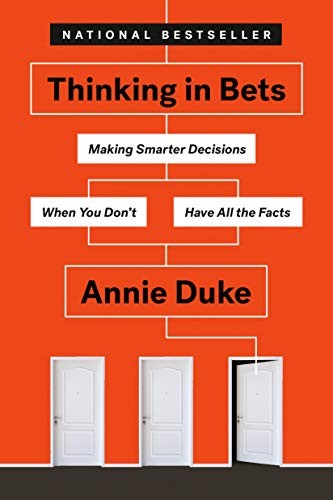
Former professional poker player Duke argues that we routinely confuse the quality of a decision with the quality of its outcome — a good decision can produce a bad result through bad luck, and vice versa — a distinction poker players are forced to internalise but most people never learn to separate.
Chess has no hidden cards. Business does.
Duke opens with a distinction she borrows from John von Neumann, who built game theory precisely because chess was not the game that interested him. Chess contains no hidden information and almost no luck. Every piece is face up, both players can see everything, and if you lose it is because you were outplayed. Poker is the opposite: most of the information that matters is face down, the cards fall as they fall, and flawless play still loses hands regularly. Duke's argument is that most people run their working lives as though business were chess, when it is unmistakably poker — decisions made with incomplete information, against opponents whose position you cannot see, where the same choice can produce a triumph one month and a disaster the next.
The example that anchors the whole book is Pete Carroll's play call at the end of Super Bowl XLIX in 2015. With the Seahawks a yard from the winning touchdown and seconds left, Carroll called a pass rather than handing the ball to one of the best short-yardage runners in the game. It was intercepted, Seattle lost, and Carroll was pilloried as the author of the worst call in football history. Duke's point is not that the call was brilliant. It is that almost nobody examined the reasoning — the clock, the number of downs left, the defensive personnel on the field, the historically low interception rate on that kind of throw. The result did all the work, and the verdict was delivered within seconds of the ball landing in the wrong hands.
She names this habit 'resulting': grading a decision by how it turned out. It is a fatal habit in poker, because it teaches exactly the wrong lesson every time. The correct call that loses gets abandoned; the reckless call that wins gets repeated. Duke's sharper observation is that business hides the problem far better than poker does, because feedback arrives months or years later, the sample size of comparable decisions is tiny, and the story of what happened has usually been rewritten by the time anybody reviews it. In poker you play thousands of hands and the luck averages out. In business you hire twelve people in a decade and draw confident conclusions from each one.
Every decision is a bet, and your beliefs are the stake
The reframe that gives the book its title is that every decision is a bet on an uncertain future, whether or not money is explicitly on the table. Taking the lease, hiring the salesperson, dropping the product line — each one commits real resources to one version of the future over the alternatives you did not pick. Framing it as a bet forces an honest number: not 'this will work' but 'I make this about 70% likely to work, given what I know today'. That single discipline is uncomfortable, because it strips away the false certainty most people prefer their own decision-making narrative to have, and it makes you accountable to what you actually believed at the time rather than what you later claim you believed.
Duke then goes after the raw material of any bet — your beliefs — and this is the most interesting stretch of the book. The intuitive model is that we hear a claim, evaluate it, and then decide whether to believe it. The psychology she draws on suggests the opposite: we believe on hearing, and only sometimes go back and vet, usually when something external forces us to. Once a belief is installed, motivated reasoning takes over and new evidence gets recruited to defend it rather than test it. Her genuinely unsettling addition is that intelligence is no protection here. A clever person is simply better equipped to construct the defence, which is why smart people are capable of holding badly-supported positions with unusual confidence.
Her practical device for interrupting this is the challenge 'wanna bet?'. The moment somebody offers to take the other side of your stated confidence, you do the vetting you skipped — you start hunting for what you might be missing rather than for reasons you are right. You do not need anyone to actually take the bet; asking the question of yourself does most of the work.
The companion idea is what Duke calls fielding outcomes: for every result, deciding how much was skill and how much was luck. Left alone, self-serving bias does the filing for us. Our wins go under skill, our losses go under luck, and both filings block learning. The mirror-image bias runs on other people: their success was luck, their failure was incompetence. A trading log or a decision journal that records the reasoning before the outcome is known is the only reliable way to separate the two, because after the fact your memory of what you thought is already contaminated by what happened.
The buddy system: a group with different rules
Duke's most structural contribution is that this is not really a solo exercise. You cannot reliably audit your own reasoning, because the thing doing the auditing is the thing that needs auditing. What works is a small group of people who have explicitly agreed to a different set of norms from an ordinary team — she borrows Robert Merton's CUDOS framework from the sociology of science, and the parts that matter for a business are universalism (judge the claim on its merits, not on who made it), disinterestedness (declare what you stand to gain from being right), and organised scepticism, meaning dissent is the job rather than a breach of etiquette.
The operational detail is where this becomes usable. Do not tell the group your conclusion before asking for their read — the moment they know what you want to hear, you have contaminated the sample. Give them the facts, including the ones that make your preferred option look bad, and ask what they would do. Reward accuracy rather than agreement, and notice that a group which never disagrees with you is not a decision group, it is an audience. Duke is honest that most working environments punish precisely this behaviour, which is why the arrangement has to be deliberately built rather than assumed.
Mental time travel: pre-mortems, backcasting and Ulysses contracts
The last section deals with the fact that the person making the decision is rarely the person who lives with it. Temporal discounting means the version of you sitting in the meeting weights today far more heavily than the version who has to deliver in eighteen months — Duke uses Jerry Seinfeld's routine about Night Guy staying up late and leaving the consequences to Morning Guy, which is a better description of most strategic planning than it ought to be.
The tools are simple and genuinely portable. Suzy Welch's 10-10-10: how will I feel about this in ten minutes, ten months and ten years? Backcasting: stand in a future where the decision worked and narrate the steps that got you there. The pre-mortem, from Gary Klein: stand in a future where it failed and explain why, which surfaces the risks that optimism suppresses at exactly the moment the information is still useful. And Ulysses contracts — decisions made in advance and made binding while you are still thinking clearly, so the later, more emotional version of you cannot quietly overturn them. A stop-loss on a project budget, a rule that you never sign anything in the meeting, a pre-agreed date to review a failing hire: all of them are commitments to your own better judgement, made before the pressure arrives.
Key lessons
- 'Resulting' — judging a decision purely by its outcome — leads to bad lessons, since good decisions can still produce bad outcomes through luck.
- Thinking in probabilities, not certainties, produces better decisions under genuine uncertainty than false confidence does.
- A 'decision group' of honest peers, willing to challenge your reasoning, improves decision quality more than deciding alone.
- Separating the quality of your process from the quality of the outcome is a discipline that has to be deliberately practised.
A good decision and a good outcome are not the same thing — learning to evaluate the quality of your reasoning, separately from how things happened to turn out, produces better decisions over time.
What this means for a UK small business
For a UK owner, the resulting trap shows up most obviously around hiring, and around big irreversible commitments like a lease or a piece of equipment. A hire that did not work out gets remembered as 'we should have known', when the honest truth is that it was a reasonable bet given what was knowable at interview and part of the failure was genuinely luck — a family situation nobody could have foreseen, a client leaving, a manager departing three months in. Treating every bad outcome as a preventable mistake breeds excessive caution over time, not better judgement.
The decision group is the cheapest idea here to actually implement, and the one most owners are missing. Most sole traders and small partnerships have nobody whose job is to challenge a decision before it is made — only people who hear about it afterwards. Two or three other owners, meeting monthly, explicitly asked to poke holes in a commitment before it is signed, costs nothing but the coffee. The one rule that makes it work is Duke's: present the situation without telling them what you have already decided.
The decision journal is the other practical takeaway. Before the next significant call, write a paragraph — what you expect to happen, roughly how confident you are as a percentage, and what would tell you it was going wrong. Six months later that paragraph is the only uncontaminated record of what you actually thought, and it is worth more than any amount of retrospective discussion.
What’s aged well
The core distinction remains a genuinely useful, well-argued mental model.
What feels outdated
Nothing significant given recent publication.
Where it falls short
The poker framing illuminates and limits the book in equal measure. Poker gives you clean, calculable odds and thousands of repetitions to learn from; a business decision gives you neither, and the probabilistic language sometimes promises a precision that a real commercial call cannot deliver. Duke acknowledges the gap, but assigning '70%' to a lease decision is a useful discipline dressed as a measurement, and readers should not mistake the second thing for the first.
It is also a book with roughly four ideas in it, generously spaced. The core argument is fully made in the first two chapters and the later material on mental time travel is a lightly connected tour of other people's tools rather than a development of Duke's own. Excellent ideas, a slightly padded book.
The Business Stuff verdict
A clear, practical framework for making better decisions under real uncertainty — directly applicable to business calls made without full information.
Three things to actually do after reading it
- Review your last big business decision on the quality of the reasoning, separately from how it actually turned out.
- Form a small, honest group of peers willing to challenge your reasoning before a major decision.
- State your next big decision as a probability, not a certainty, and check back on the actual result later.
If you liked this, read next
Five similar books
- Thinking, Fast and Slow (Daniel Kahneman)
- Superforecasting (Tetlock & Gardner)
- Noise (Kahneman, Sibony & Sunstein)
- The Art of Thinking Clearly (Rolf Dobelli)
- Principles (Ray Dalio)
Common questions
Do I need to know poker to get anything out of Thinking in Bets?
No — the poker content is illustration rather than instruction, and Duke explains every hand she uses. What you need is a tolerance for the underlying idea, which is that you will never be able to tell a good decision from a lucky one by looking at the result. If anything, readers who have never played poker tend to get more from the book, because the ideas land as new rather than as things they already knew from the table. The one bit of poker vocabulary worth holding onto is 'tilt' — playing badly because you are angry about the last hand — which describes a great deal of ordinary business behaviour.
How is this different from Thinking, Fast and Slow?
Kahneman catalogues the biases; Duke gives you something to do about a handful of them. Thinking, Fast and Slow is the deeper and more authoritative book, and it is also four times the length and largely descriptive — it will convince you your judgement is unreliable without telling you how to run a Tuesday. Thinking in Bets is narrower, focused almost entirely on hindsight bias, motivated reasoning and outcome bias, and it is built around practices: probability estimates, decision journals, truth-seeking groups, pre-mortems. Read Duke first if you want to change how you decide this quarter, and Kahneman when you want to understand why any of it works.
Can you really assign probabilities to business decisions when you have no data?
Not with any real accuracy, and this is the fair criticism of the book. A poker player knows the deck; you do not know how likely your new hire is to work out. What the exercise buys you is not precision, it is honesty and a record. Saying out loud that you are about 60% confident stops you claiming afterwards that it was a certainty, forces you to notice when you are at 55% and behaving as though you are at 95%, and gives you something specific to compare against when the result arrives. Treat the number as a way of pinning down your own belief, not as a measurement of the world.
How long does it take to read?
About four to five hours — it runs to roughly 270 pages and moves quickly. The heart of it is chapters one to four, which cover resulting, betting as a frame, fielding outcomes and truth-seeking groups; if you read nothing else you will have the whole argument. The later chapters on mental time travel are lighter and can be skimmed for the tools, which are all short: 10-10-10, backcasting, the pre-mortem, and the Ulysses contract. It is a good audiobook too, read by Duke herself, and the material survives listening better than most business books because the examples carry the argument.