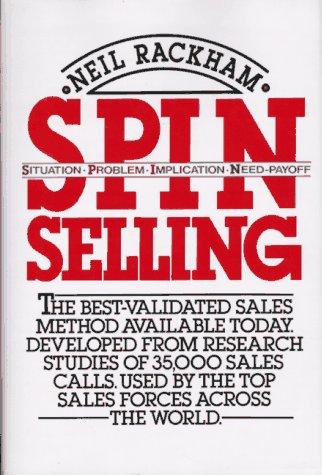
Rackham's research team analysed over 35,000 real sales calls to work out what actually separated successful large-scale sales from unsuccessful ones — and found that the traditional hard-close techniques that work for small, simple purchases actively hurt larger, more considered sales. In their place, he identified a four-stage questioning sequence — Situation, Problem, Implication, Need-payoff — that leads a buyer to articulate their own need for a solution, rather than being told they have one.
The research, and why it was unusual
SPIN Selling is not a book of opinions about selling, which is what makes it durable in a genre almost entirely built on them. Neil Rackham's team at Huthwaite spent over a decade observing real sales calls in the field — the figure usually cited is around 35,000 calls, across dozens of countries, with funding from clients including Xerox and IBM — and coded what the salesperson actually did against whether the call succeeded. That method produces findings the trainers of the day did not want, which is the book's main source of value.
The first casualty was the closing technique. Rackham's data showed that in small, low-value sales, more closing attempts did increase the success rate. In large sales, the same behaviours reduced it — and the more expensive the product, the worse the effect. His explanation is about risk. A buyer making a small decision has little to lose from being nudged into it; a buyer whose reputation inside their own organisation is riding on the decision experiences pressure as a reason to stall. The second casualty was objection handling. Teams trained heavily in objection-handling techniques got more objections, not fewer, because they were trained to present early and defend rather than to develop need first.
Rackham's other structural insight is about where a call is won. He splits any call into four stages — Preliminaries, Investigating, Demonstrating Capability, Obtaining Commitment — and finds that in large sales the difference between top performers and average ones sits overwhelmingly in the Investigating stage. Most sales training of the era concentrated on the opening and the close, which are the two stages that matter least.
The four questions
SPIN is the sequence that emerged from the successful calls. Situation questions gather facts about the buyer's circumstances — how many vehicles do you run, who handles this now. They're necessary but Rackham is scathing about their overuse: inexperienced salespeople ask lots of them because they feel safe, and they mostly bore the buyer, who is being interrogated about things a bit of homework would have answered.
Problem questions surface dissatisfaction — where does the current setup let you down. These correlate with success in small sales quite directly. In large sales they're necessary but not sufficient, because what they produce is what Rackham calls an implied need: a grumble, a mild irritation, something the buyer would fix if it were free.
Implication questions are the ones that separate the top performers, and they are the hardest to ask. They explore the consequences of the problem — what does that delay cost you in a month, how often does it pull your engineers off billable work, what happens when it hits during your busiest quarter. The effect is to grow the problem in the buyer's own mind until the cost of living with it exceeds the cost of solving it. Rackham frames this as a value equation: a buyer only moves when the seriousness of the problem outweighs the price of the fix, and implications are the only lever that raises the left-hand side.
It is worth doing the arithmetic out loud, because that is what an implication question is for. Take an illustrative example: a plumbing firm mentions that jobs occasionally get aborted because the engineer arrives without the right part. That is an implied need — mildly annoying, free to live with. Two aborted visits a week, an engineer costing roughly £45 an hour fully loaded and two hours lost each time, is £180 a week, or about £9,000 a year in wages alone, before the rebooked customer and the van diesel. Set against a £4,000 stock-and-scheduling fix, the decision changes shape entirely — and the crucial part is that the buyer, not the seller, does the adding up. A seller who simply asserts 'this will save you £9,000 a year' gets argued with. A buyer who works it out in their own head is already sold.
Need-payoff questions then flip the tone from negative to positive — would it help if that could be turned around same day, what would it be worth to have that visible before month end. They get the buyer to state the benefit themselves, which does two things. People believe their own conclusions far more readily than anybody else's, and in complex sales the person you're talking to usually has to sell the decision internally to somebody you'll never meet. Need-payoff questions rehearse them in the argument they'll have to make without you in the room.
Implied needs, explicit needs, and the FAB correction
The single most useful distinction in the book is between implied and explicit needs. An implied need is a statement of a problem — 'the current system is slow'. An explicit need is a statement of want — 'we need to cut turnaround to twenty-four hours'. Rackham found that the number of implied needs a call generated predicted success in small sales but not in large ones; explicit needs predicted success in large sales strongly. The whole SPIN sequence exists to convert one into the other, and the conversion happens through implication questions.
This also produces a sharper version of the features-advantages-benefits idea than the usual training. Features are facts about your product. Advantages describe how the feature could help. Benefits, in Rackham's strict definition, show how the product meets a need the buyer has explicitly stated. His data found features had a neutral to slightly negative effect in large sales — and were received differently by different people in the room, with users tolerating them and decision-makers switching off. Advantages, the 'this means you can' statements that most pitches are made of, correlated with success in small sales and not in large ones. Only benefits in the strict sense held up. Which means a pitch full of impressive capability, delivered before the buyer has articulated a need, is measurably worse than saying nothing.
Calls that go nowhere, and how to actually change
Rackham's four possible call outcomes are worth the price on their own. There's the Order; the Advance, where the buyer agrees to a specific action that moves things forward; the Continuation, where the call ends pleasantly with no agreed action; and the No-sale. His point is that most salespeople record Continuations as good calls. They aren't — they're failures with nice manners, and a pipeline full of them is why forecasts don't land. Planning an Advance before the call, and naming the specific next commitment you'll ask for, is one of the most practical habits in the book.
The final section on implementation is unusually honest for the genre. Rackham's advice is to practise one behaviour at a time, to go for quantity before quality — ask ten clumsy implication questions before worrying about elegance — and to practise in safe accounts rather than on the deal you can't afford to lose. He is explicit that people get worse before they get better, because a new skill practised consciously is always clumsier than an old habit performed fluently. Anyone who has tried to change how they sell will recognise the warning, and it explains why most sales training evaporates within a fortnight of the course ending.
Planning the call, and where the openings really matter
Rackham devotes the back half of the book to how a call gets prepared, and his findings there are as counter-intuitive as the ones about closing. On Preliminaries — the opening minutes — he found that the small talk and rapport-building that sales training obsesses over has surprisingly little effect on the outcome of a large sale. What matters is getting quickly to a stated purpose and earning permission to ask questions, rather than opening with a benefit statement about your product, which invites the buyer to start evaluating a solution before any need has been established.
Demonstrating Capability comes late by design. Because features have a neutral effect and advantages only work in small sales, the correct place to describe what you do is after the buyer has stated an explicit need, and the correct thing to describe is the part of your offer that matches that stated need — not the full tour. Rackham's point about preventing objections rather than handling them follows directly: an objection is usually the sound of capability presented before need, and the fix belongs earlier in the call, not in a rebuttal.
The planning method itself is simple enough to use before your next quote. Start from the problems you know your service actually solves. For each, write the problem questions that would surface it. For each of those, write the implications — the knock-on costs in time, money, risk or reputation that the buyer may not have added up. Then write the need-payoff questions that let them say what solving it would be worth. You go into the meeting with a page of questions rather than a page of claims, and Rackham is clear that this alone changes most people's results more than any refinement of technique.
He is equally clear that SPIN is not a script. The four question types are a description of what good calls contain, not an order to recite them in, and a buyer who volunteers a problem in the first minute should not be dragged back through situation questions for the sake of the sequence.
Key lessons
- SPIN questions — Situation, Problem, Implication, Need-payoff — guide a buyer to voice their own need, which is far more persuasive than being told what their need is.
- Traditional closing techniques that work for small sales actively backfire in larger, more considered purchases with real risk attached for the buyer.
- Implication questions — asking about the knock-on effects of a problem — build urgency more effectively than simply describing the problem yourself.
- Features matter less in larger sales than benefits, and benefits matter less than the buyer's own articulated need-payoff.
- Objections are frequently a symptom of insufficient need-development earlier in the call, not a separate problem to be handled with a clever rebuttal.
In any sale with real consideration behind it, asking the right questions in the right order beats pitching features, and beats traditional hard-closing entirely.
What this means for a UK small business
Anything with a genuine decision cycle is SPIN territory: a quote for a loft conversion, a year-long accountancy retainer, a fit-out, a B2B software contract. It is also a direct antidote to the pushy, script-driven approach that UK buyers switch off from faster than almost any other market. Swapping 'let me talk you through what we offer' for a real implication question — 'what does it actually cost you when a job gets held up for a fortnight?' — does more for urgency than any capability list.
The objections lesson deserves the most attention from small firms. An owner who dreads the price conversation should look first at whether the problem and its cost were properly established before the number was named. Reaching for a discount treats the symptom and leaves the gap untouched. If the client has never said out loud what the problem is costing them, your price is being compared against zero.
The Advance is the other idea to steal immediately. A quote emailed after a friendly meeting with no agreed next step is a Continuation, and a UK pipeline full of unanswered quotes is usually a pipeline of them. Book the follow-up in the room, or agree a site visit, a trial job, or a call with the other decision-maker. Nice meetings are not progress.
What’s aged well
The underlying research and questioning framework remain the standard reference point in B2B sales training, decades on.
What feels outdated
The prose and some examples feel like a formal 1980s sales-training manual rather than a modern business book, but the substance holds up.
Where it falls short
The prose is dry, closer to a research report than a business book, and the 1980s corporate examples have aged badly. It also demands patience: the useful material is spread thin across chapters that repeat the method and the evidence more than they need to.
The bigger caveat is that the research is proprietary. The 35,000-call study was conducted by Rackham's own consultancy, was never independently replicated or published for peer review, and its headline figures have been repeated for forty years on the author's word. That doesn't make the conclusions wrong, and they match most experienced sellers' instincts, but it is not the same as evidence. And in a genuinely fast transaction, a full SPIN sequence will just feel slow and stilted.
The Business Stuff verdict
Dry to read, but among the most practically transformative books on this list for anyone doing considered, higher-value selling.
Three things to actually do after reading it
- Write out one full SPIN question sequence for your most common sales conversation before your next call.
- Replace one feature-led pitch line with an implication question that surfaces the cost of not solving the problem.
- Review your last lost sale for whether the objection was really about price, or about insufficient need-development earlier in the conversation.
If you liked this, read next
Five similar books
- Never Split the Difference (Chris Voss)
- The Challenger Sale (Matthew Dixon & Brent Adamson)
- Influence (Robert Cialdini)
- To Sell Is Human (Daniel Pink)
- Consultative Selling (Mack Hanan)
Common questions
Does SPIN Selling still work now buyers research everything online first?
Yes, and arguably better, because the shift has stripped out precisely the part of the book that was weakest. Situation questions — the fact-gathering that Rackham already criticised as boring for the buyer — are now largely answerable before you turn up, so any decent seller should arrive knowing the company size, the systems and the obvious constraints. What buyers cannot do for themselves is work out the full cost of their own problem, which is exactly what implication questions are for. The framework's core claim, that people are convinced by conclusions they reach themselves, has not been affected by search engines at all.
How solid is the 35,000 sales calls research?
It's the book's weakest point and worth knowing about. The study was carried out by Rackham's own firm, Huthwaite, which sold the training the findings support; it was never published for peer review and has not been independently replicated. The figures — the call count, the years, the countries — rest on the author's account. That said, the conclusions align closely with what experienced sellers of complex, high-value services report from their own experience, and nothing in the framework requires you to accept the numbers to test whether the questioning sequence improves your own conversations. Treat it as a well-argued hypothesis rather than proven science.
Is it useful for a one-person business or only for corporate sales teams?
Very useful for a one-person business, and in some ways more so, because there is nobody else to blame for a weak first half of a conversation. Consultants, tradespeople quoting bigger jobs, agencies and accountants all sell exactly the kind of considered, risky-for-the-buyer purchase the research covers. The parts written for sales managers — coaching, call reviews, training programmes — can be skipped entirely. What you want is the questioning sequence, the implied-versus-explicit-need distinction, and the four call outcomes, which together take about two hours to read and a month of deliberately clumsy practice to start using.
Do I need to read it if I've already read Never Split the Difference or The Challenger Sale?
They're complementary rather than overlapping. Never Split the Difference is about negotiation once both sides want a deal and are arguing about terms; SPIN is about the stage before, when the buyer hasn't yet decided there's a problem worth spending on. The Challenger Sale is closer, and partly argues against Rackham — its research suggests top performers teach and provoke rather than only ask. A fair reading is that SPIN describes how to get a buyer to articulate a need they already half-have, and Challenger describes how to introduce one they don't. Read SPIN first; it's the foundation the later book is arguing with.