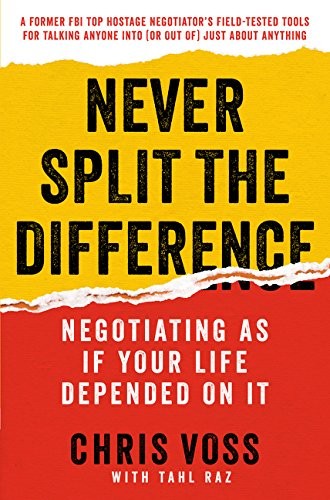
Voss, a former FBI lead hostage negotiator, applies the tactics of high-stakes crisis negotiation to everyday business situations. The central thesis rejects splitting the difference as a lazy, mutually unsatisfying compromise, and instead teaches specific, practical techniques — tactical empathy, mirroring, calibrated questions, the strategic use of 'no' — for getting to genuinely better outcomes than a straight 50/50 split.
Why the fair compromise is usually a failure
Voss opens by picking a fight with the dominant text in his field. Getting to Yes, the Harvard negotiation project's classic, treats negotiation as rational problem-solving between two parties who can be brought to see their shared interests: separate the people from the problem, focus on interests rather than positions, know your walk-away alternative. Voss spent a career discovering that when the stakes are high enough, people are not rational problem-solvers at all. They are emotional, frightened and irrational, and a framework that assumes otherwise fails at exactly the moment you need it. A man holding hostages in a Brooklyn bank does not have a walk-away alternative in any useful sense.
The title comes from his standing example. Your partner wants you to wear the black shoes; you want the brown. Split the difference and you go out with one black shoe and one brown one. Compromise feels fair because it feels even-handed, but it routinely produces an outcome neither side actually wanted, arrived at because negotiating properly was uncomfortable. Voss's harder claim sits underneath it: no deal is better than a bad deal, and a genuine willingness to walk is what makes every other technique in the book function.
The uncomfortable implication for commercial life is that his techniques were built for situations of radically asymmetric information and stakes — which, he argues, describes an ordinary supplier or client negotiation far more accurately than either side likes to admit. You rarely know what the other party's costs, deadlines or alternatives really are.
Tactical empathy: voice, mirroring, labelling
Tactical empathy is the foundation, and Voss is careful with the definition. It is the discipline of recognising and articulating the other side's perspective and feelings, without agreeing with them, in order to gain influence over what happens next. It is not niceness and it is not conceding. It is demonstrating comprehension, because people become dramatically more open once they believe they have genuinely been heard.
Three techniques carry it. The first is voice. Voss identifies three registers: the late-night FM DJ voice, downward-inflecting, slow and calm, used to signal that everything is under control; the positive and playful voice, which should be the default and which changes measurably when you actually smile while using it; and the direct, assertive voice, which he says should be used almost never, because it invites the other side to harden. Most negotiators reach for the third and then wonder why the room closes.
The second is mirroring: repeating the last one to three words the other person said, with an upward inflection, and then saying nothing at all. It is almost embarrassingly simple, and it works because it invites elaboration rather than defence. 'We can't do it on those terms.' 'On those terms?' — and the other side explains which terms are the actual problem. The silence after the mirror does most of the work, and most people cannot bear to leave it there.
The third is labelling: naming the emotion you can see, out loud, in the third person. 'It seems like the timeline is the real worry here.' 'It sounds like you've been let down by a supplier before.' Labels defuse negative emotions by making them explicit and reinforce positive ones by confirming them. The related tool, the accusation audit, extends the logic pre-emptively: list every bad thing the other side could accuse you of, before they get to it. 'You're going to think I'm being difficult, and you're probably going to think this quote is late.' Saying it first strips it of force.
'No' is the start, and 'that's right' is the finish
The most counter-intuitive chapter inverts what sales training teaches. Chasing 'yes' — the small agreements, the assumptive close — puts people on guard, because everyone has learned that yes leads to commitment and commitment leads to a trap. Voss separates three kinds: the counterfeit yes, where they intend to escape; the confirmation yes, a simple affirmation of fact; and the commitment yes, the real thing. Most of the yeses that sales technique produces are the first sort.
'No', by contrast, makes people feel safe and in control, and people who feel safe talk. So Voss engineers it deliberately: 'Is it a ridiculous idea to revisit the payment terms?' 'Have you given up on this project?' A no to either opens the conversation rather than closing it. That second question is the famous one-line email that rescues dead threads, and it works because it is far easier to answer than a chasing note saying you are just following up.
But the goal is not no. It is 'that's right'. Voss draws a sharp line between 'you're right', which means the other side has stopped listening and would like you to stop talking, and 'that's right', which is the moment your summary of their position is so accurate that they endorse it out loud. Getting there uses a summary — a full labelling and paraphrase of their world handed back to them, until they say the words themselves. Voss argues this moment, not a clever concession, is the hinge on which most negotiations actually turn.
Bending their reality: anchors, Ackerman and Black Swans
The final third is the tactical mechanics. On anchoring, Voss's position is that the first number frames everything that follows, so where you can, make it a range and pitch the top of it high — then use calibrated questions rather than counter-offers to move.
Calibrated questions are the workhorse of the whole book: open questions beginning with 'how' or 'what', never 'why', which sounds accusatory in every language. They hand the other side the appearance of control while making them solve your problem for you. 'How am I supposed to do that?' is the single most useful sentence Voss teaches. It is not a refusal, it cannot be answered yes or no, and it makes the other party go looking for the flexibility rather than defending their position.
The Ackerman model is the most concrete deliverable in the book — a haggling system in five steps. Set your target. Open at 65% of it. Make three increasing offers at 85%, 95% and 100%, using empathy and calibrated questions between each one so the other side effectively bids against themselves. Use a precise, non-round figure for the final number — £37,893 rather than £38,000 — because odd numbers read as calculated rather than plucked from the air. And on the last move, throw in a small non-monetary item, which signals you have reached the end of the money.
Two smaller tools in the same chapter earn their keep. The Rule of Three says get to the same agreement three times in the same conversation, in three different ways — the commitment itself, then a summary they confirm, then a calibrated question about implementation — because a yes repeated three times is very hard to fake and the second or third attempt is where a soft commitment falls over. And Voss is emphatic that deadlines are far softer than everyone treats them: they are usually arbitrary, almost always negotiable, and the fear of one is what produces the concessions people later regret. The side that believes the clock is real is the side that gives ground.
Finally, the Black Swans: the pieces of information the other side holds which would restructure your entire approach if you knew them. Voss's argument is that the mirrors, the labels and the silences exist mainly to surface these, because negotiating hard with half the picture is exactly how confident negotiators lose.
Key lessons
- Tactical empathy — genuinely understanding and articulating the other side's perspective — gets better outcomes than pressure or aggression.
- Mirroring the last few words someone says, and using calibrated open questions ('how am I supposed to do that?'), draw out more information than direct demands.
- A well-placed 'no' often moves a negotiation forward faster than a 'yes' — people feel safer, and more open, once they've been allowed to say no.
- Labelling emotions out loud ('it seems like you're worried about...') defuses tension and builds trust faster than ignoring them.
- The goal isn't to 'win' a negotiation at the other side's expense — the best outcomes come from genuinely understanding what the other side actually needs.
Splitting the difference is usually a worse outcome for both sides than a negotiation built on genuine understanding of what the other party actually needs.
What this means for a UK small business
The calibrated question is close to a free upgrade for any UK owner. Replacing 'can you do better on price?' — which invites a straight no — with 'how am I supposed to make this work at that price?' moves a supplier from defending a number to solving a problem alongside you. It works on landlords at lease renewal, on wholesalers, on subcontractors, and on the client who wants the same fee for a bigger scope.
The 'no' material fits British commercial culture unusually well. The British instinct in negotiation is conflict-averse: we accept the first compromise offered because pushing feels rude, then quietly resent it for the length of the contract. Deliberately inviting a no — 'would it be a terrible idea to look at the payment terms again?' — gives the other side a comfortable exit and, paradoxically, tends to produce a conversation instead.
One caution. Most small-business negotiation is with people you will deal with again next month. Use the accusation audit, the labels and the calibrated questions, which build trust and survive repetition. Go carefully with the extreme anchor and the Ackerman ladder, which are designed for one-off adversarial deals and will cost you a good supplier if you run them on one.
What’s aged well
The techniques are grounded in real, tested hostage-negotiation experience and translate cleanly to commercial negotiation without needing updates.
What feels outdated
Nothing meaningful — the tactics are essentially timeless human psychology.
Where it falls short
Voss leans on the '7-38-55' rule — the claim that communication is 7% words, 38% tone and 55% body language — and that figure is among the most persistently misused numbers in business writing. The original experiments dealt narrowly with how people judge feelings when signals about liking are inconsistent, and the researcher behind them has said publicly that the percentages do not generalise to communication at large.
More broadly, the book teaches through dramatic anecdote — kidnappings in Haiti, a bank siege in Brooklyn — and dramatic anecdotes are unfalsifiable and selected for their endings. You never learn how often a technique failed, or against whom. It is a superb toolkit taught in a form that makes it feel more reliably effective than any negotiation tactic really is.
The Business Stuff verdict
One of the most immediately useful books on this list — the techniques can be tried in your very next negotiation.
Three things to actually do after reading it
- Before your next negotiation, write down three calibrated 'how' or 'what' questions to draw out the other side's real position.
- Practise labelling emotions out loud in your next difficult conversation, even a small one, and notice the effect.
- Stop offering to 'split the difference' as a default — dig one layer deeper into what the other side actually needs first.
If you liked this, read next
Five similar books
- Influence (Robert Cialdini)
- Getting to Yes (Fisher & Ury)
- Bargaining for Advantage (G. Richard Shell)
- Thinking, Fast and Slow (Daniel Kahneman)
- Crucial Conversations (Patterson et al.)
Common questions
Is Never Split the Difference still worth reading in 2026?
Yes, and it is the rare business book you can use the same afternoon you finish it. The core moves — mirroring the last three words somebody said, labelling the emotion in the room, asking 'how am I supposed to do that?' instead of saying no — cost nothing to try and work equally well on a supplier call, a late-paying client or a salary conversation. Nothing in it has dated, because it is about how people behave under pressure rather than about any particular market. Read it with one eye open, though: Voss teaches through dramatic stories with clean endings, which makes every technique feel more reliable than any negotiating tactic really is. Treat them as things to practise, not guarantees.
Do I need to read Getting to Yes first?
No, but it helps to know what Voss is arguing against. Getting to Yes, from the Harvard Negotiation Project, treats negotiation as rational problem-solving: separate the people from the problem, focus on interests rather than positions, invent options for mutual gain. Voss's objection is that the person across the table is not rational and is not trying to be — they are anxious, defensive, and working from a story about themselves that has nothing to do with your spreadsheet. His book stands perfectly well alone, and he explains the position he is rejecting clearly enough that you lose nothing by skipping the original. If you negotiate often, read both: the Harvard framing is stronger on preparation and on what a genuinely good deal looks like.
Do FBI hostage tactics really transfer to ordinary business deals?
Mostly, with one significant gap the book skates over. A kidnapper cannot walk away and neither can the negotiator, so the entire discipline assumes both sides are stuck in the room. In business both sides can leave, which means your alternative if the deal dies does a great deal of the work — and Voss spends far less time on that than on technique. Use the tools, but do the unglamorous preparation as well: know what you will actually do if this client says no, and what walking away costs you. The empathy techniques genuinely are universal, and they will improve almost any conversation you have. The implied promise that skill alone beats a weak position is not.
How long does it take to read, and what should I try first?
Around five or six hours, and the chapters are self-contained enough to read one an evening. Start with labelling and mirroring, because they are close to impossible to get wrong. In your next difficult conversation, repeat back the last three words the other person used and then say nothing — most people fill the silence with the real objection, which is the one you never get told directly. Add a single label: 'it sounds like the timing is the problem here.' Leave the Ackerman bargaining sequence and the no-oriented calibrated questions until those two feel natural, because a technique you are visibly performing does more damage than using no technique at all.