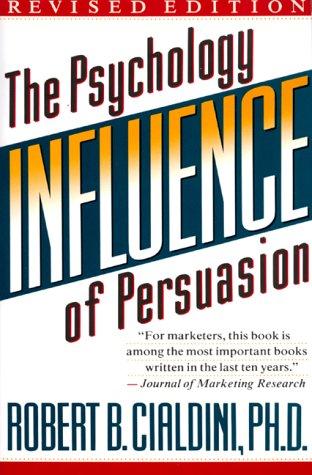
Cialdini identifies six (later expanded to seven) universal principles that drive people to say yes: reciprocity, commitment and consistency, social proof, liking, authority, scarcity, and unity. Drawing on both formal research and years spent undercover training with salespeople, fundraisers and marketers, he shows how these principles get used — and misused — constantly, and how to apply them ethically in your own business.
Click, whirr: why shortcuts exist at all
Cialdini opens with an animal behaviour analogy that sets up everything after it. Many species run fixed-action patterns — rigid behavioural sequences triggered by a single cue, like a mother turkey that will mother anything making the right chirping sound, including a stuffed model of its natural predator. Humans have a version of the same machinery. Faced with more decisions than we can possibly reason through, we lean on reliable rules of thumb: expensive means good, an expert is probably right, if everyone's doing it there must be a reason. Most of the time the shortcut serves us well. The problem is that the shortcut can be triggered by the cue alone, with none of the substance behind it, and that is the gap professional persuaders live in.
What separates the book from the rest of the genre is where the evidence came from. Cialdini spent three years going undercover — training as a car salesman, a fundraiser, a telemarketer, an advertising trainee — on the reasoning that people who make a living from compliance have run more experiments than any laboratory, and keep only what works. He pairs that field material with academic research, and the result is a catalogue of the levers that reliably fire the automatic response, written with an explicit dual purpose: use them honestly, and recognise when they are being used on you.
Before the principles proper he introduces the contrast effect, which underlies several of them. Show something expensive first and the next item seems cheap; show a wreck of a house first and the ordinary one looks like a find. Nothing about the second thing changed. This is why suits get sold before jumpers and why the first number in any negotiation does so much work.
An illustrative version of the same effect, and one most small firms hand away for free: an agency asked for a price on a website quotes £7,500 cold, and the client — with no reference point at all — treats it as the number to negotiate down from. The same agency that presents a £24,000 full rebuild, a £12,000 mid option and a £7,500 essentials package has changed nothing about the work, but £7,500 is now the modest choice rather than the opening bid. Cialdini's related sequence, rejection-then-retreat, does the same job in conversation: ask for the twelve-month retainer, accept the no, and settle for the three-month pilot you actually wanted. Both are legitimate when the larger option is a real thing you would genuinely deliver, and straightforwardly dishonest when it exists only to make the small one look reasonable.
Reciprocity and commitment
Reciprocity is the oldest and the most reliably documented: an unsolicited favour creates an obligation to repay, and the repayment is frequently out of all proportion to the original gift. Cialdini's illustrations include a classic experiment in which an unrequested can of Coke roughly doubled how many raffle tickets the recipient later bought, and charity mailings whose response rates rose sharply once a small unsolicited gift such as personalised address labels was enclosed. The rule holds even when the gift is unwanted and even when we dislike the giver, which is what makes it a weapon rather than merely good manners.
Its second form is reciprocal concession, better known as door-in-the-face. Ask for something large, get refused, then retreat to the smaller thing you actually wanted — the retreat reads as a concession, and the other person feels obliged to concede in turn. Cialdini's own experiments with student volunteers found this dramatically outperformed asking for the modest request cold, with the added twist that people who agreed under this sequence were more likely to follow through and to agree again later, because the deal felt like something they had negotiated rather than been handed.
Commitment and consistency is subtler and, in a business context, the most powerful of the seven. Once we have taken a position — especially publicly, in writing, and with a sense that we chose it freely — we come under real pressure to behave consistently with it afterwards. The classic demonstration is the foot-in-the-door study in which homeowners who had agreed to display a small sign about safe driving became far more willing, weeks later, to accept an enormous and unattractive billboard on their lawn. Car dealers' low-balling exploits the same machinery: once you have mentally bought the car, discovering the price was wrong rarely undoes the decision. The honest version of this is why free trials, small first commitments and written agreements work, and the exploitative version is why they sometimes feel like a trap.
Social proof, liking, authority, scarcity
Social proof — we decide what to do by looking at what people like us are doing — operates hardest under two conditions: uncertainty and similarity. That's why testimonials from a business of your size and sector land harder than a famous name, and why canned laughter works on audiences who claim to find it irritating. Cialdini's darkest material sits here, including the bystander effect, and his practical advice from it is genuinely useful: in an emergency in a crowd, don't shout for help generally, point at one specific person and give them one specific instruction, because diffuse responsibility means everybody waits to see what everybody else does.
Liking runs on similarity, compliments, familiarity and cooperation towards a shared goal — the reason the Tupperware party model was so effective was that the request came from a friend, not a salesperson. Authority is Milgram's territory, and Cialdini's contribution is showing how easily the symbols substitute for the substance: titles, uniforms and trappings shift behaviour even when the person wearing them has no relevant expertise. His medical example, where nurses followed a written instruction to put ear drops in a patient's rear, is the memorable version of a serious point about how rarely people challenge apparent authority.
Scarcity is the most commercially abused. Things become more desirable as they become less available, and the effect is strongest when the scarcity is new rather than long-standing, and when there's competition for what's left. Cialdini attributes much of it to psychological reactance — the reflex against losing an option — which also explains why banning or censoring something reliably increases its appeal. Which brings the important caveat: manufactured scarcity works once. A deadline that renews every Monday teaches the customer that your deadlines mean nothing, and it corrodes trust faster than the other six principles can build it.
How to say no
Each chapter ends with a defence section, and collectively they are the most practically useful part of the book for anyone who buys as well as sells. The defences are not 'refuse all gifts' or 'ignore all experts', because the shortcuts are usually right and living without them is impossible. They are narrower and cleverer than that: notice when the trigger has been detached from the substance, and let that recognition change what you owe.
Against reciprocity, the move is to accept genuine favours freely but to mentally reclassify anything given as a compliance tactic — the free lunch attached to a pitch is not a gift, it is the first half of a transaction, and relabelling it dissolves the obligation. Against commitment, Cialdini's test is to ask yourself whether, knowing what you know now, you would make the same commitment again; if the honest answer is no, the consistency pressure is working on you rather than for you. Against social proof, check whether the crowd is responding to evidence or only to each other. Against liking, notice if you have come to like a salesperson unusually quickly for the circumstances — that speed is itself the signal. Against authority, ask two questions: is this person genuinely an expert in this specific thing, and how truthful can I expect them to be here, given what they stand to gain. Against scarcity, notice the arousal, then ask whether you want the thing for what it does or only because it might be taken away.
For a business owner this is not an academic exercise. These are the levers pointed at you by agencies, franchisors, software vendors and anyone selling a 'business opportunity', usually in combination and usually within one meeting.
Unity, and reading it as self-defence
Unity was added in the 2016 edition and is the strongest of the set precisely because it isn't about persuasion at all. Where liking runs on 'people I like', unity runs on 'people who are us' — shared identity of family, place, tribe, profession. It is why 'we work with independent cafés like yours' lands harder than 'we work with small businesses', and why co-creation is so effective: asking a customer for advice, rather than an opinion, makes them a partner in the thing rather than an audience for it.
Cialdini's throughline is that all seven are legitimate when the trigger reflects reality — real expertise, real scarcity, real generosity, real shared identity — and manipulative when the cue is manufactured without the substance behind it. He is unusually firm that the manipulative version is bad business rather than merely wrong, because the effect is a one-off and the reputational damage is permanent. Half the value of reading it is the defensive half: recognising a rejection-then-retreat sequence in a supplier's negotiation, or a fake deadline in a franchise pitch, or manufactured authority in an agency's credentials deck, is worth as much to a small business owner as anything on the selling side.
Key lessons
- Reciprocity: people feel obliged to return favours, even small unsolicited ones — genuine value given first builds real goodwill.
- Social proof: people look to others' behaviour to decide their own, especially under uncertainty — which is why testimonials and reviews work.
- Authority: genuine, relevant expertise signals trustworthiness — credentials and demonstrated knowledge measurably change how persuasive you are.
- Scarcity: people want more of what there's less of, but manufactured scarcity that isn't genuine erodes trust once customers notice.
- Commitment and consistency: people want to act in line with commitments they've already made, even small ones — which is why small first steps matter in sales.
Persuasion isn't manipulation when it's built on genuine value, genuine expertise and genuine scarcity — the same principles that persuade unethically also work honestly, and honestly is more sustainable.
What this means for a UK small business
Every one of the principles is already running in your business, named or not: the free consultation before the paid engagement is reciprocity, the deposit that makes cancelling feel like breaking a promise is commitment, the Google reviews on the homepage are social proof, the 'as featured in' strip is authority, and the genuinely limited early-bird places on a course are scarcity. Naming the mechanism is what lets you use it deliberately, and honestly, rather than by accident.
The commitment principle is the most underused by UK small firms. Getting a client to put in writing what they want the work to achieve, in their own words, before you quote does two things: it makes them far more likely to proceed, and it gives you something to point at when the scope drifts in month four. A short written statement of objectives beats a beautifully worded proposal on both persuasion and protection.
Use the defensive reading too, because the same levers get pointed at owners constantly — by lead-generation agencies with borrowed credentials, franchise sellers running rejection-then-retreat on the fee, and software vendors whose 'offer ends Friday' has ended every Friday since March. The one to watch hardest is your own use of scarcity: UK consumers are protected against misleading urgency claims under consumer protection rules, and beyond the legal risk, a countdown timer that resets is the fastest way to teach your market that nothing you say is load-bearing.
What’s aged well
The six principles are grounded in solid, well-replicated psychology and remain directly observable in modern marketing, online and off.
What feels outdated
A few of the classic case examples feel dated, and some of the more manipulative applications the book documents (fake scarcity, dishonest social proof) have become so overused online that audiences are now more sceptical of them than they were in 1984.
Where it falls short
It was written in 1984, and although the revised edition adds unity and refreshes some material, the texture is still door-to-door sales crews, encyclopaedia salesmen and American charities. Audiences are also far more inoculated than Cialdini's original readers were: forty years of marketing built on these exact levers means obvious scarcity claims and stock testimonials now trigger suspicion rather than compliance.
There is a harder problem too. The book leans on classic social psychology from an era whose findings have not all survived the replication crisis in the field — some of the studies quoted have been re-examined and the effect sizes revised down. The core principles are among the better-supported findings, and Cialdini has defended them, but the confident tone of the original edition outruns the current evidence in places.
The Business Stuff verdict
A genuinely foundational marketing and sales psychology book — read it to use these principles ethically, and to spot when they're being used on you.
Three things to actually do after reading it
- Add one genuine piece of social proof (a real review, a real number) to your highest-traffic sales page or listing.
- Find one place you're offering something valuable for free before asking for the sale, and make sure it's genuinely useful, not a bait-and-switch.
- Audit your marketing for any scarcity claims that aren't strictly true, and fix or remove them before a customer catches you out.
If you liked this, read next
Five similar books
- Pre-Suasion (Robert Cialdini)
- Thinking, Fast and Slow (Daniel Kahneman)
- This Is Marketing (Seth Godin)
- Contagious (Jonah Berger)
- Predictably Irrational (Dan Ariely)
Common questions
Has the replication crisis in psychology undermined Influence?
It has dented it rather than demolished it, and the book doesn't tell you that itself. Much of Cialdini's evidence comes from social psychology of the 1960s to 1980s, a period whose findings have been re-examined heavily since 2011, with some famous effects failing to replicate or shrinking substantially. The principles have fared better than most: reciprocity, social proof, authority and the foot-in-the-door effect all have reasonable meta-analytic support. Some of the more colourful individual studies are on shakier ground. Read it as a well-evidenced framework whose specific anecdotes should be held loosely, rather than as settled science, and be sceptical of any single startling study quoted once.
Which edition should I buy — the original or the new and expanded one?
Buy the 2021 New and Expanded edition if you're choosing now. It adds unity as a seventh principle, which is genuinely the most useful one for anybody building a business around a community or a niche, and it refreshes a fair amount of the supporting material and examples. The original is shorter and reads faster, and if you find a secondhand copy it still contains six of the seven principles intact. What you lose is the unity chapter and the updated commentary on how much more sceptical modern audiences have become. Ignore the many summaries and 'condensed' versions; the studies and the fieldwork are what make the argument stick.
Is it a manual for manipulation?
It's both, unavoidably, and Cialdini knows it — he frames the book as self-defence and devotes sections to spotting and refusing dishonest use, but the same seven levers work just as well for someone who doesn't care. His practical distinction is the useful one: a principle is legitimate when the trigger is real. Genuine expertise, a genuinely limited number of slots, a real favour freely given, a real shared identity. It becomes manipulation when the cue is manufactured with nothing behind it — a fake deadline, borrowed credentials, invented reviews. That line also happens to be good business, because manufactured cues work once and the damage when they're spotted is permanent.
How long does it take to read, and can I skip to the summary?
About seven to eight hours for the expanded edition, and the summaries at the end of each chapter genuinely do capture the principles — but skipping to them is a mistake, because the studies and undercover fieldwork are what make the ideas stick in a way you'll actually notice in the wild. The value isn't knowing that reciprocity exists; almost everyone does. It's having enough vivid examples in your head that you recognise the pattern mid-conversation, when a supplier drops their opening ask by half and waits. If you're short of time, read the reciprocity, commitment and scarcity chapters in full and summarise the rest.